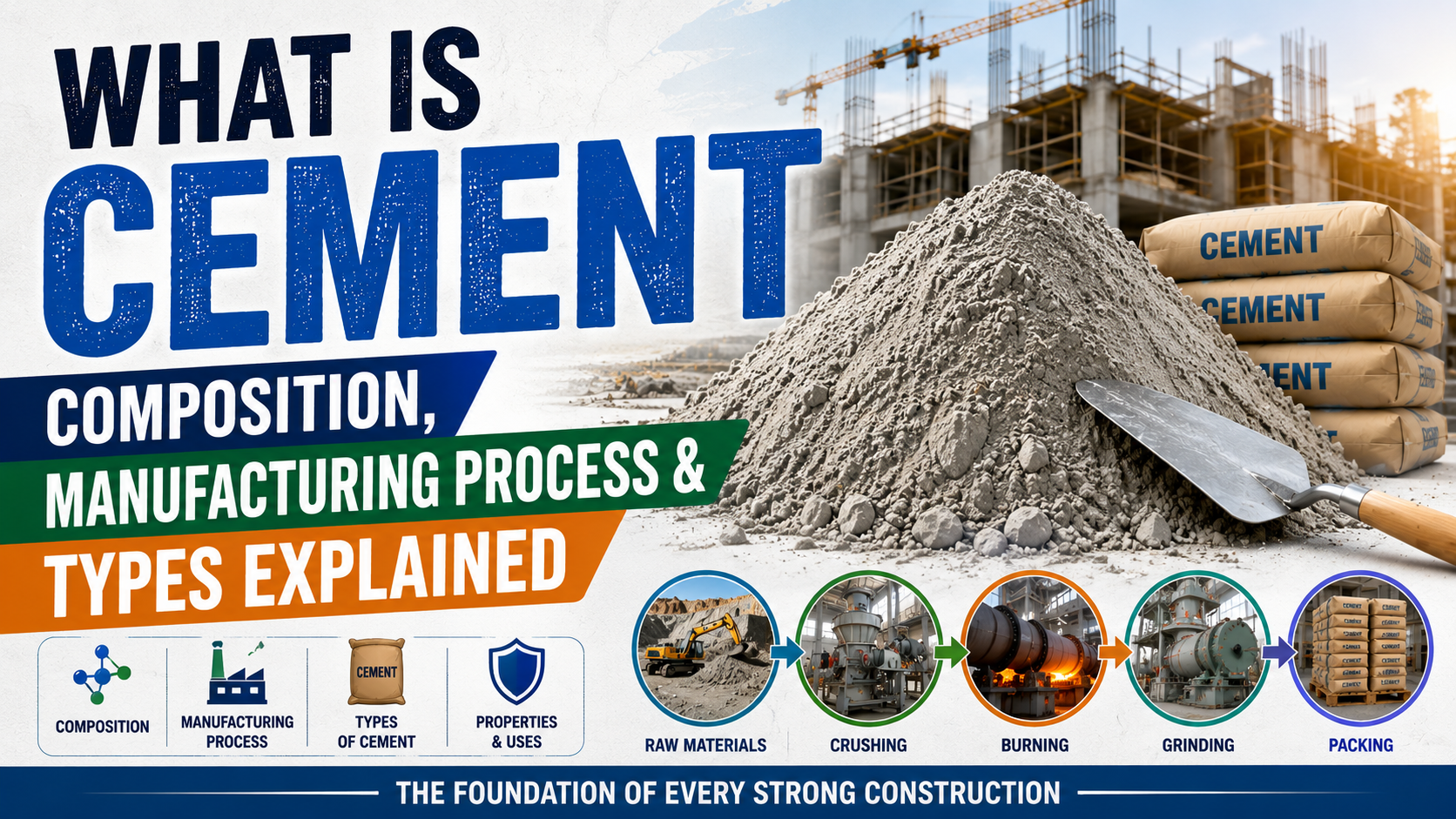
Cement is a fine, powdery construction material with strong binding (adhesive and cohesive) properties. When mixed with water it forms a paste that binds sand and aggregate together into concrete — the most widely used building material in the world.
In this guide, we’ll break down what cement is made of, how it’s manufactured, why it hardens the way it does, and which of the many cement types is right for your project.
What Is Cement?
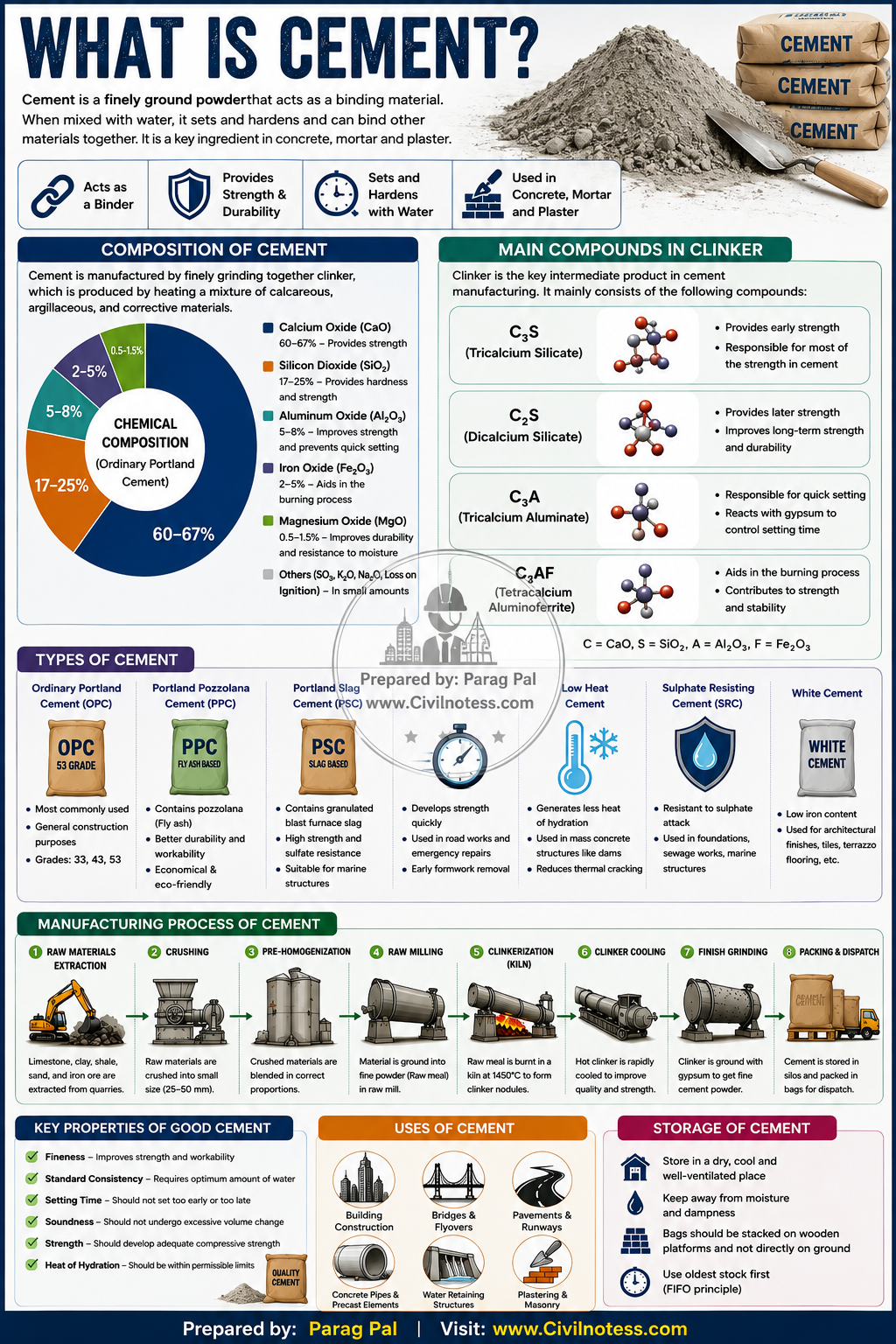
Cement is obtained by pulverizing (grinding into powder) clinker — a material formed by heating a mix of limestone (lime) and clay (silica, alumina, iron oxide) to extremely high temperatures.
- Finer cement particles generally set faster and gain early strength quicker
- The reaction between cement and water is exothermic — it releases heat
- Standard specific gravity of cement is 3.15
- A standard cement bag weighs 50 kg (≈0.035 m³ in volume)
- Cement typically reaches 70% of its final strength in 28 days and 90% within a year
Quick fact: The name “Portland cement” comes from its inventor, Joseph Aspdin, who thought the hardened material resembled the natural stone quarried near Portland, England.
Chemical Composition of Cement
Cement is made mainly from two raw material groups, combined in roughly a 3:1 ratio:
- Calcareous materials (provide lime) — limestone, chalk, marine shells, marl
- Argillaceous materials (provide silica, alumina, iron oxide) — clay, shale, slate, blast furnace slag
Typical chemical composition of Portland cement
| Compound | Approx. % | Effect |
|---|---|---|
| Lime (CaO) | 62% | Main strength contributor; excess makes cement unsound |
| Silica (SiO₂) | 22% | Gives strength; excess prolongs setting time |
| Alumina (Al₂O₃) | 5% | Speeds up setting; lowers clinkering temperature |
| Iron Oxide (Fe₂O₃) | 3% | Adds colour, hardness and strength |
| Gypsum (CaSO₄) | 3–5% | Prevents flash (instant) setting |
| Magnesia (MgO) | ≤2% | Small amounts help; too much causes unsoundness |
Inside the clinker, four key compounds — known as Bogue compounds — determine how cement behaves:
Bogue compounds and their role
| Compound | Typical % | What it does |
|---|---|---|
| C₃S (Tricalcium Silicate) | 30–50% | Drives early strength (7–28 days) |
| C₂S (Dicalcium Silicate) | 20–45% | Slow-reacting; builds long-term/ultimate strength |
| C₃A (Tricalcium Aluminate) | 8–12% | Causes flash set; highest heat of hydration |
| C₄AF (Tetracalcium Aluminoferrite) | 6–10% | Gives cement its grey colour |
How Cement Is Manufactured
Cement is produced through two main methods — the wet process (older, energy-intensive, now largely phased out) and the dry process (modern, more fuel-efficient).
1. Crushing & Grinding
Raw materials are crushed to about 25 mm and ground into a fine powder (dry process) or mixed with water to form a slurry (wet process).
2. Preheating (Dry Process Only)
The dry raw mix passes through a preheater at around 850°C using waste kiln gases, which cuts down burning time and fuel use.
3. Burning in the Rotary Kiln
The raw material is fed into a large rotating kiln (typically 90–120 m long, 2.5–3 m in diameter, tilted at a 1:25 to 1:30 gradient). Inside, it passes through three zones:
- Drying/Calcination zone (~700°C): limestone breaks down into lime and CO₂
- Burning zone (~1450°C): materials fuse into clinker (marble-sized nodules)
- Cooling zone: clinker is cooled before grinding
4. Grinding & Packing
Cooled clinker is ground together with 2–5% gypsum (to prevent flash setting), stored in silos, and packed into 50 kg bags for distribution.
What Happens When Cement Meets Water?
The chemical reaction between cement and water is called hydration. It’s exothermic — meaning it releases heat — and it doesn’t happen all at once; it continues at a slowing rate for a long time.
The main product of hydration is Calcium Silicate Hydrate (C–S–H) gel, which is what actually gives concrete its strength. A by-product, calcium hydroxide, is less desirable since it’s soluble and can leach out over time.
Good to know: Cement needs roughly 38% water (by weight) for complete hydration — about 23% for the chemical reaction itself and 15% to fill gel pores. Adding more water than needed weakens the concrete by creating capillary voids.
Types of Cement (and When to Use Them)
Not all cement is the same. Bureau of Indian Standards (BIS) recognizes several types, each suited to different site conditions:
Common types of cement and their uses
| Type | Best used for |
|---|---|
| Ordinary Portland Cement (OPC) — 33/43/53 grade | General construction; most common type |
| Rapid Hardening Cement | Fast-track work, early shuttering removal, road repairs |
| Low Heat Cement | Mass concrete works — dams, large foundations |
| Portland Blast Furnace Slag Cement | Marine structures, foundations, sulphate-exposed sites |
| Portland Pozzolana Cement (PPC) | Hydraulic structures, marine works, general use |
| Sulphate Resisting Cement | Soil/water with high sulphate content |
| White / Coloured Cement | Architectural finishes, decorative work |
| High Alumina Cement | Chemical plants, refractory work, fast strength gain |
How to Check Cement Quality
Quick Field Tests
- Colour: should be grey with a light greenish tint
- Feel: smooth to the touch when rubbed between fingers
- Temperature: should feel cool when your hand is inserted into a bag
- Float test: a handful thrown into water should sink, not float
- No lumps: good cement should be completely lump-free
Laboratory Tests
Professional labs verify cement using standardized tests, including:
- Consistency & setting time — using the Vicat apparatus (initial set ≥30 min, final set ≤10 hours for OPC)
- Soundness — Le Chatelier test (expansion ≤10 mm) and the autoclave test (expansion ≤0.8%)
- Compressive & tensile strength — tested at 3, 7 and 28 days
- Fineness — sieve or air-permeability methods
- Specific gravity — should be close to 3.15
Frequently Asked Questions
What is cement made of? Mainly limestone (for lime) and clay or shale (for silica, alumina, and iron oxide), fused into clinker and ground with a small amount of gypsum.
What is the difference between cement and concrete? Cement is the binding powder; concrete is the finished material made by mixing cement, water, sand, and coarse aggregate together.
Which cement grade is best for house construction? OPC 43 grade is the most commonly used for general residential construction, though OPC 53 offers higher early strength for structural elements.
Why is gypsum added to cement? Gypsum controls the setting time and prevents “flash setting” — an overly fast, unworkable hardening reaction.
How long does cement take to fully cure? Cement reaches about 70% of its strength in 28 days, with the remaining strength developing gradually over roughly a year.