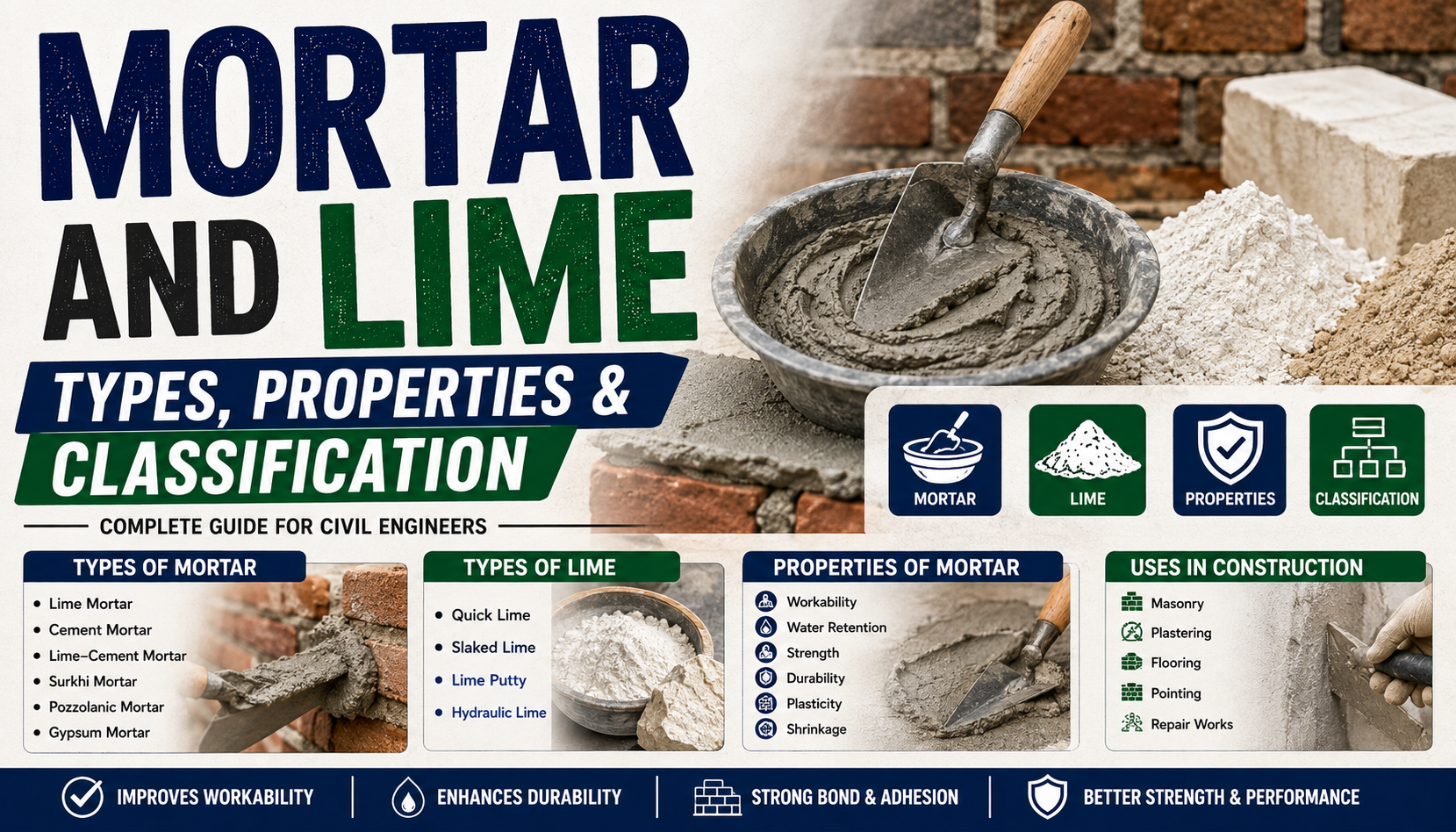
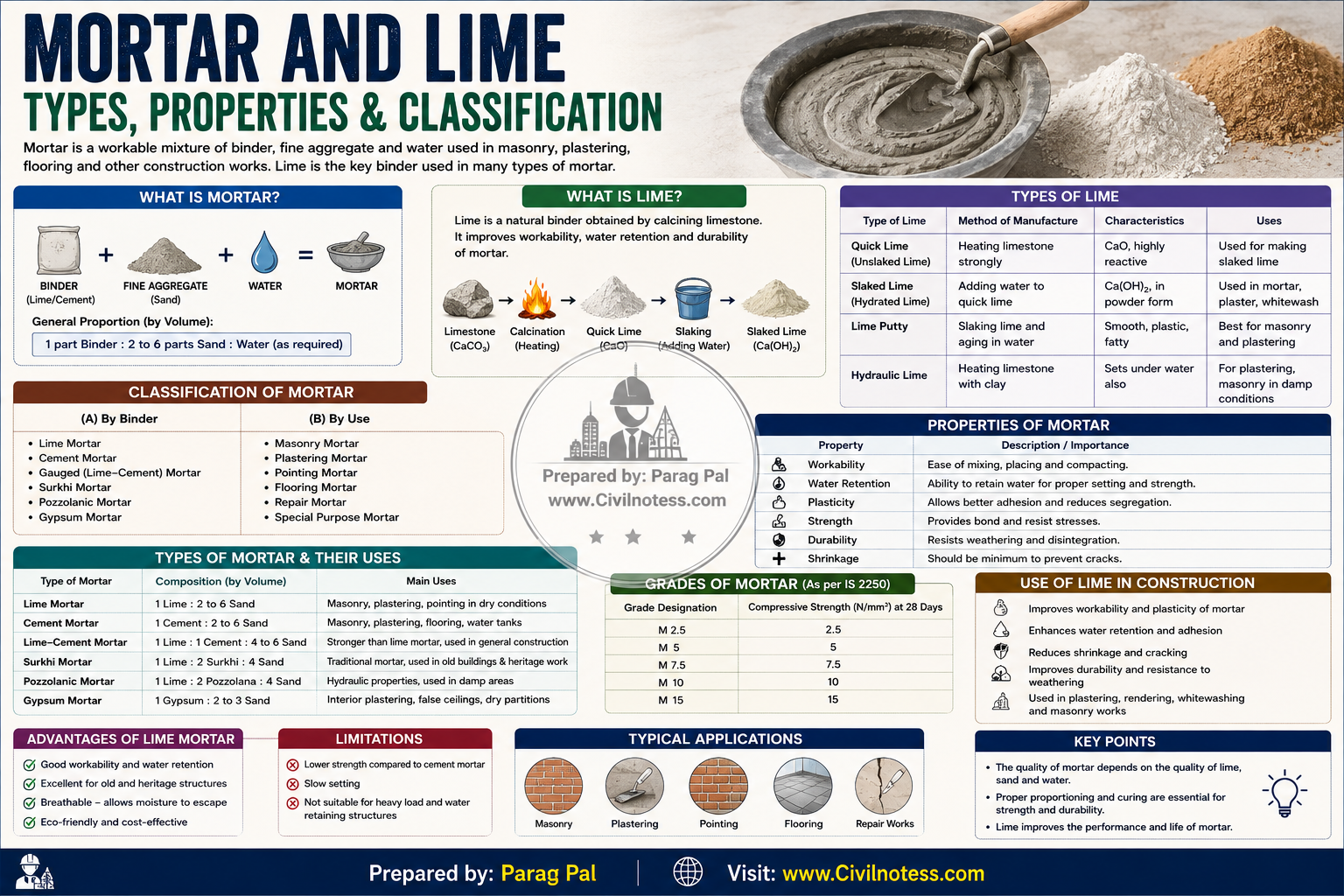
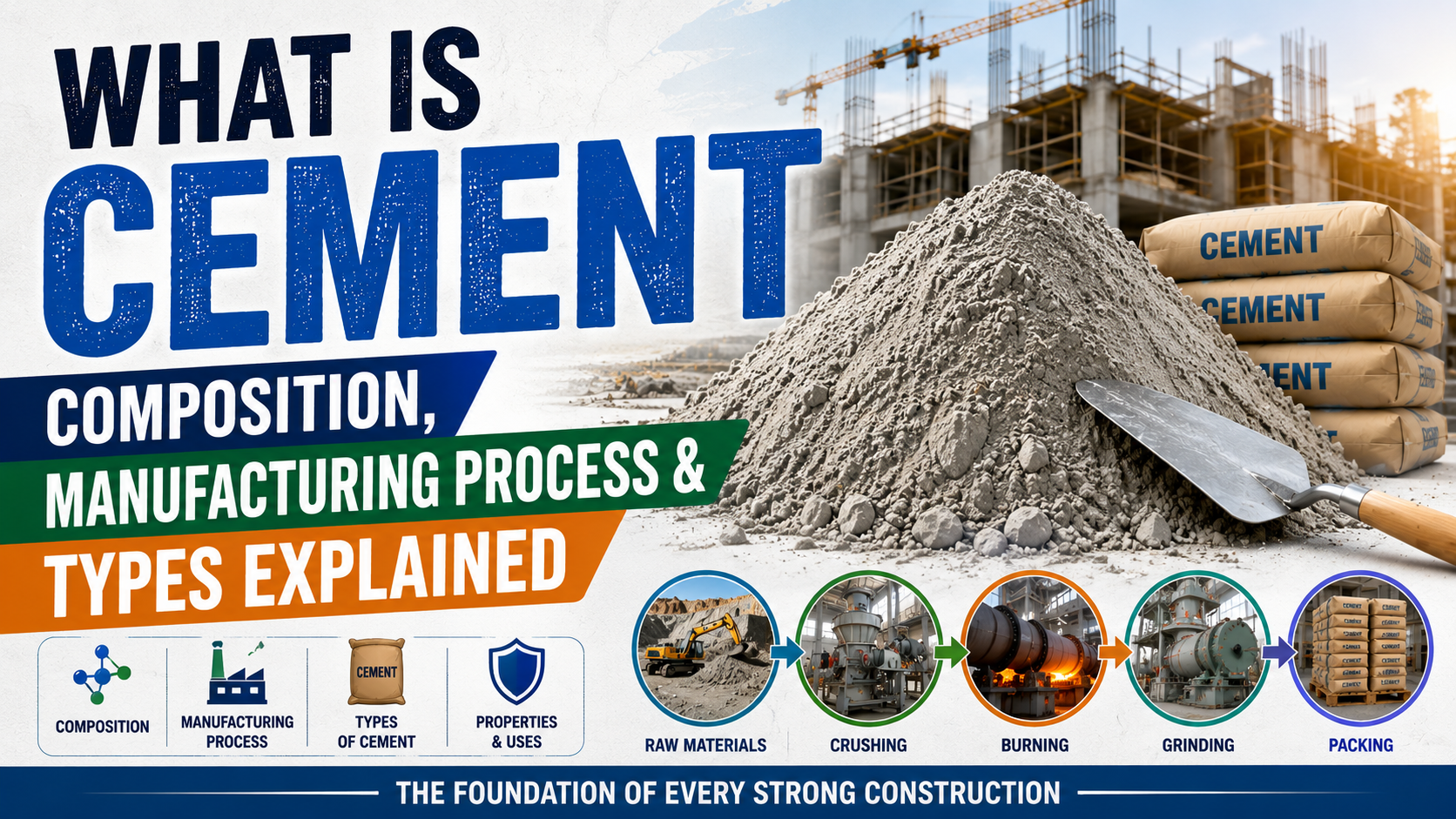
Mortar is a paste made by mixing a binding material (cement or lime) with water and fine aggregate (sand). It’s similar to concrete but does not contain coarse aggregate. Lime, one of the oldest binding materials, is obtained by heating limestone and still plays a key role in plastering, masonry, and specialty mortars today.
This guide covers everything you need to know: why sand “bulks” when damp, the different types of mortar and lime, how they’re tested, and what impurities affect lime quality.
Bulking of Sand
When sand carries moisture, a thin film of water forms around each particle and pushes them apart — this increases the sand’s volume, a phenomenon called bulking of sand.
At 5–8% moisture content, sand volume can increase by 20–40%
Fine sand bulks the most (up to ~35–40% at 5–7% moisture)
Coarse sand bulks the least (around 15% at 4–5% moisture)
Bulking disappears once sand is fully saturated with water
Why it matters: Bulking affects the volumetric proportioning of sand in a mix. If you measure sand by volume without accounting for bulking, you can end up with less sand — and a weaker, more cement-heavy mix — than intended.
Mortar and Lime Types, Properties & Classification Explained
Types of Mortar
Mortars are classified by bulk density, binding material, and special application.
By bulk density
Heavy mortars — bulk density ≥ 15 kN/m³, made with heavy quartz or dense sand
Light-weight mortars — bulk density < 15 kN/m³, made with porous sand, pumice, or similar light aggregate
By binding material
Type
Composition
Best used for
Lime Mortar
Fat lime or hydraulic lime + sand
General masonry; hardens slowly; not for damp or waterlogged areas
Surkhi Mortar
Surkhi (burnt brick powder) instead of sand
Foundation and superstructure masonry; not suitable for plastering or pointing
Cement Mortar
Cement as binder, proportion 1:2 to 1:6
High-strength, water-resistant work — underground construction, wet soil
Gauged Mortar
Lime mortar + cement (cement:lime = 1:6 to 1:8)
Bedding and thick walls; more economical and durable than lime alone
Portland cement, lime, gypsum (bulk density 6–12 kN/m³)
Reducing noise levels
Properties of a Good Mortar
Develops strong adhesion with bricks, stones, and other building units
Cheap, durable, and easily workable while still meeting design strength
Sets quickly enough to keep construction moving
Resists cracking and holds its appearance over time
Tests for Mortars
Adhesiveness test — Two bricks are joined at right angles with a 9 cm × 9 cm (81 cm²) mortar joint. Adhesive strength = maximum load ÷ 81 cm².
Tensile strength (briquette test) — Mortar is cast into a standard “dog-bone” briquette with a central cross-section of 38 mm × 38 mm (1,444 mm²). Load is applied at 0.7 N/mm² over 12 seconds. For OPC mortar, minimum strength is 2.0 MPa at 3 days and 2.5 MPa at 7 days.
Key Definitions
Term
Meaning
Calcination
Heating limestone to redness in contact with air
Hydraulicity
Lime’s ability to set/harden in damp places, water, or thick walls with no free air circulation
Lime
Product of calcining limestone: CaCO₃ → CaO + CO₂
Quick Lime
Lime from calcining pure limestone (CaO); also called caustic or lump lime
Slaking
Adding water to quick lime causes it to crack, swell, and crumble into calcium hydroxide: CaO + H₂O → Ca(OH)₂ + heat
Slaked Lime
The white powder produced by slaking — chemically Ca(OH)₂
Classification of Lime
Lime is grouped into three types based on purity and hydraulic behaviour:
Fat Lime vs. Hydraulic Lime vs. Poor Lime
Property
Fat Lime
Hydraulic Lime
Composition
Pure carbonate; impurities under 5%
Limestone + 5–30% clay, plus iron oxide
Slaking
Vigorous; volume increases 2–2.5×
Slow; volume increases only slightly
Setting
Sets slowly in air, absorbing CO₂ to form CaCO₃
Sets underwater, forming aluminate and dicalcium silicate crystals
Hydraulic property
None
Present
Colour / strength
Perfectly white; not very strong
Less white; stronger
Typical use
Plastering, white-washing, general mortar
Mortar for thick walls and damp locations
Shrinkage
Shrinks considerably while setting
Shrinks less than fat lime
Clay content
Under 5%
5–30%
Poor (lean) lime contains more than 30% clay. It slakes very slowly, forms a thin paste, hardens poorly, and is only used for interior work when better lime isn’t available.
Impurities in Limestone
The impurities present in limestone strongly influence how the resulting lime behaves:
Impurity
Effect
Magnesium carbonate
Causes irregular calcination, slaking, and hardening; up to 5% MgO actually improves hydraulic properties
Clay
Main source of hydraulic properties — 10–30% clay creates hydraulicity, and 20–30% gives excellent hydraulic lime suited for underwater foundations
Free silica
Has a harmful effect on lime’s properties
Iron compounds
Pyrite (iron sulphide) is highly undesirable, but 2–5% iron oxide is necessary for good hydraulic lime
Sulphates
Slow down slaking and increase setting time
Alkalies
Undesirable in pure lime, but up to 5% in hydraulic lime causes no harm
Mortar Strength Grades
Mortars are graded by minimum compressive strength:
Grade
Minimum Compressive Strength
H₁ Mortar
10 N/mm²
H₂ Mortar
6–7.5 N/mm²
M₁ Mortar
3–5 N/mm²
M₂ Mortar
2–3 N/mm²
M₃ Mortar
1.5 N/mm²
L₁ Mortar
0.7 N/mm²
L₂ Mortar
0.5 N/mm²
Additional notes:
Cement mortar richer than 1:3 is avoided in masonry — it shrinks too much
Adding surkhi to fat lime produces artificial hydraulic lime
Calcining “Kankar” (impure limestone nodules) also yields hydraulic lime
The 28-day modulus of rupture for mortar should be no less than 1.5 N/mm²
Frequently Asked Questions
What is the difference between mortar and concrete? Mortar contains only fine aggregate (sand); concrete also contains coarse aggregate like gravel or crushed stone.
Why does sand bulk when it gets wet? A thin film of water forms around each sand particle and pushes the particles apart, increasing the sand’s apparent volume — most noticeably at 5–8% moisture content.
What’s the difference between fat lime and hydraulic lime? Fat lime is nearly pure and sets slowly in air but can’t set underwater. Hydraulic lime contains 5–30% clay, which lets it set even underwater or in damp conditions.
Why is gauged mortar used instead of plain lime mortar? Adding a small amount of cement (gauged mortar) makes lime mortar stronger, denser, and more economical while keeping good workability.
What causes lime to be classified as “poor” or “lean”? Poor lime contains more than 30% clay, which makes it slake and set very slowly with weak binding properties — suitable only for minor interior work.