
Introduction
Highway Engineering is one of the most important subjects in Civil Engineering. It deals with the planning, design, construction, operation, maintenance, and improvement of roads and highways to ensure the safe, efficient, and economical movement of people and goods. Whether you are preparing for GATE, SSC JE, RRB JE, State AE/JE, or university examinations, understanding the fundamentals of highway engineering is essential.
What is Highway Engineering?
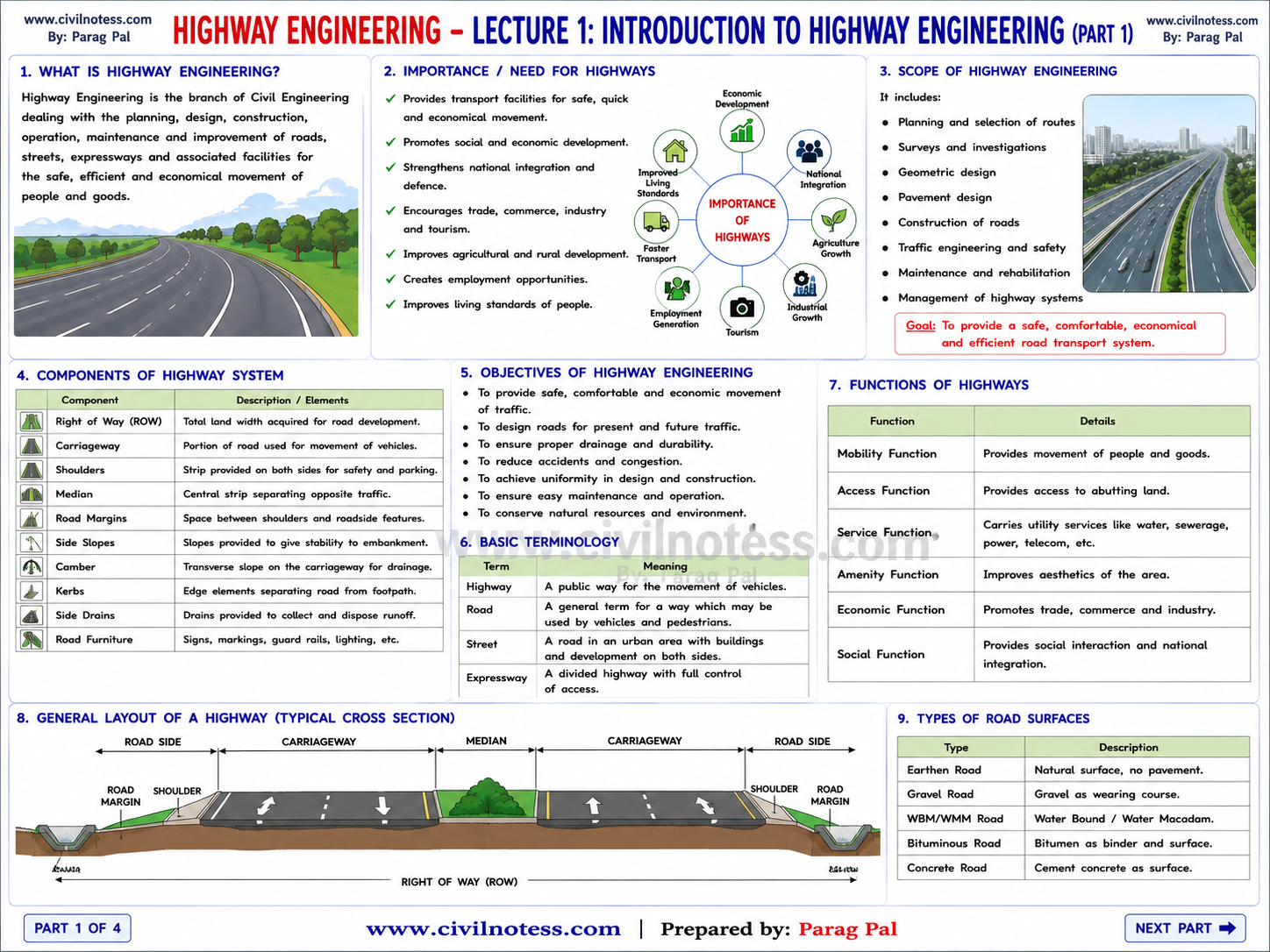
Highway Engineering is a branch of Civil Engineering that focuses on the planning, design, construction, operation, and maintenance of roads, highways, expressways, and other transportation facilities. The primary aim is to provide a transportation system that is safe, comfortable, economical, and efficient for the movement of people and goods.
Importance of Highways
Highways play a vital role in the development of any nation. They provide a reliable transportation network that connects cities, towns, villages, industries, and markets.
Some major benefits of highways include:
- Safe and quick transportation
- Economic growth and industrial development
- National integration and defense
- Promotion of trade and commerce
- Growth of tourism
- Improvement of agricultural and rural development
- Employment generation
- Better quality of life
Scope of Highway Engineering
Highway Engineering covers almost every activity involved in road development, including:
- Route planning and selection
- Surveys and site investigations
- Geometric design
- Pavement design
- Drainage design
- Road construction
- Traffic engineering
- Road safety
- Maintenance and rehabilitation
- Highway management
The overall goal is to provide a road network that serves both current and future transportation needs.
Objectives of Highway Engineering
The major objectives are:
- Provide safe and comfortable transportation
- Ensure economical movement of traffic
- Design roads for future traffic demand
- Reduce accidents and congestion
- Improve drainage and pavement durability
- Maintain uniform construction standards
- Simplify maintenance operations
- Protect natural resources and the environment
Components of a Highway System
Every highway consists of several important components that ensure smooth and safe traffic movement.
| Component | Purpose |
|---|---|
| Right of Way (ROW) | Total land acquired for road development |
| Carriageway | Portion used for vehicle movement |
| Shoulder | Safety and emergency parking area |
| Median | Separates opposite traffic streams |
| Road Margin | Space beside the roadway |
| Side Slopes | Stability of embankments and cuttings |
| Camber | Removes rainwater from the road surface |
| Kerbs | Separate roadway from footpath |
| Side Drains | Collect and dispose runoff water |
| Road Furniture | Traffic signs, markings, guard rails, lighting |
Basic Highway Terminology
| Term | Meaning |
|---|---|
| Highway | Public road used for movement of vehicles |
| Road | General transportation path |
| Street | Urban road with buildings on both sides |
| Expressway | Fully access-controlled divided highway |
| Carriageway | Portion of road used by vehicles |
| Shoulder | Strip provided beside the carriageway |
| Median | Central divider between opposite traffic |
| ROW | Total land width acquired for the road |
| Camber | Cross slope provided for drainage |
| Pavement | Surface constructed for vehicle movement |
| Subgrade | Prepared soil supporting the pavement |
| Formation Width | Width including carriageway and shoulders |
Functions of Highways
Highways perform several important functions in transportation and economic development.
Mobility Function
Provides efficient movement of people and goods.
Access Function
Provides access to adjoining land and properties.
Service Function
Carries utility services such as water supply, sewer lines, electric cables, and telecommunication lines.
Amenity Function
Improves roadside appearance and user comfort.
Economic Function
Supports trade, commerce, industries, and business activities.
Social Function
Promotes national integration, social interaction, and balanced regional development.
Types of Road Surfaces
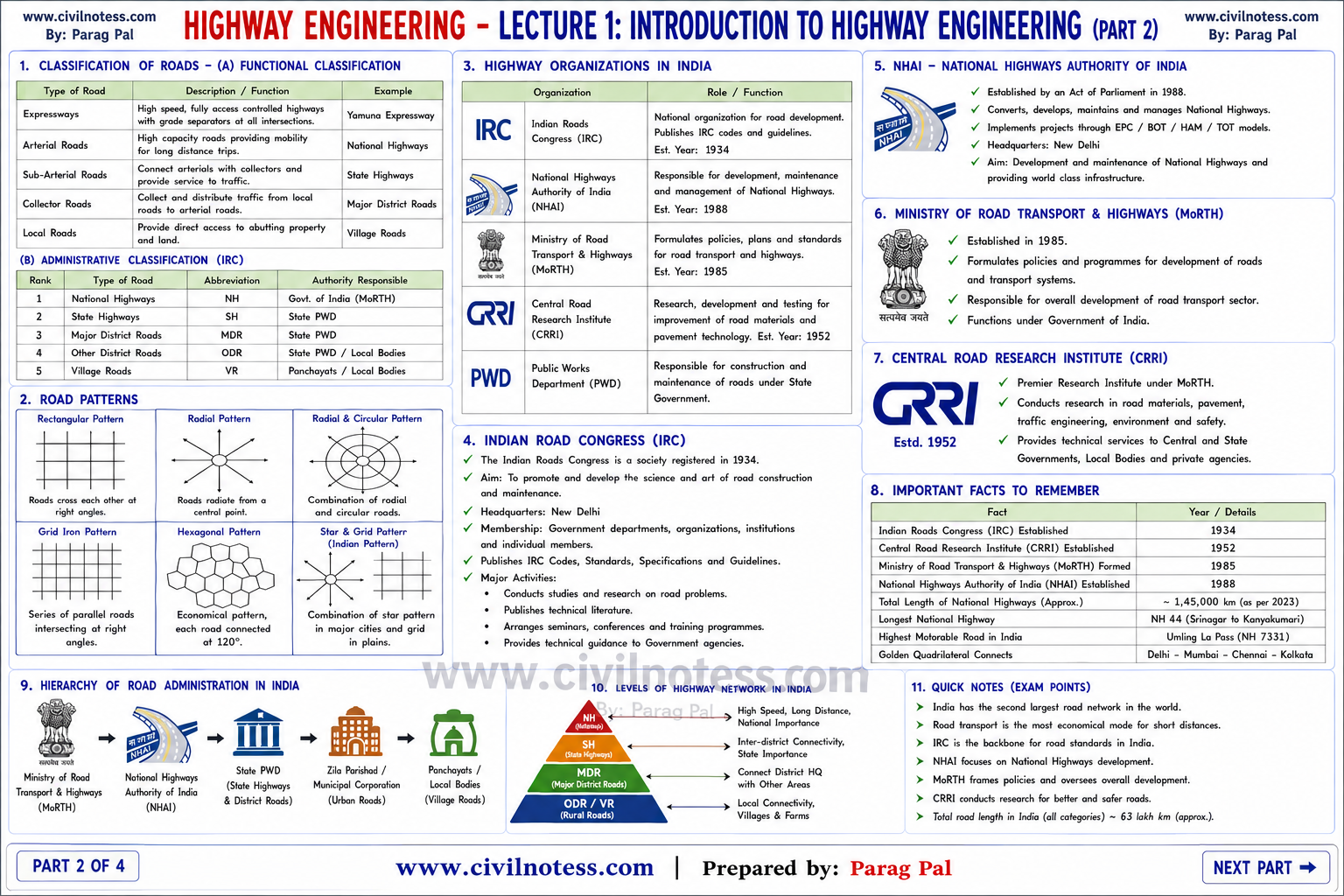
| Road Type | Description |
|---|---|
| Earthen Road | Natural soil surface without pavement |
| Gravel Road | Gravel used as the wearing surface |
| WBM/WMM Road | Water Bound Macadam or Wet Mix Macadam |
| Bituminous Road | Bitumen used as binder and surface course |
| Concrete Road | Cement concrete pavement |
Classification of Roads
Functional Classification
Expressways
- High-speed highways
- Fully access-controlled
- Grade-separated intersections
Example: Yamuna Expressway
Arterial Roads
- Carry long-distance traffic
- National Highways are examples
Sub-Arterial Roads
- Connect arterial roads with collector roads
Collector Roads
- Collect traffic from local roads and distribute it to arterial roads
Local Roads
- Provide direct access to residential and commercial properties
Administrative Classification (IRC)
| Road Type | Abbreviation | Authority |
|---|---|---|
| National Highways | NH | Government of India (MoRTH) |
| State Highways | SH | State PWD |
| Major District Roads | MDR | State PWD |
| Other District Roads | ODR | State PWD / Local Bodies |
| Village Roads | VR | Panchayats / Local Bodies |
Road Network Patterns
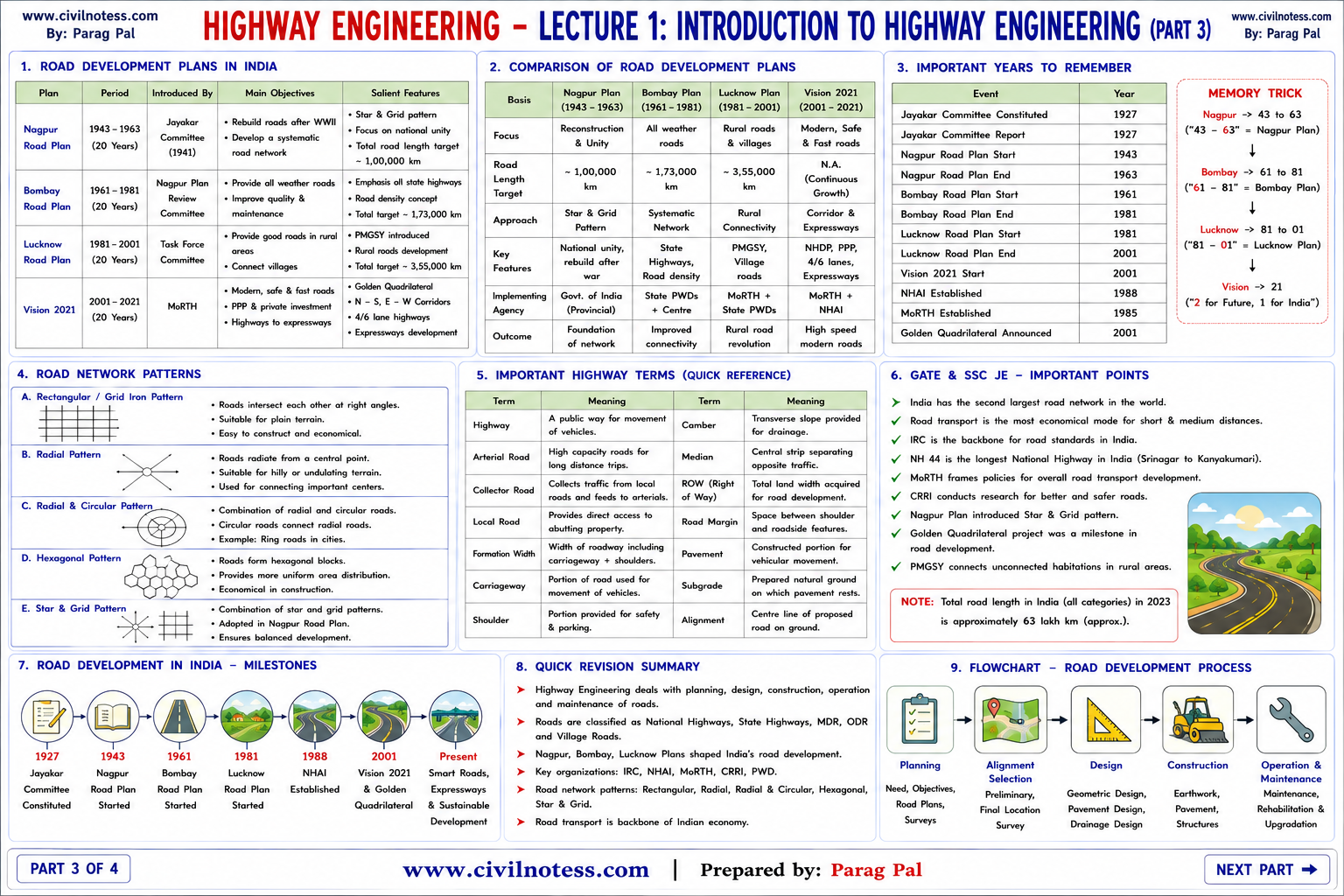
Different road network patterns are adopted depending on terrain and planning requirements.
Rectangular (Grid Iron) Pattern
- Roads intersect at right angles.
- Suitable for plain terrain.
- Simple and economical layout.
Radial Pattern
- Roads originate from a central point.
- Suitable for hilly or undulating terrain.
- Connects major activity centers.
Radial and Circular Pattern
- Combination of radial and circular roads.
- Widely used in metropolitan cities.
Hexagonal Pattern
- Roads form hexagonal blocks.
- Provides efficient traffic distribution.
- Economical for planned developments.
Star and Grid Pattern
- Combination of star and grid layouts.
- Introduced in the Nagpur Road Plan.
Highway Organizations in India
Indian Roads Congress (IRC)
Established: 1934
The Indian Roads Congress develops standards, specifications, and guidelines for road construction and maintenance.
Its major functions include:
- Publishing IRC Codes
- Conducting technical research
- Organizing seminars and conferences
- Providing technical guidance
National Highways Authority of India (NHAI)
Established: 1988
NHAI is responsible for:
- Development of National Highways
- Highway maintenance
- Implementation of highway projects
- Infrastructure development
Ministry of Road Transport and Highways (MoRTH)
Established: 1985
MoRTH formulates national policies related to road transportation and oversees highway development across India.
Central Road Research Institute (CRRI)
Established: 1952
CRRI conducts research in:
- Road materials
- Pavement technology
- Traffic engineering
- Highway safety
- Environmental engineering
Public Works Department (PWD)
PWD is responsible for the construction and maintenance of state roads and other public infrastructure.
Road Development Plans in India
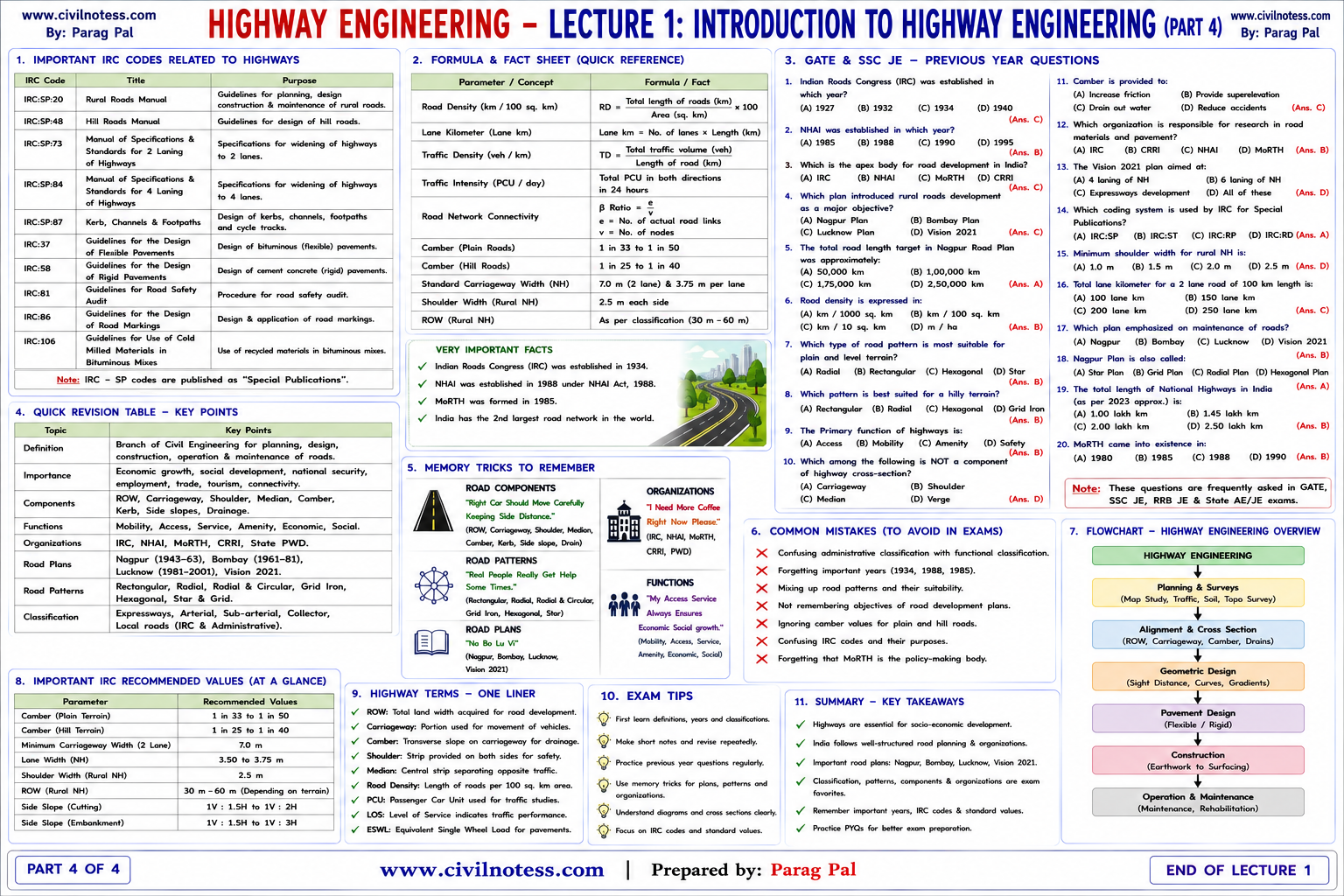
Nagpur Road Plan (1943–1963)
Objectives:
- Rebuild roads after World War II
- Develop a systematic road network
Features:
- Star and Grid road pattern
- National connectivity
- Road length target of approximately 1,00,000 km
Bombay Road Plan (1961–1981)
Objectives:
- Develop all-weather roads
- Improve road quality and maintenance
Features:
- Road density concept
- Target road length of approximately 1,73,000 km
Lucknow Road Plan (1981–2001)
Objectives:
- Improve rural connectivity
- Connect villages with major roads
Features:
- PMGSY concept
- Road length target of approximately 3,55,000 km
Vision 2021 (2001–2021)
Objectives:
- Modernize highway infrastructure
- Promote Public-Private Partnership (PPP)
- Develop expressways and economic corridors
Major Features:
- Four and six-lane highways
- High-speed corridors
- Safer road infrastructure
Comparison of Road Development Plans
| Plan | Main Focus |
|---|---|
| Nagpur Plan | Reconstruction and national unity |
| Bombay Plan | All-weather roads |
| Lucknow Plan | Rural connectivity |
| Vision 2021 | Modern highways and expressways |
Important Years to Remember
| Event | Year |
|---|---|
| Jayakar Committee | 1927 |
| Nagpur Road Plan | 1943 |
| Bombay Road Plan | 1961 |
| Lucknow Road Plan | 1981 |
| MoRTH Established | 1985 |
| NHAI Established | 1988 |
| Vision 2021 | 2001 |
| Golden Quadrilateral | 2001 |
Important IRC Codes
| IRC Code | Purpose |
|---|---|
| IRC SP:20 | Rural Roads Manual |
| IRC SP:48 | Hill Roads Manual |
| IRC SP:73 | Two-Lane Highway Standards |
| IRC SP:84 | Four-Lane Highway Standards |
| IRC SP:87 | Kerbs, Footpaths and Cycle Tracks |
| IRC:37 | Flexible Pavement Design |
| IRC:58 | Rigid Pavement Design |
| IRC:81 | Road Safety Audit |
| IRC:86 | Road Markings |
| IRC:106 | Cold Mix Bituminous Mixes |
Highway Engineering Formula Sheet
Road Density
Road Density = (Total Road Length ÷ Area) × 100
Unit: km per 100 sq. km
Lane Kilometer
Lane Kilometer = Number of Lanes × Road Length
Traffic Density
Measured as vehicles per kilometer.
Traffic Intensity
Measured in PCU/day.
Road Network Connectivity
β Ratio = Number of Links ÷ Number of Nodes
Standard Highway Dimensions
| Parameter | Standard Value |
|---|---|
| Standard NH Carriageway (2 Lane) | 7.0 m |
| Lane Width | 3.5–3.75 m |
| Shoulder Width | 2.5 m each side |
| Rural ROW | 30–60 m |
| Camber (Plain Roads) | 1 in 33 to 1 in 50 |
| Camber (Hill Roads) | 1 in 25 to 1 in 40 |
Highway Engineering Process
The development of a highway generally follows these stages:
- Planning
- Surveys
- Alignment Selection
- Geometric Design
- Pavement Design
- Construction
- Operation
- Maintenance
- Rehabilitation
Common Mistakes Students Should Avoid
- Confusing functional and administrative classifications
- Forgetting important years
- Mixing up road development plans
- Confusing different road patterns
- Ignoring standard IRC values
- Mixing the functions of IRC, NHAI, MoRTH, and CRRI
Quick Revision Notes
- Highway Engineering deals with planning, design, construction, operation, and maintenance of roads.
- India has the second-largest road network in the world.
- IRC was established in 1934.
- CRRI was established in 1952.
- MoRTH was established in 1985.
- NHAI was established in 1988.
- Nagpur Road Plan introduced the Star and Grid Pattern.
- NH 44 is India’s longest National Highway.
- Road density is expressed in km per 100 sq. km.
- Standard carriageway width for a two-lane National Highway is 7.0 m.
Conclusion
Highway Engineering forms the backbone of transportation infrastructure and plays a crucial role in economic and social development. From road planning and geometric design to construction, maintenance, and modernization, every aspect contributes to building a safe and efficient transportation network. Understanding road classifications, highway organizations, development plans, IRC standards, formulas, and important dimensions provides a strong foundation for Civil Engineering students and professionals, especially those preparing for competitive examinations such as GATE, SSC JE, RRB JE, and State AE/JE.
Frequently Asked Questions (FAQs)
What is Highway Engineering?
Highway Engineering is the branch of Civil Engineering that deals with the planning, design, construction, operation, and maintenance of roads and highways.
What is the primary objective of Highway Engineering?
Its main objective is to provide safe, economical, comfortable, and efficient transportation.
What are the major road development plans in India?
The four major plans are the Nagpur Plan, Bombay Plan, Lucknow Plan, and Vision 2021.
What is the role of IRC?
IRC develops standards, specifications, guidelines, and technical publications for highway engineering.
What is the difference between IRC and NHAI?
IRC prepares standards and technical codes, while NHAI develops, manages, and maintains National Highways.
Which road pattern was introduced in the Nagpur Road Plan?
The Star and Grid Pattern was introduced in the Nagpur Road Plan.
Which organization conducts highway research in India?
The Central Road Research Institute (CRRI) is responsible for research related to roads, pavements, traffic engineering, and highway safety.
Note: This post data developed and generated by Parag Pal and copywrite content belongs to www.civilnotess.com Kindly do not copy and reproduce the content.