
If you’re a site engineer, project manager, or civil engineering student, you already know that a construction site runs on paperwork as much as it runs on concrete and steel. Among all the forms you’ll fill out, none is more important — or more used — than the Daily Site Report (DSR).
In this post, we’ll break down exactly what a Daily Site Report is, why it matters, what should go into one, and we’ll give you a free, ready-to-use Excel template you can start using on your project today.
What Is a Daily Site Report?
A Daily Site Report is a standardized document that a site engineer fills out at the end of (or during) every working day. It captures everything that happened on site — manpower, equipment, materials, work progress, delays, safety incidents, and site visitors — in one single, easy-to-read record.
Think of it as the site’s diary. Every day gets its own entry, and over the life of a project, these reports build into a complete, day-by-day history of construction — which becomes critical for:
- Tracking actual progress against the schedule
- Resolving disputes over delays or extra work
- Supporting claims and variation orders
- Providing evidence in case of accidents or defects
- Giving management, clients, and consultants daily visibility into the project
Why Every Site Engineer Needs One
New engineers often underestimate how much a simple daily report protects them. Here’s why it’s non-negotiable:
1. It’s your legal record. If a dispute arises months later over a delay, an accident, or a missed delivery, your daily reports are often the first document pulled out to establish what actually happened.
2. It keeps everyone aligned. Project managers, clients, and consultants rarely visit the site every day. The DSR is often their only real-time window into what’s happening.
3. It builds accountability. Recording manpower, equipment, and progress daily makes it much harder for delays or productivity issues to go unnoticed until it’s too late to fix them.
4. It’s the foundation for weekly and monthly reports. Instead of scrambling to remember what happened over the last 30 days, you simply roll up your daily reports.
What Should a Daily Site Report Include?
A good DSR needs to be detailed enough to be useful, but simple enough that you can actually fill it out every day without it becoming a burden. Here’s what a complete template should cover:
1. Project Information
- Report number and date
- Project name and site address
- Site engineer, contractor, and consultant names
- Weather conditions and temperature (this matters more than people think — weather delays are one of the most common causes of schedule disputes)
2. Manpower on Site
A breakdown by trade (mason, carpenter, steel fixer, electrician, etc.) showing:
- Planned headcount vs. actual present
- Absences
- Overtime hours
- Remarks (e.g., “2 workers reassigned to Block B”)
This section alone is often the difference between a report that’s useful and one that’s decorative — manpower numbers reveal productivity trends that are invisible day-to-day but obvious over a few weeks.
3. Equipment and Plant on Site
- Equipment type and quantity
- Hours worked vs. idle hours
- Whether it’s owned or rented (idle rental equipment is money leaking out of the project)
4. Materials Received
- Material name, unit, and quantity delivered
- Supplier and delivery note number
- Any remarks (damaged shipment, short delivery, etc.)
5. Work Progress
- Activity or work item
- Location on site
- Planned quantity vs. achieved quantity
- Percentage complete (ideally auto-calculated, not hand-typed)
6. Delays, Issues, and Instructions
- What happened
- What caused it
- What action was taken and by whom
This is often the most legally significant section of the entire report — vague entries here (“delay in work”) are far less useful than specific ones (“delay in slab pour due to late concrete truck arrival, contractor notified at 10:15 AM”).
7. Health, Safety, and Environment (HSE)
- Toolbox talk topic for the day
- Number of incidents and near misses
- PPE compliance
- Safety remarks
8. Site Visitors
- Name, company, and purpose of visit
- Time in and out
9. Sign-Off
- Prepared by (site engineer) with date
- Verified by (project manager or consultant) with date
Common Mistakes Engineers Make With Daily Reports
- Filling it out from memory at the end of the week. Details get lost, and the report becomes inaccurate.
- Being too vague in the delays section. “Work delayed” tells no one anything useful six months later.
- Not getting it signed/verified. An unsigned report carries far less weight if it’s ever needed for a claim.
- Skipping weather and site conditions. These are often the first thing referenced in any delay dispute.
- Using a different format every day. Consistency is what makes reports comparable over time — which is exactly why a fixed template matters.
Free Daily Site Report Template (Excel)
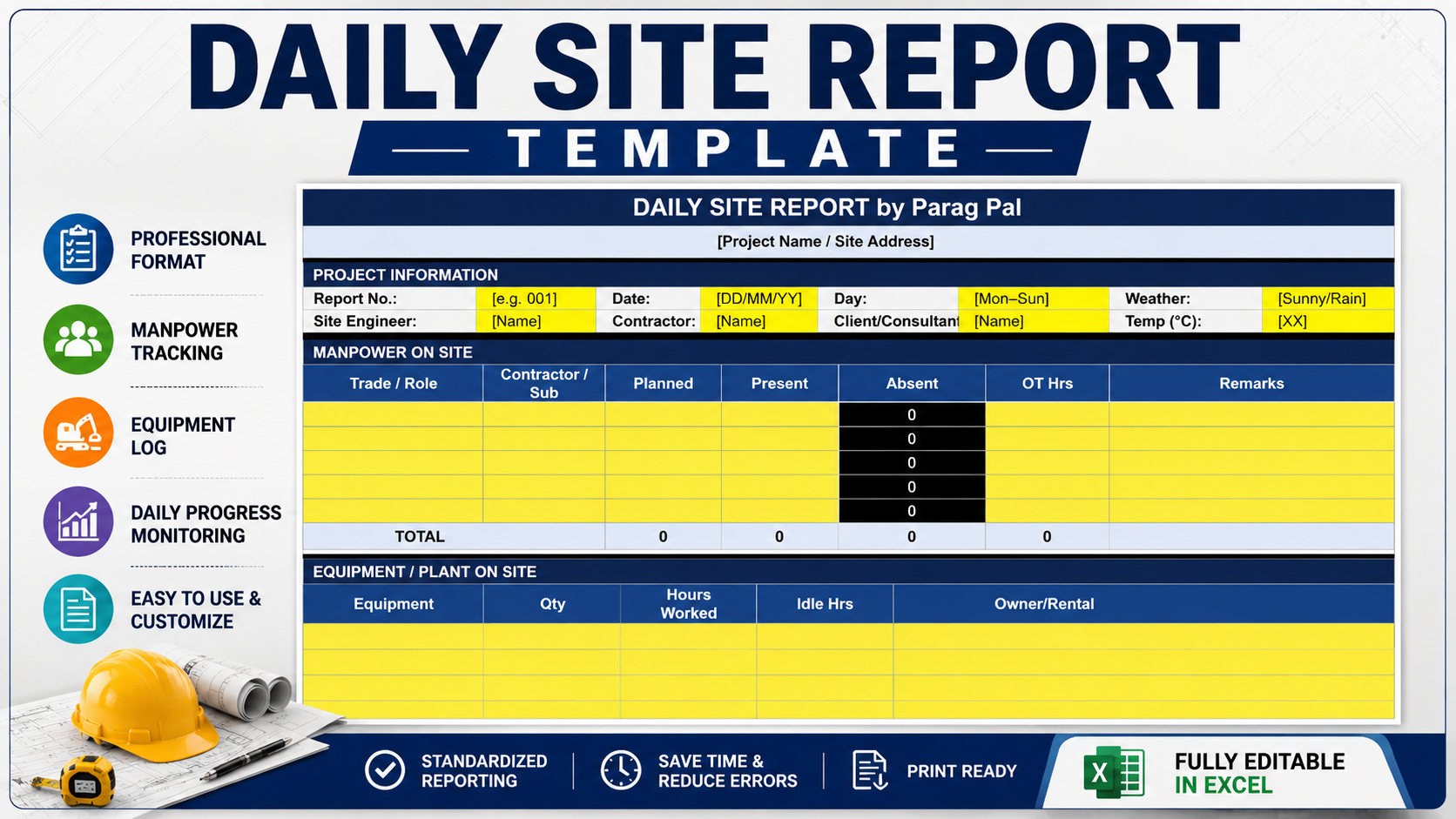
To make this easier, I put together a ready-to-use Excel template that covers everything above — manpower, equipment, materials, progress, delays, HSE, visitors, and sign-off — with built-in formulas so totals and percentages calculate automatically.
What’s included:
- Pre-formatted sections for every category above
- Auto-calculated absentee counts and % work completion
- Color-coded input cells (yellow = fill in daily) so it’s obvious what to edit
- Clean, print-ready layout (fits on 2 pages)
👉 [Download the free Daily Site Report Template here]
Final Thoughts
A Daily Site Report only takes a few minutes to fill out, but its value compounds over the life of a project. Engineers who keep clean, consistent daily records are the ones who can defend their progress claims, resolve disputes quickly, and hand over well-documented projects.
If you found this template useful, check out our other free civil engineering templates — including Bar Bending Schedules, BOQ sheets, and site engineer resume templates — all built to save you time on site.