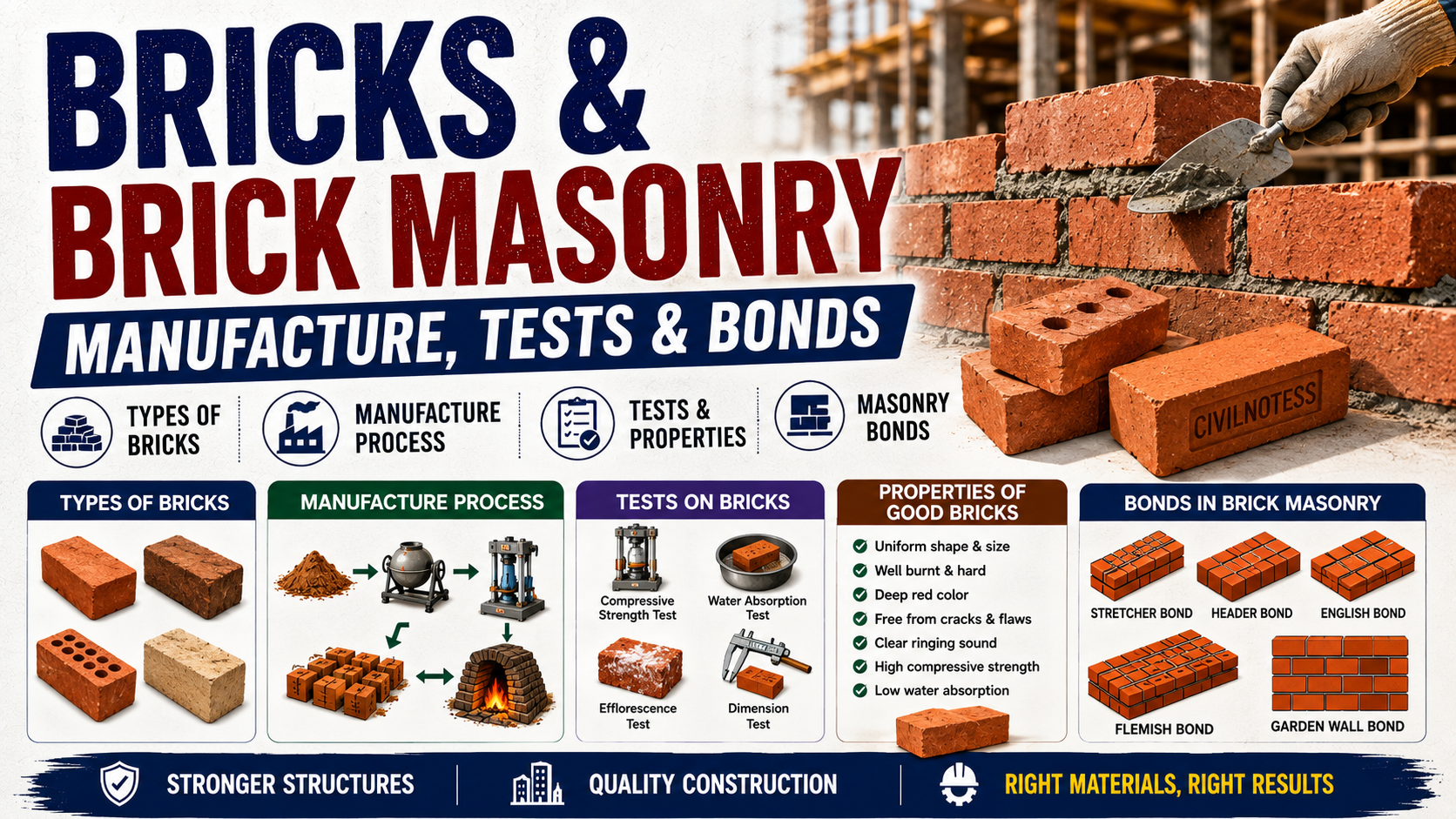
Bricks are one of the oldest and most widely used building materials, made by shaping and firing clay into hard, durable blocks. Their quality depends heavily on the raw clay’s composition, and their strength in a wall depends on how they’re arranged — the “bond” pattern.
This guide covers the composition of good brick earth, the four-step manufacturing process, kiln types, the tests used to grade bricks, key masonry terminology, and the most common bonding patterns used in brickwork.
Composition of Good Brick Earth
Good brick earth is a careful balance of five constituents. Too little or too much of any one throws off the final brick’s strength, colour, or durability.
| Constituent | Typical % | Function | Effect of Excess |
|---|---|---|---|
| Alumina | 20–30% | Chief constituent of clay; gives plasticity so bricks can be moulded | Raw bricks shrink and warp during drying and burning |
| Silica | 50–60% | Prevents cracking, shrinking, and warping; gives uniform shape | Destroys cohesion — bricks become brittle |
| Lime | Not exceeding 5% | Prevents shrinkage of raw bricks (must be finely powdered, not in lumps) | Brick melts, or lime lumps expand after burning and split the brick — causes unsoundness |
| Iron Oxide | 5–6% | Imparts red colour; helps lime fuse with sand | Excess produces dark blue or blackish bricks; too little gives a yellowish tone |
| Magnesia | Small amount | Imparts a yellow tint and decreases shrinkage | Excess causes decay of bricks |
Harmful Ingredients in Brick Earth
| Ingredient | Effect |
|---|---|
| Lime (in lumps) | Causes unsoundness — lumps turn to quicklime on burning, then slake and expand, splitting bricks apart |
| Iron pyrites | Bricks crystallize and disintegrate during burning |
| Alkalies (soda & potash) | Act as a flux, causing bricks to fuse, twist, and warp; leftover alkalies absorb moisture and create white/grey efflorescence deposits |
| Pebbles | Prevent uniform mixing of clay — bricks become weak and porous |
| Organic matter | Helps combustion during burning, but if not fully burnt leaves bricks porous |
Manufacture of Bricks
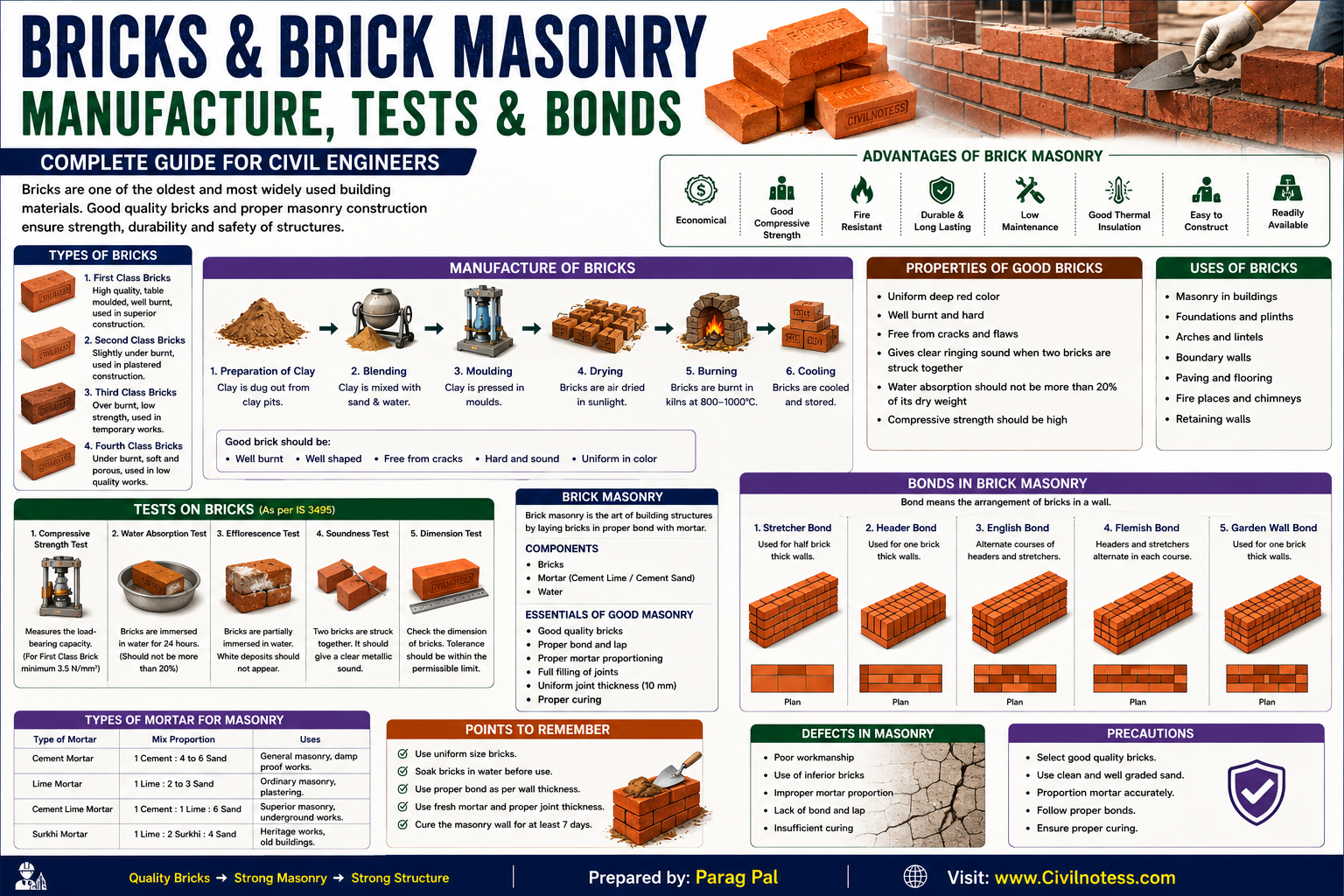
Brick manufacturing follows four main operations: preparation of clay → moulding → drying → burning.
1. Preparation of Clay
Six sub-operations turn raw earth into workable clay:
- Unsoiling — removing the top ~20 cm of soil
- Digging — excavating clay and heaping it 60–120 cm high
- Cleaning — removing pebbles and vegetable matter
- Weathering — exposing clay to the atmosphere to soften it
- Blending — turning the clay and adding ingredients as needed
- Tempering — kneading clay with water, usually in a pug mill (60 cm diameter at the bottom, widening to about 1 m at the top)
2. Moulding
- Hand moulding — used where labour is cheap and scale is small; includes ground-moulded (slope/sand-moulded) and table-moulded bricks
- Machine moulding — plastic clay machines produce wire-cut bricks; dry clay machines produce pressed bricks
- Moulds are made 8–12% larger in all directions to allow for shrinkage during drying and burning
3. Drying
Moisture content must drop to about 2% before burning, or the bricks will crack and distort in the kiln.
- Natural drying — bricks stacked on edge, 8–10 tiers high, in rows two bricks wide
- Artificial drying — done below 120°C over 1–3 days using hot air channels or floors
4. Burning
- At 650°C, organic matter oxidizes and water of crystallization evaporates
- At 1100°C, clay, alumina, and sand particles fuse together, giving the brick its final strength and density
- Clamps — temporary structures, small scale, cheap fuel (grass, cowdung, husks), about 60% good-quality output
- Kilns — permanent structures, larger scale, coal-dust fuel, about 90% good-quality output with controlled firing
- Over-burnt bricks become vitrified; under-burnt bricks stay soft
Common Kiln Types
Bulls Trench Kiln — the most widely used kiln in India, giving a continuous supply of bricks. It’s rectangular, circular, or oval in plan, with distinct loading, unloading, cooling, burning, and heating sections. It has no permanent roof, so it stops functioning during the monsoon. Burning capacity is roughly 3 lakh bricks in 12 days.
Hoffman’s Kiln (Flame Kiln) — circular in plan, divided into chambers each with fuel holes, doors, and a radial flue connecting to a central chimney. Because it has a permanent roof, it functions year-round, including the rainy season. Burning capacity is about 25 lakh bricks per season, generally producing higher-quality bricks than clamps.
| Item | Clamp Burning | Kiln Burning (Bulls Trench / Hoffmans) |
|---|---|---|
| Quality of bricks | ~60% good quality; fire can’t be regulated | ~90% good quality; fire controlled throughout |
| Capacity | 20,000–1,00,000 | Avg. 25,000/day; Hoffmans ~25 lakh/season |
| Structure / fuel | Temporary; grass, cowdung, husks — low cost | Permanent; coal dust fuel; needs continuous skilled supervision |
Qualities of Good Bricks
A good brick should meet all of the following criteria:
- Table-moulded, well-burnt in kilns, copper-coloured, free from cracks, with sharp and square edges
- Uniform in shape and standard size
- Produces a clear, metallic ringing sound when struck against another brick
- Shows a bright, homogeneous, compact structure free from voids when broken
- Absorbs no more than 20% water by weight (1st class) or 22% (2nd class) after 24 hours of soaking
- Hard enough that a fingernail scratch leaves no impression
- Doesn’t break into pieces when dropped flat onto hard ground from about one metre
- Has low thermal conductivity and provides good soundproofing
- Shows no white salt deposits after 24 hours soaking and drying in shade
- Has crushing strength of at least 5.50 N/mm²
Good to know: Hand-moulded bricks average around 60,000 kN/m² crushing strength and 2,000 kN/m² tensile strength. Shearing strength is roughly one-tenth of crushing strength.
Tests for Bricks
| Test | Method | Limit / Result |
|---|---|---|
| Water absorption | Brick weighed dry, immersed 16 hours, weighed again | 1st class ≤20%; 2nd class ≤22.5%; 3rd class ≤25% of dry weight |
| Crushing strength | Compressed in a machine until it fails | 1st class ≥10 N/mm²; 2nd class <7.5 N/mm²; no brick <5.50 N/mm² |
| Hardness | Scratch test with a fingernail | No impression left = sufficiently hard |
| Efflorescence (soluble salts) | Immersed in water 24 hours, dried in shade, inspected for deposits | <10% surface = slight; 10–50% = moderate; >50% = heavy/serious |
| Shape and size | 20 bricks measured against standard 19×9×9 cm | Total for 20 bricks: length 368–392 cm, width & height 174–186 cm each |
| Soundness | Two bricks struck together | Should not break; produces a clear ringing sound |
| Structure | Brick broken and internal structure examined | Should be homogeneous, compact, free from holes and lumps |
Classification, Colours and Size of Bricks
Unburnt (sun-dried) bricks are only suitable for temporary, cheap structures and should never be used where they’ll face heavy rain.
Burnt bricks are graded into four classes:
| Class | Description | Use |
|---|---|---|
| First Class | Table-moulded, kiln-burnt, standard shape, sharp and smooth edges — meets all quality criteria | Superior, permanent construction |
| Second Class | Ground-moulded, kiln-burnt, slightly rough and irregular | Common where brickwork will be plastered |
| Third Class | Ground-moulded, clamp-burnt, rough surface, irregular edges, dull sound when struck | Unimportant, temporary structures |
| Fourth Class | Over-burnt, irregular shape, dark colour, very compact — sometimes stronger than first class | Used as aggregate in concrete for foundations, floors, roads |
Standard Size Reference (India)
- Standard size: 19 cm × 9 cm × 9 cm
- Nominal size with mortar: 20 cm × 10 cm × 10 cm
- Traditional nominal size: 23 cm × 11.4 cm × 7.6 cm
- Weight per brick: ~3–3.5 kg (1 m³ of brick earth ≈ 1,800 kg)
- Minimum crushing strength: no brick below 5.5 N/mm²; 1st class ≥10 N/mm²
Fire-Clay and Fire Bricks
- Composition: alumina 25–35%, silica 65–75%; total impurities (lime, magnesia, iron oxide, alkalies) should not exceed 5%
- Graded by fire-resisting capacity into high-duty, medium-duty, and low-duty fire-clays
- Fire bricks are usually white or yellowish-white, weigh about 30–35 N, and have a compressive strength of 200–220 N/mm² with water absorption of 5–10%
- Used to line furnaces, chimneys, kilns, ovens, and fireplaces
Brick Masonry Terminology
Understanding brickwork requires a shared vocabulary:
| Term | Definition |
|---|---|
| Stretcher | Longer face of the brick (19 × 9 cm) as seen in elevation |
| Header | Shorter face of the brick (9 × 9 cm) as seen in elevation |
| Lap | Horizontal distance between vertical joints of successive courses |
| Perpend | Imaginary vertical line separating two adjoining bricks |
| Bed | Lower surface (19 × 9 cm) of a brick when laid flat |
| Closer | A portion of brick placed at the end of a course to complete the bond |
| Queen-closer | A brick cut lengthwise into two pieces, each half as wide as a full brick |
| King-closer | One end has half the width of a full brick, the other end full width, with a triangular piece cut away |
| Bat | A portion of brick cut across its width, shorter in length than a full brick |
| Frog (kick) | An indentation on the brick’s face that keys in mortar — usually one frog on top; pressed bricks may have two, wire-cut bricks have none |
| Racking back | Termination of a wall in a stepped fashion |
| Toothing | Termination of a wall where alternate courses project, to allow bonding if the wall is extended later |
| Quoin | The corner or external angle on the face of a wall, generally at right angles |
| Arris | The edge of a brick |
| Bull nose | A special moulded brick with one or two rounded edges |
| Bevelled closer | A special form of king-closer, half width at one end and full width at the other |
| Splay | Special moulded bricks (splay stretcher, splay header) often used to form a plinth |
Bonds in Brick-Work
A “bond” is the systematic arrangement of bricks so vertical joints don’t line up continuously — which would create weak points running through the wall.
English Bond
- Alternate courses of headers and stretchers
- Vertical joints in header courses align with each other, as do vertical joints in stretcher courses
- A queen-closer must be placed after the first header in each header course — never let a header course start with one, or it can get displaced
- Stretchers should overlap headers below by at least a quarter of their length
- For walls thicker than 1½ brick, English bond is stronger than Flemish bond
Flemish Bond
- Each course has alternate headers and stretchers within the same row
- Alternate headers are centred over the stretchers in the course below
- Every alternate course starts with a header at the corner
- Closers are inserted in alternate courses next to the quoin header
- Divided into Single Flemish and Double Flemish bond
Double Flemish Bond
- Every course looks the same on both the front and back faces
- Best choice when both economy and appearance matter, giving a uniform look on both sides of a one-brick wall
English vs Flemish Bond: Merits and Demerits
| Point | English Bond | Flemish Bond |
|---|---|---|
| Strength | Stronger for walls thicker than 1½ brick | Slightly weaker; better for thinner walls |
| Appearance | Less attractive | Better appearance — more pleasing to the eye |
| Economy | Less economical | Slightly more economical — uses bats, though needs more mortar for additional joints |
| Supervision | Needs less attention for vertical joint alignment | Requires more careful supervision to keep vertical joints aligned in alternate courses |
Other Types of Bonds
| Bond Type | Description | Use |
|---|---|---|
| Stretcher Bond | All bricks laid as stretchers, overlapping by starting alternate courses with a half brick bat | Half-brick-thick walls only |
| Header Bond | All bricks laid as headers, overlapping via a three-quarter bat at quoins; distributes load well | Footings and curved walls |
| Garden Wall Bond | Suited to one-brick-thick garden or boundary walls | Garden and boundary walls |
| Facing Bond | Used where facing and backing bricks differ in thickness — a header course appears after several stretcher courses | Thick walls with mixed facing/backing |
| Raking Bond | Bricks laid at an angle other than 0° or 90° to boost longitudinal stability | Thick walls (English bond) |
| Diagonal Bond | Introduced every 5th–7th course in walls 2–4 bricks thick, with bricks placed end to end | Very thick walls |
| Dutch Bond | A modification of old English cross bond, using alternate courses of headers and stretchers | General masonry |
Frequently Asked Questions
What makes a brick “first class”? First-class bricks are table-moulded, kiln-burnt, have standard sharp shape and edges, absorb no more than 20% water, and meet all the quality benchmarks — making them suitable for superior, permanent construction.
Why is a queen-closer used in English bond? It’s placed right after the first header in each header course to maintain the correct overlap and prevent continuous vertical joints — and it should never be the very first brick in a course, since it could get displaced.
What causes efflorescence on brick walls? Soluble salts (soda and potash) present in the brick earth or mixing water get carried to the surface by moisture and leave white or grey deposits once the water evaporates.
Which is stronger — English bond or Flemish bond? For walls thicker than 1½ brick, English bond is structurally stronger. Flemish bond, however, gives a more attractive finish and is slightly more economical.
What’s the difference between a bat and a closer? A bat is a brick cut across its width to make it shorter in length; a closer is a piece (like a queen-closer or king-closer) placed specifically at the end of a course to complete the bonding pattern.