
Home ›
Highway Engineering ›
Factors Controlling Geometric Design of Highway
Factors Controlling Geometric Design of Highway as per IRC
Topics covered: Design speed • Topography • Traffic volume • Design vehicle • Human factors • Economic factors • Environmental factors • Sight distance • Type of road • IRC criteria • GATE & SSC JE FAQs
- What Controls Geometric Design?
- All 10 Factors — Overview Diagram
- Factor 1 — Design Speed (Most Important)
- Factor 2 — Topography / Terrain
- Factor 3 — Traffic Volume and Composition
- Factor 4 — Design Vehicle
- Factor 5 — Human Factors
- Factor 6 — Economic Factors
- Factor 7 — Sight Distance
- Factor 8 — Environmental Factors
- Factor 9 — Funding and Standards
- Factor 10 — Type and Class of Road
- Design Speed Controls Everything — Diagram
- Detailed Criteria Panel — Diagram
- Keywords / Glossary
- FAQs for GATE & SSC JE
1. What Controls Geometric Design of Highway?
The geometric design of a highway is not done randomly. It is governed by specific factors and each factor has well-defined criteria prescribed by the Indian Roads Congress (IRC). These factors determine how wide the road should be, how sharp the curves can be, how steep the slopes are, and how far ahead a driver must see.
Understanding these factors is important because:
- Every GATE question on highway design links back to one of these factors
- SSC JE directly asks “which factor controls geometric design?” as a 1-mark question
- Knowing the factors helps you understand why IRC has set specific values like 2.5 seconds reaction time, 7% max superelevation, or 1 in 30 ruling gradient
The factors controlling geometric design of highway as per IRC can be grouped into 10 major factors. Among all these, Design Speed is the most important and most critical factor because all other geometric elements — sight distance, superelevation, curve radius, gradient, vertical curve length — are all directly derived from design speed.
2. All 10 Factors — Overview Diagram
The diagram below shows all 10 factors controlling geometric design of highway and how they relate to the central geometric design process. Each factor influences one or more design elements.
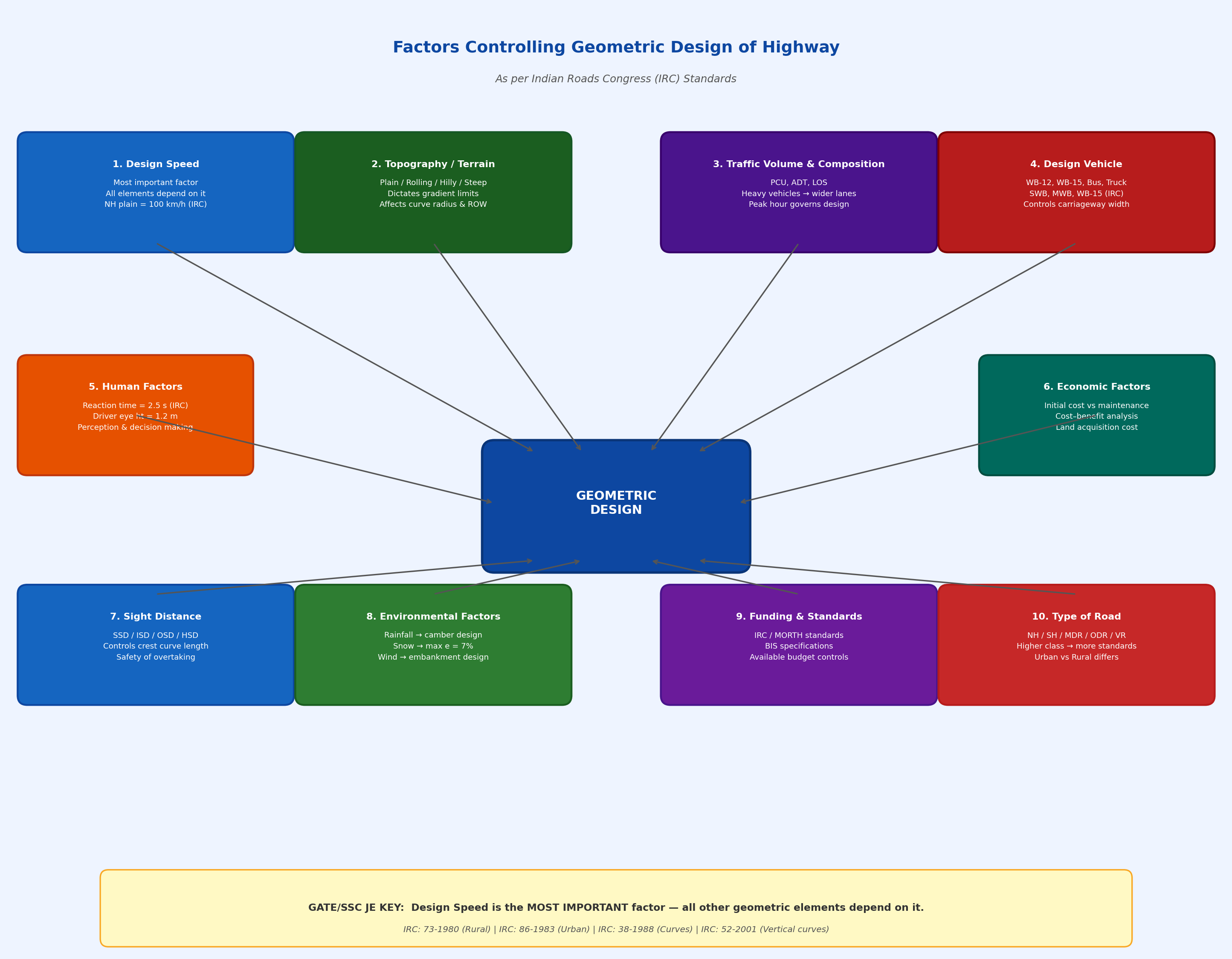
Fig 1: All 10 factors controlling geometric design of highway as per IRC standards — GATE & SSC JE
3. Factor 1 — Design Speed (Most Important Factor)
Design speed is the selected speed used to determine the various geometric design features of a road. It is the maximum safe speed that can be maintained on a section of highway when conditions are so favourable that design features of the road govern.
Why is it the most important factor? Because every single geometric element depends on it:
- Higher design speed → Longer sight distance required (SSD increases)
- Higher design speed → Larger minimum curve radius needed (Rmin increases)
- Higher design speed → Longer transition curves needed
- Higher design speed → Longer vertical curves (summit and valley) needed
- Higher design speed → Flatter ruling gradient needed
Design Speed Values as per IRC: 73-1980
| Road Classification | Terrain | Ruling Design Speed (km/h) | Minimum Design Speed (km/h) | Absolute Minimum (km/h) |
|---|---|---|---|---|
| National Highway (NH) | Plain | 100 | 80 | 60 |
| NH | Rolling | 80 | 65 | 50 |
| NH | Hilly | 50 | 40 | 30 |
| NH | Steep | 40 | 30 | 20 |
| State Highway (SH) | Plain | 80 | 65 | 50 |
| SH | Rolling | 65 | 50 | 40 |
| Major District Road (MDR) | Plain | 65 | 50 | 40 |
| MDR | Rolling | 50 | 40 | 30 |
| Other District Road (ODR) | Plain | 50 | 40 | 25 |
| Village Road (VR) | Plain | 40 | 30 | 20 |
4. Factor 2 — Topography and Terrain Type
The physical features of the land through which the road passes — hills, valleys, plains — directly control the alignment, gradient, curve design, and cost of the road. A road in hilly terrain will always have sharper curves and steeper gradients than the same class of road in plain terrain.
| Terrain Type | Cross Slope of Country | Effect on Ruling Gradient | Effect on Curve Radius |
|---|---|---|---|
| Plain | 0 to 10% | Flat gradient (3.3% for NH) | Large radius (360 m for 100 km/h) |
| Rolling | 10 to 25% | Moderate gradient (5% for NH) | Moderate radius |
| Hilly | 25 to 60% | Steep gradient (6% for NH) | Smaller radius allowed |
| Steep / Mountainous | Above 60% | Max gradient (7% for NH) | Minimum radius used |
Topography also affects the Right of Way (ROW) — in hilly terrain, less land is available and ROW is reduced from 45 m (plain) to 24 m (hilly) for National Highways.
5. Factor 3 — Traffic Volume and Composition
The volume and type of traffic using the road determines the number of lanes, lane width, shoulder width, and level of service (LOS) required. A road with high heavy vehicle percentage needs a flatter gradient because trucks lose speed on steep grades.
Key Traffic Parameters and Their Effect
| Traffic Parameter | Definition | Effect on Geometric Design |
|---|---|---|
| ADT / AADT | Average Daily Traffic (vehicles/day) | Determines number of lanes needed |
| PCU | Passenger Car Unit (traffic equivalence) | Used for capacity and lane width design |
| Design Hourly Volume | 30th highest hourly volume of the year | Used for peak hour capacity design |
| Heavy Vehicle % | Trucks, buses as % of total traffic | Above 15% → flatter gradient needed |
| Level of Service (LOS) | Quality of traffic flow (A to F) | LOS C or D is design standard for IRC |
| Mixed traffic | Bullock carts, cycles, NMVs | Wider shoulder, lower design speed |
6. Factor 4 — Design Vehicle
A design vehicle is a selected motor vehicle whose weight, dimensions, and operating characteristics are used to establish highway design controls. The road is designed to safely accommodate this vehicle at the design speed.
IRC Standard Design Vehicles
| Design Vehicle Class | Overall Length | Width | Min Turning Radius | Used For |
|---|---|---|---|---|
| Passenger Car (P) | 5.8 m | 2.1 m | 7.3 m | Urban roads, basic design |
| Single Unit Bus (SU) | 12.0 m | 2.6 m | 12.8 m | Urban and rural roads |
| SWB Truck | 7.8 m | 2.4 m | 8.7 m | Rural / ODR design |
| WB-12 (2-axle truck) | 12.0 m | 2.6 m | 12.8 m | NH and SH design |
| WB-15 (Semi-trailer) | 15.0 m | 2.6 m | 13.7 m | Expressway and NH |
How Design Vehicle Affects Geometric Design
- Carriageway width — must be wide enough for the design vehicle with clearances
- Minimum curve radius — must allow the design vehicle to negotiate at design speed
- Turning radius at intersections — kerb radius must match vehicle turning radius
- Sight distance — driver eye height depends on vehicle type
- Vertical clearance — bridges must have minimum clearance for vehicle height
7. Factor 5 — Human Factors
Human factors are the physical and psychological characteristics of drivers that affect their ability to control a vehicle safely on the road. IRC has fixed specific values for human factors that are used in all design calculations.
IRC Fixed Values for Human Factors
| Human Factor | IRC Value | IRC Code | Used In |
|---|---|---|---|
| Total reaction time | 2.5 seconds | IRC: 66 | SSD formula |
| Driver eye height | 1.2 m | IRC: 52 | Summit curve (SSD) |
| Object height (SSD) | 0.15 m | IRC: 52 | Summit curve design |
| Head light height | 0.75 m | IRC: 52 | Valley curve (HSD) |
| Beam inclination | 1 degree | IRC: 52 | Valley curve design |
| Lateral friction (f) | 0.15 | IRC: 38 | Superelevation formula |
| Longitudinal friction (f) | 0.35 to 0.37 | IRC: 66 | SSD formula |
Components of Reaction Time (2.5 seconds)
- Perception time — Time to see the hazard and understand it (~1.5 seconds)
- Brake reaction time — Time to move foot to brake and apply pressure (~1.0 second)
- Total = 2.5 seconds — This is the PIEV time (Perception, Identification, Emotion, Volition)
8. Factor 6 — Economic Factors
The available budget for a road project directly influences the design standards that can be adopted. In developing countries like India, economic constraints often require designers to adopt minimum design standards for lower-category roads while maintaining safety.
Economic Criteria for Geometric Design
| Economic Factor | Design Criterion | Impact on Geometric Design |
|---|---|---|
| Initial construction cost | Land acquisition + earthwork + structure cost | Forces use of limiting rather than ruling gradient to reduce cuttings |
| Maintenance cost | Pavement life, drainage efficiency | Good camber and drainage reduce long-term cost |
| Cost–benefit analysis | Vehicle operating cost (VOC) savings | Justifies higher design standards on high-traffic corridors |
| Land acquisition cost | High in urban areas | Urban roads have lower ROW and flatter curves |
| Phased development | Two-lane now, four-lane later | ROW is reserved for future expansion |
9. Factor 7 — Sight Distance Requirements
Sight distance is both a design output and a controlling factor for geometric design. The minimum sight distance that must be available on any section of road controls:
- Summit curve length — SSD governs the minimum length of crest vertical curves
- Valley curve length — HSD governs the minimum length of sag vertical curves
- Horizontal curve design — Sight line must be clear of obstructions within the curve
- Median width — Must not block sight distance on divided highways
- Overtaking zones — Must have sufficient OSD available for safe overtaking
OSD = d₁ + d₂ + d₃ + d₄ — Controls overtaking zones on two-way roads
10. Factor 8 — Environmental Factors
The local climate, geography, and ecological sensitivity of the region all influence specific geometric design decisions.
| Environmental Factor | IRC Design Criterion | Geometric Design Impact |
|---|---|---|
| Rainfall (high) | Higher camber needed for drainage | Earth road camber up to 5%, camber increased in waterlogged areas |
| Snow / ice | Max superelevation = 7% (limited) | Cannot bank too steeply — stationary vehicle slides on ice |
| Desert / dry areas | Min camber acceptable | Lower drainage requirement reduces camber |
| Forest areas | Alignment must avoid forest | Road curved around protected forest land |
| Earthquake zones | Special embankment design | Slope angles modified for stability |
| Coastal areas | Higher embankment | Road raised above flood level |
11. Factor 9 — Funding and Standards
The type of funding (central government NH, state government SH, local body rural road) determines which IRC standard applies and what level of design is mandatory. MORTH (Ministry of Road Transport and Highways) specifications govern NH design, while state PWDs govern SH and MDR design.
IRC Standards by Road Funding Type
| Funding Source | Road Type | Applicable IRC Standard | Design Level |
|---|---|---|---|
| Central Govt (MORTH) | National Highway | IRC: 73 + IRC: 38 + IRC: 52 | Highest — ruling speed 100 km/h |
| State Govt (PWD) | State Highway | IRC: 73 | High — ruling speed 80 km/h |
| District / Panchayat | MDR / ODR | IRC: 73 / SP: 43 | Moderate — ruling 50-65 km/h |
| PMGSY / Rural funds | Village Roads | SP: 20 (Rural Roads Manual) | Basic — ruling speed 40 km/h |
12. Factor 10 — Type and Class of Road
The classification of the road — whether it is a National Highway, State Highway, MDR, ODR, or Village Road — directly sets the design standards. A higher-class road must meet stricter geometric design requirements.
| Road Class | Design Speed (Plain) | Carriageway Width | ROW (Plain) | Ruling Gradient |
|---|---|---|---|---|
| NH (Expressway) | 120 km/h | 2 × 7.5 m | 60 m | 2.5% |
| NH (2-lane) | 100 km/h | 7.0 m | 45 m | 3.3% |
| SH | 80 km/h | 7.0 m | 25 m | 3.3% |
| MDR | 65 km/h | 5.5 m | 15 m | 5% |
| ODR | 50 km/h | 3.75 m | 12 m | 5% |
| Village Road | 40 km/h | 3.0 m | 9 m | 6% |
13. How Design Speed Controls Every Geometric Element
Design speed is the master factor in geometric design. The diagram below shows exactly how a change in design speed affects every other geometric design element. When design speed increases, almost everything becomes larger and more demanding.
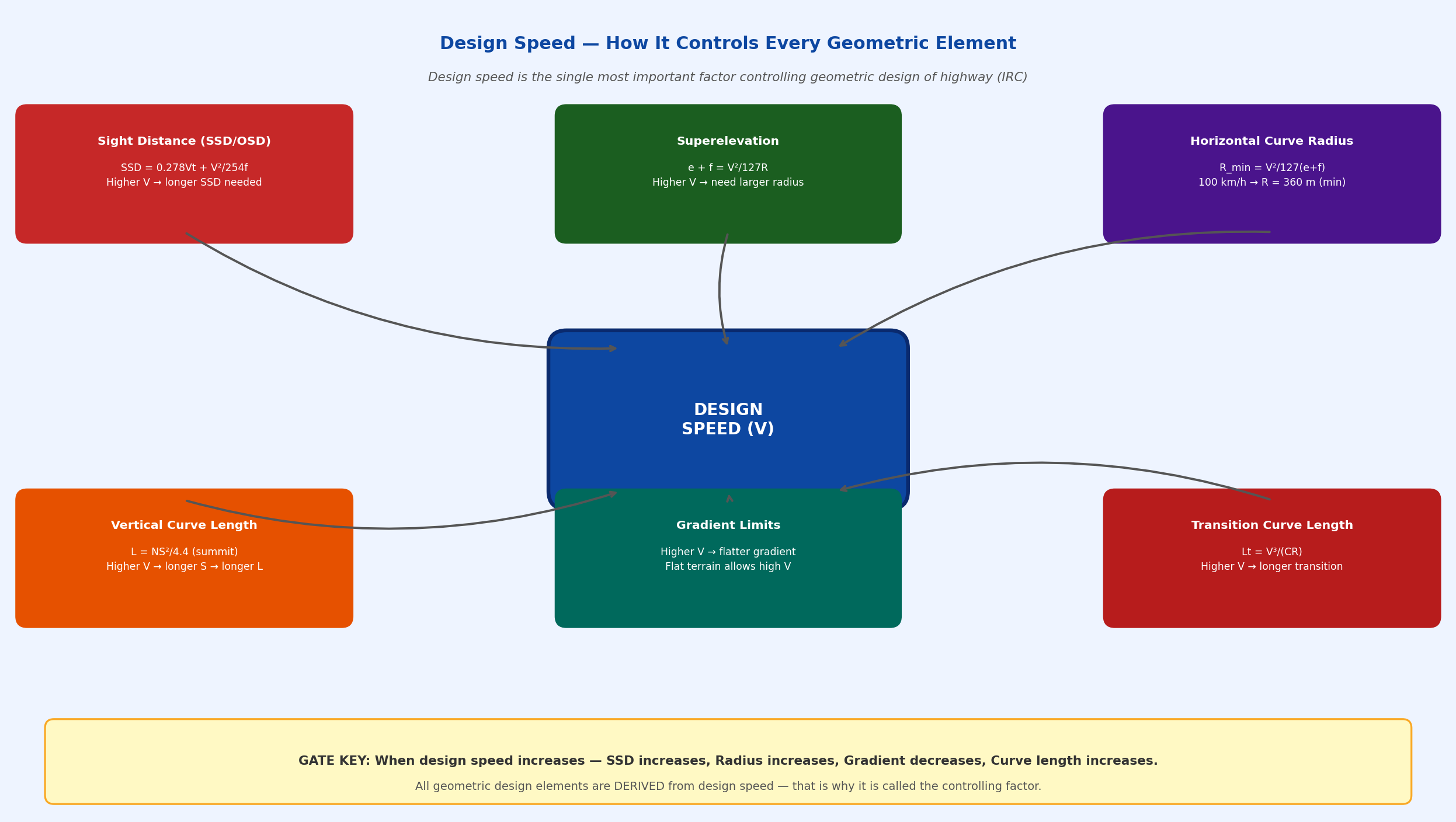
Fig 2: Design speed is the most important factor — all geometric elements are derived from it (IRC)
- Design speed increases → SSD increases (SSD = 0.278Vt + V²/254f)
- Design speed increases → Minimum radius increases (R = V²/127(e+f))
- Design speed increases → Gradient decreases (flatter road needed)
- Design speed increases → Vertical curve longer (L = NS²/4.4 or 9.6)
- Design speed increases → Transition curve longer (Lt = V³/CR)
14. Detailed Criteria for Each Factor — Panel Diagram
The diagram below shows the detailed IRC criteria for the six most important factors controlling geometric design of highway. Each panel shows the specific values and their design impact — exactly what you need for GATE and SSC JE.
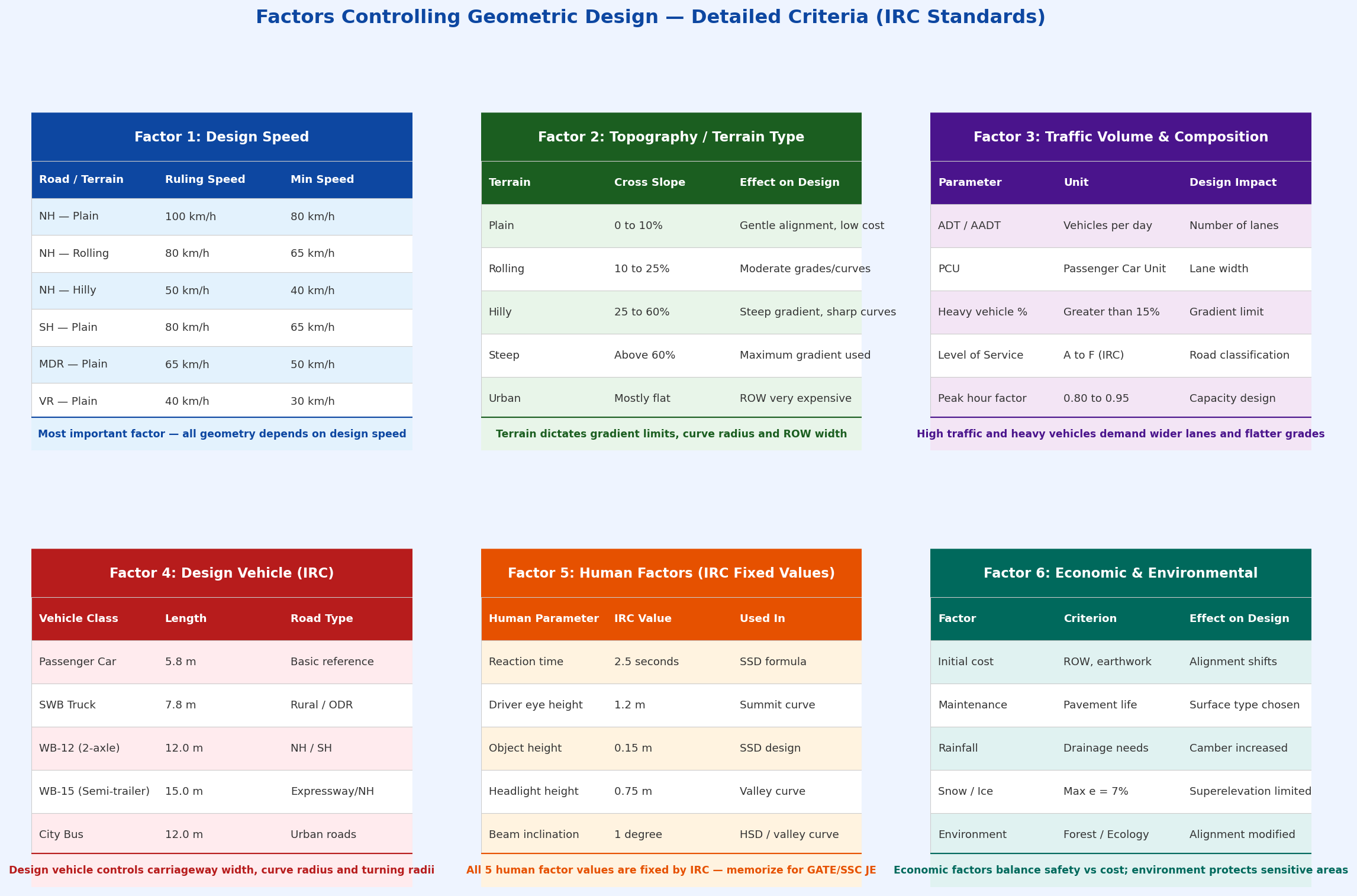
Fig 3: Detailed criteria and IRC values for all 6 major factors controlling geometric design of highway
15. Keywords / Glossary
geometric design of highway
design speed
ruling design speed
topography
terrain type
traffic volume
design vehicle
WB-12
WB-15
human factors
PIEV time
reaction time 2.5 seconds
driver eye height 1.2m
economic factors highway
sight distance
environmental factors
IRC 73
IRC 38
IRC 52
level of service
PCU
ADT
MORTH
GATE highway engineering
SSC JE highway
factors affecting highway design
IRC standards geometric design
16. FAQs for GATE & SSC JE
🌟 Must-Remember — Factors Controlling Geometric Design of Highway (GATE & SSC JE)
- Most important factor: Design Speed — all elements derived from it
- Design speed: NH plain = 100 km/h, SH = 80, MDR = 65, ODR = 50, VR = 40
- PIEV time (reaction time) = 2.5 seconds (IRC: 66) — Perception + Identification + Emotion + Volition
- Human factors: Eye ht = 1.2 m, Object = 0.15 m, Headlight = 0.75 m, Beam = 1 deg
- Terrain: Plain = 0–10%, Rolling = 10–25%, Hilly = 25–60%, Steep = above 60% cross slope
- Heavy vehicles above 15% → use flatter gradient or provide climbing lane
- Design vehicle for NH: WB-12 (12 m), Expressway: WB-15 (15 m)
- Lateral friction f = 0.15 (IRC: 38) | Longitudinal friction f = 0.35–0.37
- Max superelevation in snow-bound areas: 7% (environment factor limits it)
- ROW NH plain = 45 m, hilly = 24 m (terrain factor controls it)
- LOS C = IRC design standard for road capacity
- Higher design speed → larger SSD, larger radius, flatter gradient, longer curves
- Economic factors: use limiting gradient to reduce earthwork cost
- IRC: 73 = rural geometric design | IRC: 86 = urban geometric design