Cement Composition and Hydration: A Student-Friendly Guide
Raw Materials of Cement
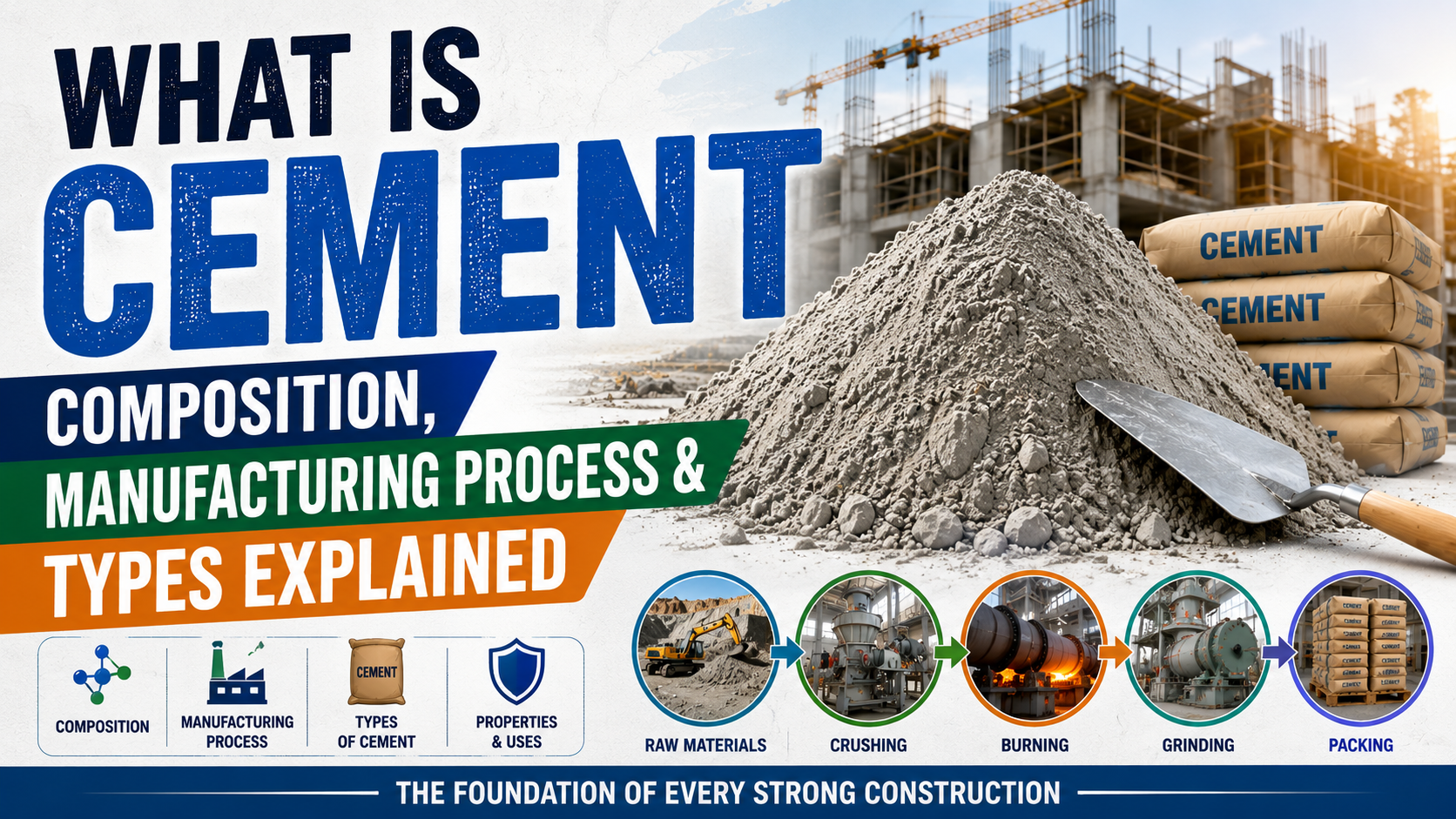
Ordinary Portland Cement (OPC) — the most common type of cement used in India — is manufactured by burning a mixture of calcareous materials (limestone, chalk) and argillaceous materials (clay, shale) at approximately 1400–1500°C in a rotary kiln. The product that comes out is called clinker. Clinker is then ground with about 3–5% gypsum to get the final cement powder.
But why gypsum? Without gypsum, cement would set so rapidly after adding water that you wouldn’t have time to mix and place the concrete. Gypsum reacts with C₃A to form ettringite, which slows down the initial set and gives you workable time — typically 30–600 minutes of initial setting time as per IS 269:2015.
Oxide Composition of OPC
When we analyze cement chemically, we express it in terms of oxide percentages. Here’s what you’ll typically find in OPC (33/43/53 grade):
| Oxide | Symbol | Typical % in OPC | Role |
|---|---|---|---|
| Lime | CaO | 60–67% | Main strength-giving component |
| Silica | SiO₂ | 17–25% | Forms C-S-H gel; gives strength |
| Alumina | Al₂O₃ | 3–8% | Flash set; controls initial rate |
| Iron Oxide | Fe₂O₃ | 0.5–6% | Gives grey colour; low heat |
| Magnesia | MgO | <5% | Unsoundness if >5% (free MgO) |
| Sulphur Trioxide | SO₃ | <2.5% | Controls setting (from gypsum) |
The cement chemist’s notation simplifies oxide names: CaO = C, SiO₂ = S, Al₂O₃ = A, Fe₂O₃ = F, H₂O = H. So Calcium Silicate Hydrate becomes C-S-H. This notation is used throughout cement chemistry.
Bogue’s Compounds (The Heart of Cement Chemistry)
R.H. Bogue calculated the approximate compound composition of Portland cement clinker from its oxide analysis. These four compounds, called Bogue’s Compounds, are the foundation of understanding cement’s behavior:
1. Tricalcium Silicate – C₃S (Alite)
Present in 40–65% of OPC. C₃S is the most important compound — it is responsible for early strength development (particularly in the first 1–28 days). The heat of hydration of C₃S is about 500 J/g. High C₃S content = high early strength = higher grade cement (OPC 53 grade has more C₃S than 33 grade).
2. Dicalcium Silicate – C₂S (Belite)
Present in 15–35%. C₂S hydrates slowly and contributes to long-term strength (beyond 28 days, even up to years). Heat of hydration is only ~260 J/g, making it desirable in mass concrete where heat buildup is a concern. Low Heat Cement has high C₂S content.
3. Tricalcium Aluminate – C₃A
Present in 5–15%. C₃A hydrates extremely rapidly and generates a lot of heat (~865 J/g). Without gypsum, C₃A would cause flash setting within minutes. C₃A also makes concrete vulnerable to sulphate attack — sulphate-resistant cement (SRC) has C₃A < 5%.
4. Tetracalcium Aluminoferrite – C₄AF (Ferrite Phase)
Present in 6–18%. C₄AF contributes little to strength but gives cement its grey colour. It generates low heat of hydration (~420 J/g) and has moderate reactivity. In white cement, C₄AF is minimized (nearly zero iron oxide) to achieve white color.
Hydration of Cement
Hydration is the chemical reaction between cement and water that produces hardened concrete. It’s not just cement “drying” — it’s a complex series of exothermic chemical reactions that create new compounds responsible for strength. Let’s go through the key reactions:
Hydration of C₃S
2C₃S + 6H₂O → C₃S₂H₃ (CSH gel) + 3Ca(OH)₂
This produces Calcium Silicate Hydrate (CSH) gel — the primary strength-giving product — and calcium hydroxide (Ca(OH)₂ or portlandite). About 60–65% of the hydrated paste is CSH gel.
Hydration of C₂S
2C₂S + 4H₂O → C₃S₂H₃ (CSH gel) + Ca(OH)₂
Same products as C₃S but reaction is much slower and less Ca(OH)₂ is produced.
Hydration of C₃A (in presence of gypsum)
C₃A + 3CaSO₄·2H₂O + 26H₂O → 3CaO·Al₂O₃·3CaSO₄·32H₂O (Ettringite)
Ettringite forms a protective layer around C₃A grains, slowing down further hydration and preventing flash set. This is the role of gypsum!
CSH Gel and Its Importance
Calcium Silicate Hydrate (C-S-H) gel is the backbone of concrete’s strength. It is a nano-scale, poorly crystalline material that forms an interlocking network of fibers and sheets, binding cement particles together and filling pores. The strength of concrete is directly proportional to the amount and quality of C-S-H gel formed.
The other major hydration product, Ca(OH)₂ (calcium hydroxide or portlandite), is not particularly helpful — it has low strength, is soluble in soft water (leading to leaching), and makes concrete vulnerable to carbonation and sulphate attack. This is why supplementary cementitious materials like silica fume, which react with Ca(OH)₂ to form more C-S-H gel (pozzolanic reaction), improve concrete quality dramatically.
Heat of Hydration
The hydration reactions are exothermic — they release heat. In thin structural members, this heat dissipates quickly and poses no problem. But in mass concrete structures (like dams, large foundations, piers), the heat cannot escape fast enough. The core temperature rises while the surface cools, creating thermal gradients that cause cracking.
Typical heat evolution (cumulative, 7 days): OPC ~335 J/g, Low Heat Cement ~250 J/g. The order of heat contribution: C₃A > C₃S > C₄AF > C₂S.
Solutions for mass concrete: use Low Heat Portland Cement (IS 12600), replace cement with fly ash/GGBS, use ice or chilled water for mixing, and pre-cool aggregates.
Setting vs Hardening of Cement
Setting refers to the stiffening of the cement paste — it transitions from a fluid to a rigid state. Initial set marks the point after which you can no longer effectively work the concrete. Final set marks complete rigidity. As per IS 269, initial setting time > 30 minutes, final setting time < 600 minutes for OPC.
Hardening is the development of strength after setting — it continues for months and years as hydration progresses. These are distinct processes: a cement can set quickly but gain strength slowly (high C₃A, low C₃S scenario).
🎯 Exam Tips (RTMNU)
- Always write Bogue’s compounds with both chemical formula AND abbreviated notation (C₃S, C₂S, C₃A, C₄AF).
- The hydration equation of C₃S (producing CSH gel and Ca(OH)₂) is frequently asked — memorize it.
- Remember: C₃A has HIGHEST heat of hydration (~865 J/g); C₂S has LOWEST (~260 J/g).
- Flash set is prevented by gypsum through ettringite formation — this mechanism is often a 5-mark question.
- Know the IS 269:2015 initial and final setting time limits for OPC (≥30 min, ≤600 min).
- Distinguish between “setting” and “hardening” — commonly confused in exams.
✅ Key Takeaways
- OPC clinker contains four major Bogue compounds: C₃S, C₂S, C₃A, and C₄AF.
- C₃S = early strength; C₂S = late strength; C₃A = rapid hydration (flash set risk); C₄AF = colour + low heat.
- Gypsum is added (~3–5%) to prevent flash set by forming ettringite over C₃A.
- CSH gel is the primary strength product of hydration; Ca(OH)₂ is a weak byproduct.
- Heat of hydration is a concern in mass concrete; Low Heat Cement (high C₂S) is the solution.
- Initial setting time ≥ 30 min, Final setting time ≤ 600 min (IS 269).
📖 Related Reading: Types of Cement and Their Applications | Water-Cement Ratio and Concrete Strength
🔗 External Reference: IS 269:2015 – Ordinary Portland Cement Specification (BIS)
❓ FAQs
Q1. What are Bogue’s compounds and why are they important?
Bogue’s compounds are the four major mineral phases formed during cement clinker manufacture: C₃S, C₂S, C₃A, and C₄AF. They determine the rate of strength gain, heat of hydration, setting behavior, and chemical resistance of cement.
Q2. Why is gypsum added to cement?
Gypsum (3–5% by weight) is added to OPC to control flash setting. It reacts with C₃A to form ettringite, which coats C₃A particles and retards their rapid hydration, giving a workable initial setting time of at least 30 minutes.
Q3. What is CSH gel?
Calcium Silicate Hydrate (C-S-H) gel is the main product of cement hydration (from C₃S and C₂S). It is a nano-porous, poorly crystalline material that forms an interlocking network constituting 60–65% of hydrated cement paste and is responsible for concrete’s compressive strength.
Q4. Which Bogue compound has the highest heat of hydration?
C₃A (Tricalcium Aluminate) has the highest heat of hydration at approximately 865 J/g. The order is: C₃A > C₃S (~500 J/g) > C₄AF (~420 J/g) > C₂S (~260 J/g).
Q5. What is the difference between setting and hardening of cement?
Setting is the process of stiffening of fresh cement paste (initial set ≥30 min; final set ≤600 min as per IS 269). Hardening is the subsequent development of mechanical strength after setting, which continues for months and years due to ongoing hydration reactions.