📋 Table of Contents
🔷 What is Core Cutting Test?
The Core Cutting Test (also called Core Drilling Test) is a semi-destructive test in which a cylindrical sample of concrete — called a core — is drilled from a hardened concrete structure using a diamond-tipped core drill. The extracted core is then tested in compression to determine the actual in-situ compressive strength of the concrete.
The test is governed by IS 516 Part 4 in India and BS EN 12504-1:2019 internationally. It is the most reliable method of determining the actual strength of concrete in an existing structure — far more accurate than NDT methods like Rebound Hammer or UPV.
❓ When is Core Test Required?
- When 28-day cube test results fail to meet the characteristic strength requirement (IS 456 Cl. 17.4)
- When there is doubt about the quality of concrete placed (improper compaction, segregation suspected)
- For investigation of distressed or damaged structures (earthquake, fire, overloading)
- For assessment of existing structures whose original construction records are not available
- In legal disputes over structural adequacy of concrete
- For bridges, dams, and critical infrastructure — periodic condition assessment
🔧 Equipment Used for Core Cutting
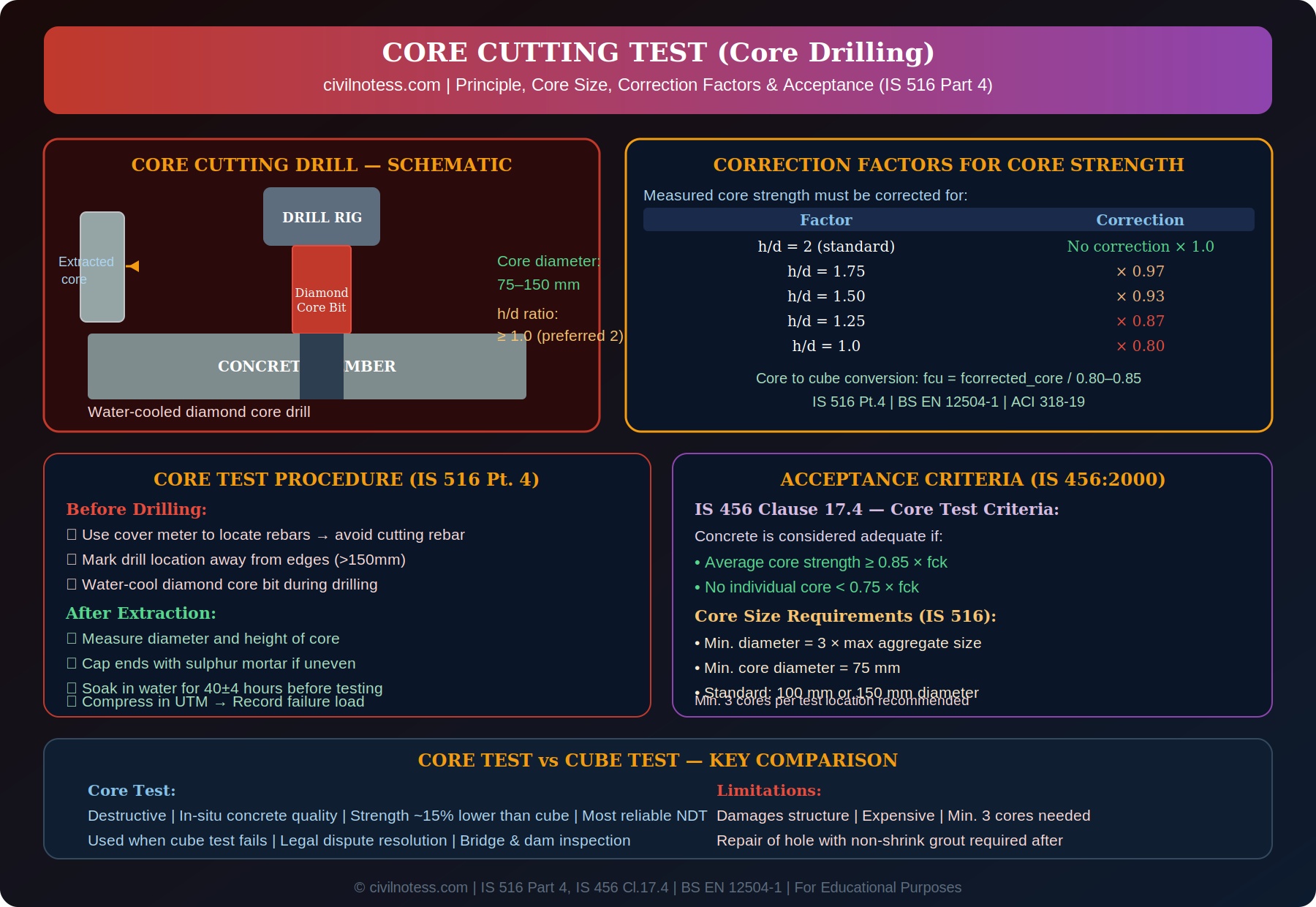
- Diamond core drill rig: Electric or hydraulic powered, with vacuum plate or anchor bolt for fixing to concrete surface. Rotary cutting action with water cooling.
- Diamond core bit: Hollow cylindrical drill bit with industrial diamond segments on the cutting edge. Available in 50mm, 75mm, 100mm, 150mm diameters.
- Cover meter: Used before drilling to locate rebar positions and avoid cutting through reinforcement.
- Water supply: Continuous water flow to cool the drill bit and flush out cuttings.
- Compression testing machine (UTM): For compressive testing of the extracted core.
- Sulphur capping compound or grinding machine: For capping uneven core ends.
🔬 Test Procedure (IS 516 Part 4)
Before Drilling:
- Use a cover meter to locate reinforcing bars. Mark bar positions on the concrete surface. Select core locations to avoid cutting through bars.
- Core location must be at least 150mm from edges, construction joints, or zones of high bending moment.
- Mark the drill centre accurately.
Drilling:
- Fix the drill rig to the concrete surface (vacuum plate or anchor bolt). Ensure rig is perpendicular to the concrete surface.
- Start drilling with continuous water cooling to prevent diamond bit overheating.
- Drill to the required depth — typically the full member thickness.
- Extract the core carefully — avoid damage to the core during extraction.
Preparation & Testing:
- Measure core diameter (d) at 3 positions and length (h) — record all dimensions.
- If core ends are uneven (due to rebar cut or rough break), cap with sulphur mortar (IS 9013) to ensure flat, parallel ends.
- Immerse cores in water for 40 ± 4 hours before testing (to achieve saturated surface dry condition).
- Test in compression at a loading rate of 140 kg/cm²/min as per IS 516.
- Record failure load and calculate strength.
📐 h/d Correction Factors for Core Strength
The standard test specimen for concrete compression is a cylinder with h/d = 2.0. Cores with different h/d ratios give different strength values and must be corrected:
| h/d Ratio | Correction Factor | Note |
|---|---|---|
| 2.0 (Standard) | 1.00 (no correction) | Standard cylinder — no correction needed |
| 1.75 | 0.97 | Multiply measured core strength by 0.97 |
| 1.50 | 0.93 | Platens confine specimen more → apparent higher strength |
| 1.25 | 0.87 | Significant confinement effect |
| 1.00 | 0.80 | Maximum correction — do not use h/d < 1.0 |
💡 Core Strength to Cube Strength Conversion
In India, design is based on 150mm cube strength (fck). Core strength is measured on cylinders. The equivalent cube strength is obtained by dividing the corrected core cylinder strength by a conversion factor:
f_cube ≈ f_core(corrected) / (0.80 to 0.85)
This is because cylinders give approximately 80–85% of cube strength for the same concrete (due to shape factor and end restraint effects).
Example: If corrected core strength = 25 MPa → equivalent cube strength = 25 / 0.83 = 30 MPa.
✅ Acceptance Criteria — IS 456:2000 Clause 17.4
IS 456 gives clear, numeric acceptance criteria for core test results:
- Condition 1: The average equivalent cube strength of cores (corrected for h/d and converted to cube equivalent) must be ≥ 0.85 × fck (85% of characteristic strength).
- Condition 2: No individual core must have an equivalent cube strength < 0.75 × fck (75% of characteristic strength).
- If both conditions are satisfied → concrete is acceptable
- If conditions are not met → load test (IS 456 Cl. 17.6) or structural intervention required
Core test acceptance: Average ≥ 0.85 fck AND each core ≥ 0.75 fck
Minimum cores: 3 cores from each area of concern
Core diameter minimum: 3 × maximum aggregate size (never < 75mm)
⚖️ Core Strength vs Cube Strength
| Parameter | Core Test | Standard Cube Test |
|---|---|---|
| Specimen | Drilled cylinder from structure | 150mm cast cube |
| Concrete tested | Actual in-situ concrete | Freshly cast, separately cured |
| Strength obtained | ~80–85% of equivalent cube | Reference cube strength (fck) |
| IS code | IS 516 Part 4 | IS 516 |
| Nature of test | Semi-destructive | Destructive (separate specimen) |
| When done | When cube test fails; existing structures | During construction (every pour) |
| Repair of hole | Yes — non-shrink grout required | Not applicable |
❓ Exam FAQs — Core Cutting Test
Q1. What is the minimum diameter of core to be cut as per IS 516?
The minimum core diameter should be 3 times the maximum aggregate size used in the concrete, with an absolute minimum of 75mm. Standard practice uses 100mm or 150mm diameter cores.
Q2. What are the acceptance criteria for core tests as per IS 456?
As per IS 456:2000 Clause 17.4: The average equivalent cube strength of cores must be ≥ 0.85 fck, AND no individual core should have equivalent cube strength < 0.75 fck.
Q3. Why is a correction factor applied to core strength based on h/d ratio?
The h/d ratio of a core affects the measured strength due to end restraint (platen friction) effects. Shorter specimens (lower h/d) have more of their volume near the loading platens where lateral confinement from friction increases apparent strength. The correction factors reduce this apparent higher strength to the equivalent of a standard h/d = 2.0 cylinder.
Q4. Why is core strength lower than cube strength?
Several reasons: (a) Cores are cylinders (h/d = 2) which give lower strength than cubes (shape factor); (b) In-situ concrete may have been compacted less uniformly than lab cubes; (c) Curing conditions in the structure differ from standard lab curing of cubes; (d) The drilling process may cause minor damage to the core.
📝 Quick Summary — Core Cutting Test
- Semi-destructive test — drilled core tested in compression (IS 516 Pt.4)
- Min. diameter: 3 × max. agg. size | min. 75mm | standard: 100–150mm
- h/d correction: h/d=2 → ×1.0 | h/d=1.5 → ×0.93 | h/d=1.0 → ×0.80
- Core to cube: f_cube ≈ f_core / 0.80–0.85
- IS 456 Cl.17.4 acceptance: avg ≥ 0.85fck AND min ≥ 0.75fck
- Minimum 3 cores per suspected zone
- Required when cube tests fail; existing structure assessment