
📋 Table of Contents
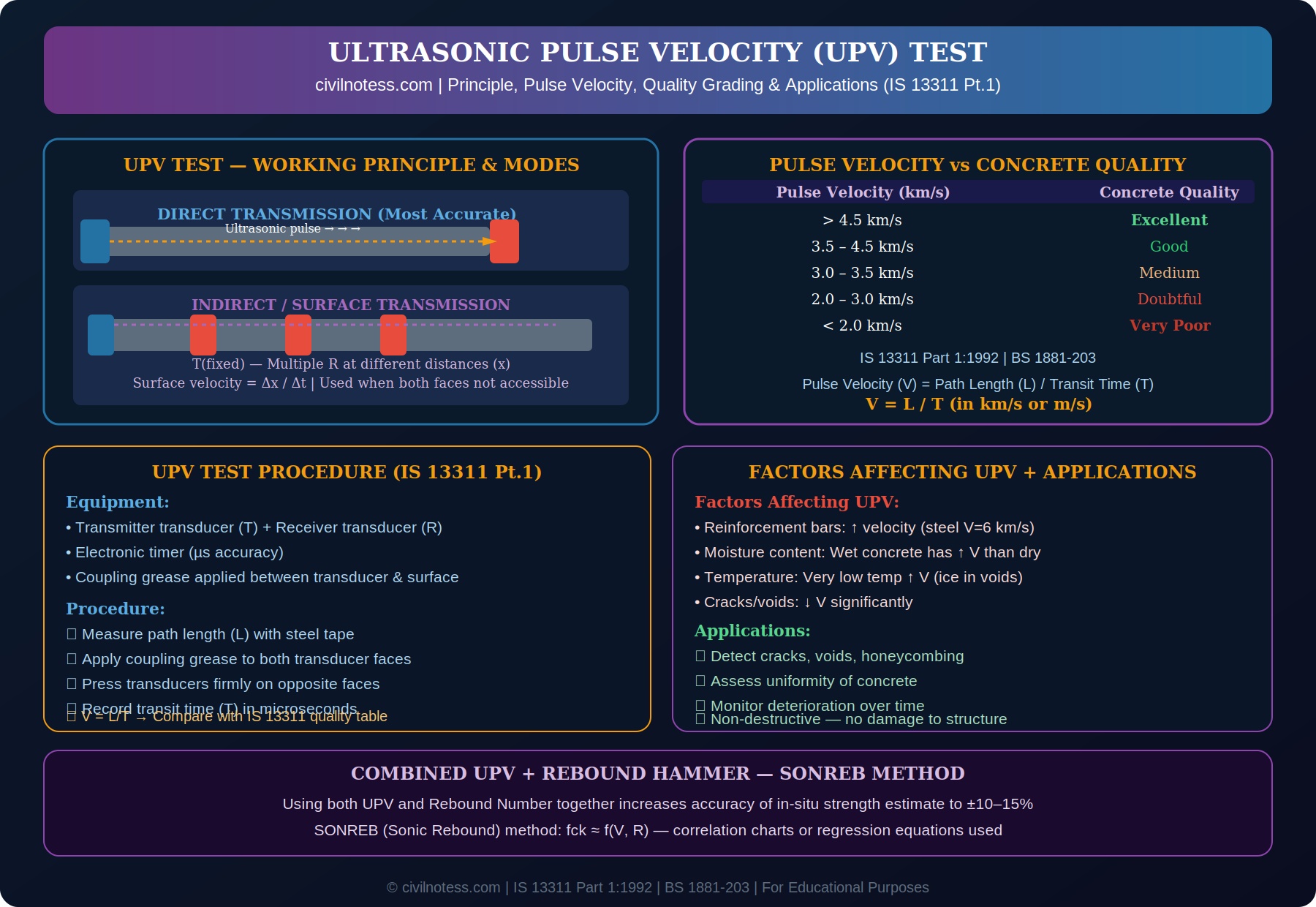
🔷 What is the Ultrasonic Pulse Velocity (UPV) Test?
The Ultrasonic Pulse Velocity (UPV) Test is a non-destructive test (NDT) that measures the velocity of longitudinal (compressional) ultrasonic pulses travelling through concrete. It is governed by IS 13311 Part 1:1992 in India and BS EN 12504-4 internationally.
The UPV test is used to:
- Assess the quality and uniformity of concrete in structures
- Detect the presence of internal cracks, voids, and honeycombing
- Monitor the progression of deterioration over time
- Estimate compressive strength (with calibration)
⚙️ Working Principle
The UPV test works on the principle that the velocity of ultrasonic waves through concrete depends on its elastic properties and density:
The relationship between pulse velocity and elastic properties:
Key physics: In denser, void-free, homogeneous concrete, the pulse travels faster. In concrete with voids, cracks, or honeycombing, the pulse must travel around defects → longer path → lower measured velocity.
📡 Three Transmission Modes
- 1. Direct Transmission: Transmitter (T) and Receiver (R) placed on opposite faces of the member. Most accurate — pulse travels through the full cross-section. Used when both faces are accessible (slabs, beams, columns).
- 2. Indirect (Surface) Transmission: Both transducers placed on the same face at different distances (x₁, x₂, x₃…). Pulse travels along the surface. Used when only one face is accessible (slabs on grade, walls). Less accurate — surface velocity only.
- 3. Semi-Direct Transmission: Transducers placed on adjacent faces at an angle. Intermediate accuracy. Used for corner sections.
💡 Why Direct Transmission is Most Accurate
In direct transmission, the pulse travels through the full depth of the concrete — measuring true bulk properties. In indirect transmission, the pulse travels mostly near the surface layer, which may have different properties (carbonation, drying, surface damage) from the interior. For structural assessment, always use direct transmission where possible.
🔬 Test Procedure (IS 13311 Part 1:1992)
- Equipment: Electronic pulse generator + transmitter transducer + receiver transducer + digital time display (µs precision) + coupling medium (petroleum jelly or special gel).
- Surface preparation: Concrete surface should be smooth. Grind if rough. Mark test grid points at 100–200mm spacing for uniformity mapping.
- Coupling: Apply coupling gel to both transducer faces. This eliminates air gaps which would block ultrasonic transmission.
- Measurement of path length (L): Measure distance between centre points of transducers using a steel tape. Record accurately to ±1mm.
- Transit time (T): Press both transducers firmly onto the concrete surfaces. Read transit time in microseconds (µs) from the digital display.
- Calculation: V = L/T. Convert units: if L in mm and T in µs, V is in km/s.
- Quality assessment: Compare V with IS 13311 Part 1 quality table.
- Repeat readings: Take minimum 2–3 readings per location. Variation > 5% indicates surface coupling problem — reapply gel.
📊 Pulse Velocity vs Concrete Quality (IS 13311 Part 1)
| Pulse Velocity (km/s) | Concrete Quality Assessment |
|---|---|
| > 4.5 km/s | Excellent — Very dense, void-free, high-quality concrete |
| 3.5 – 4.5 km/s | Good — Satisfactory concrete for most applications |
| 3.0 – 3.5 km/s | Medium / Fair — Investigate further, possible voids |
| 2.0 – 3.0 km/s | Doubtful — Poor quality, probable honeycombing or cracking |
| < 2.0 km/s | Very Poor — Severely damaged, cracked, or delaminated concrete |
Reference velocities: Steel ≈ 6.0 km/s | Dense rock ≈ 5.0–6.0 km/s | Good concrete ≈ 4.0–4.5 km/s | Air ≈ 0.34 km/s (ultrasound stops completely — cannot cross air gaps)
⚠️ Factors Affecting UPV Readings
| Factor | Effect on UPV |
|---|---|
| Reinforcement bars in pulse path | ↑ Increases V (steel V = 6 km/s — faster than concrete) |
| Moisture content (wet vs dry) | Wet concrete: ↑ V slightly (water fills pores, conducts better) |
| Temperature (very low / frozen) | ↑ V (ice in pores has higher velocity than water) |
| Cracks or voids in pulse path | ↓↓ Decreases V significantly (pulse must travel around defect) |
| Aggregate type (dense granite vs lightweight) | Granite: ↑ V | Lightweight agg.: ↓ V |
| Mix proportions (higher cement, silica fume) | ↑ V (denser matrix) |
| Path length (longer paths less accurate) | Errors increase with path length > 1.5m |
🔗 SONREB Method — Combined UPV + Rebound Hammer
The SONREB method (Sonic Rebound) combines readings from both the UPV test and Rebound Hammer Test to improve the accuracy of in-situ strength estimation:
- Using UPV alone: Accuracy of strength estimate ≈ ±25%
- Using Rebound Hammer alone: Accuracy ≈ ±15–20%
- Using SONREB (combined V and R): Accuracy improves to ±10–15%
The combined method uses regression equations of the form: fck ≈ f(V, R) — specific equations are determined by calibrating against core tests from the same structure. RILEM (International Union of Laboratories) has published standard SONREB correlation curves.
❓ Exam FAQs — UPV Test
Q1. What is the IS code for UPV Test?
IS 13311 Part 1:1992 — Non-Destructive Testing of Concrete: Methods of Test, Part 1: Ultrasonic Pulse Velocity. (Part 2 covers Rebound Hammer.)
Q2. What is the pulse velocity threshold for good quality concrete as per IS 13311?
Pulse velocity > 4.5 km/s indicates excellent quality concrete. Values between 3.5–4.5 km/s indicate good quality. Below 3.0 km/s, concrete quality is doubtful and further investigation (core tests) is recommended.
Q3. Why does reinforcement affect UPV readings?
Steel has a higher pulse velocity than concrete (≈6 km/s vs 4.0 km/s). When reinforcing bars are in the direct path between transducers, part of the ultrasonic pulse travels along the bars and arrives earlier than expected → the recorded transit time is shorter → calculated velocity appears higher than the actual concrete velocity. This gives a falsely optimistic (higher) UPV reading.
Q4. What is the difference between direct and indirect transmission in UPV test?
In direct transmission, transducers are on opposite faces (most accurate — measures full depth). In indirect transmission, both transducers are on the same face (used when only one face is accessible, but less accurate as it measures only surface layer properties).
📝 Quick Summary — UPV Test
- NDT test — measures pulse velocity through concrete (IS 13311 Pt.1)
- Formula: V = L / T (km/s) | L = path length | T = transit time (µs)
- Quality: >4.5 Excellent | 3.5–4.5 Good | <3.0 Doubtful | <2.0 Very Poor
- 3 modes: Direct (best) | Semi-direct | Indirect (surface)
- Reinforcement bars INCREASE UPV (falsely high) — correction needed
- UPV + Rebound Hammer = SONREB method (accuracy ±10–15%)
- Can detect internal voids/cracks — advantage over Rebound Hammer