📋 Table of Contents
🔷 What is Self Compacting Concrete (SCC)?
Self Compacting Concrete (SCC) — also called Self Consolidating Concrete — is a highly flowable, non-segregating concrete that can flow and compact under its own weight without the need for mechanical vibration. It was developed in Japan in the late 1980s by Professor Hajime Okamura at the University of Tokyo to overcome problems of incomplete consolidation in heavily reinforced structures.
SCC achieves workability through a combination of superplasticizers, viscosity-modifying agents (VMA), and optimized aggregate content. It passes through congested reinforcement, fills complex formwork, and self-levels — all without vibration.
• EFNARC 2002 — European guidelines for SCC (specifications and test methods)
• IS 1199 (Part 6):2018 — Fresh concrete testing including slump flow
• ACI 237R — Self-consolidating concrete guide
🔺 3 Key Fresh Properties of SCC
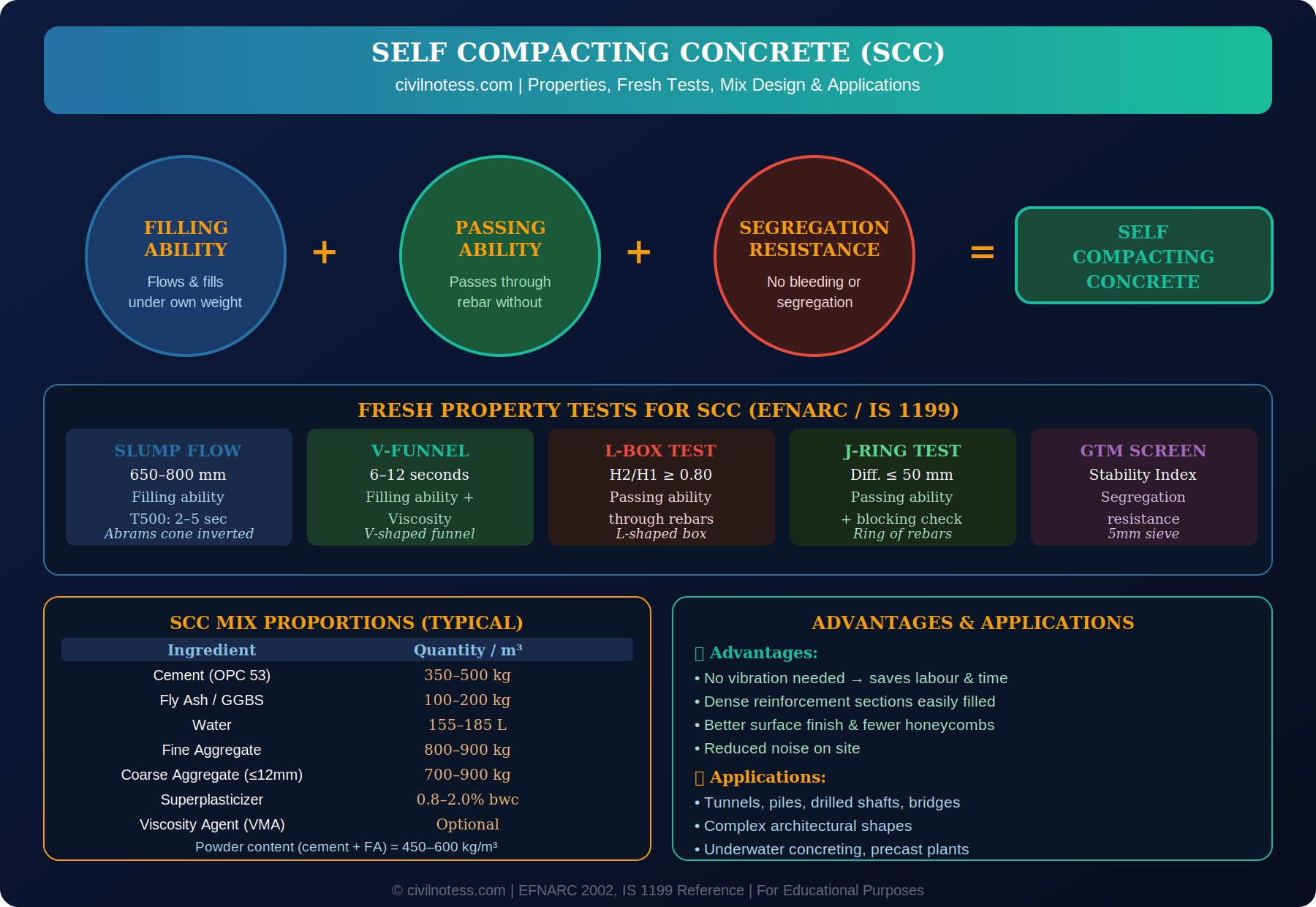
SCC must simultaneously satisfy three essential properties to be classified as self-compacting:
- 1. Filling Ability: The ability of SCC to flow under its own weight and completely fill the formwork, including corners and tight spaces. Measured by Slump Flow Test (target: 650–800mm) and V-Funnel Test.
- 2. Passing Ability: The ability of SCC to pass through narrow gaps between reinforcing bars and other obstacles without blocking or bridging. Measured by L-Box Test (H2/H1 ≥ 0.80) and J-Ring Test.
- 3. Segregation Resistance (Stability): The ability of SCC to remain homogeneous without segregation of aggregate or bleeding of water during flow, transit, and placement. Measured by GTM Screen Stability Test and visual inspection (VSI < 2).
🔬 Fresh Concrete Tests for SCC
| Test Name | Property Measured | Acceptance Criteria | Equipment |
|---|---|---|---|
| Slump Flow Test | Filling ability + fluidity | 650–800 mm; T500: 2–5 sec | Inverted Abrams cone, steel plate |
| V-Funnel Test | Filling ability + viscosity | 6–12 seconds (SF2 class) | V-shaped funnel (10L capacity) |
| L-Box Test | Passing ability through rebars | H2/H1 ≥ 0.80 | L-shaped box with 3 rebar gates |
| J-Ring Test | Passing ability + blocking | Slump flow diff. ≤ 50 mm | Steel ring with vertical bars (16 bars) |
| GTM Screen Test | Segregation resistance | Screen segregation < 15% | 5mm sieve, weighing scale |
| U-Box Test | Filling ability in walls | Height diff. ≤ 30 mm | U-shaped chamber with rebars |
💡 EFNARC SCC Classification (2005)
Slump Flow Classes: SF1 = 550–650mm (normal) | SF2 = 660–750mm (standard) | SF3 = 760–850mm (high flow)
Viscosity Classes: VS1/VF1 = T500 ≤ 2 sec / V-funnel ≤ 8 sec | VS2/VF2 = T500 > 2 sec / V-funnel 9–25 sec
Passing Ability Classes: PA1 = J-ring 10–25mm | PA2 = J-ring ≤ 10mm (high PA)
📐 SCC Mix Design & Proportions
SCC mix design is governed by EFNARC 2002 guidelines and IS 10262:2019. Key differences from conventional concrete mix design:
| Ingredient | SCC Range (per m³) | Comparison: Normal Concrete |
|---|---|---|
| Cement (OPC 53) | 350–500 kg | 300–400 kg |
| Fly Ash / GGBS (SCM) | 100–200 kg | 0–100 kg (optional) |
| Total powder (C+SCM) | 450–600 kg | 300–450 kg |
| Water | 155–185 L | 180–200 L |
| W/P ratio | 0.30–0.40 | 0.45–0.55 |
| Fine Aggregate | 800–900 kg | 700–800 kg (higher FA in SCC) |
| Coarse Aggregate (≤12mm) | 700–900 kg | 1000–1200 kg (less CA in SCC) |
| Superplasticizer | 0.8–2.0% bwc | Not required or 0.2–0.4% |
| Viscosity Modifying Agent | 0.02–0.05% bwc (optional) | Not used |
Key design principle: In SCC, the maximum coarse aggregate content is reduced to ~28–35% by volume (compared to ~40–45% in normal concrete). The increased powder and fine aggregate content is what gives SCC its characteristic flowability and segregation resistance.
🏭 Production & Quality Control
- Mixing: All powder and aggregates are mixed dry first. Water and SP are added together. Extended mixing of 3–4 minutes. VMA added last if used.
- Testing at plant: Slump flow test mandatory for every batch. V-funnel, L-box, and J-ring for characterization tests and during mix trials.
- Transport: Transit mixer at low speed agitation (2–4 rpm). SCC must be placed within 90 minutes of water addition (IS 4926).
- Placement: No vibration. Cast from one point and allow concrete to flow. Pouring height should not cause excessive pressure — check formwork design. Maximum rate of rise: 10–15 m/h.
- Formwork pressure: SCC exerts higher lateral pressure on formwork than conventional concrete. Full hydrostatic pressure must be assumed in design.
🏗️ Applications of SCC
- Tunnels and underground structures: Annular grouting, precast tunnel segments, drilled shafts.
- Bridge columns and piers: Heavily reinforced sections where vibration is impractical.
- High-rise building cores and shear walls: Congested rebar layouts.
- Precast manufacturing plants: Faster casting cycles, better surface finish, reduced labor.
- Complex architectural concrete: Curved surfaces, intricate formwork.
- Underwater concreting: Where vibration is impossible.
- Retrofit and repair: Filling jackets around existing columns.
❓ Exam FAQs — SCC
Q1. What are the 3 essential properties of SCC?
Filling ability, Passing ability, and Segregation resistance — all three must be satisfied simultaneously for SCC to function properly.
Q2. What is the acceptance criteria for the Slump Flow Test of SCC?
As per EFNARC, slump flow should be 650–800 mm. T500 time (time for concrete to reach 500mm diameter) should be 2–5 seconds for SF2 class (standard SCC).
Q3. What is the L-Box test and its acceptance criteria for SCC?
The L-Box test measures the passing ability of SCC through vertical rebar obstacles. The ratio H2/H1 (final height / initial height of concrete in vertical section) must be ≥ 0.80 for SCC to pass.
Q4. Why is powder content high in SCC?
High powder content (450–600 kg/m³) is necessary in SCC to provide the cohesion and viscosity needed for segregation resistance while also providing sufficient paste volume for flowability. Low coarse aggregate content reduces inter-particle friction, enabling flow.
📝 Quick Summary — SCC
- SCC = No vibration needed — flows and compacts under self-weight
- 3 key properties: Filling + Passing ability + Segregation resistance
- Slump flow: 650–800mm | L-Box: H2/H1 ≥ 0.80
- High powder content: 450–600 kg/m³ | Low CA content
- Mandatory: Superplasticizer (PCE type)
- Standards: EFNARC 2002 | IS 1199 Pt.6 | ACI 237R