📋 Table of Contents
🔷 Introduction
Maintenance is the routine care of a structure to preserve it in its as-built condition and prevent premature deterioration. Rehabilitation is the intervention to restore or improve the structural or functional performance of a deteriorated structure. Together, maintenance and rehabilitation (M&R) form the complete lifecycle management strategy for concrete infrastructure.
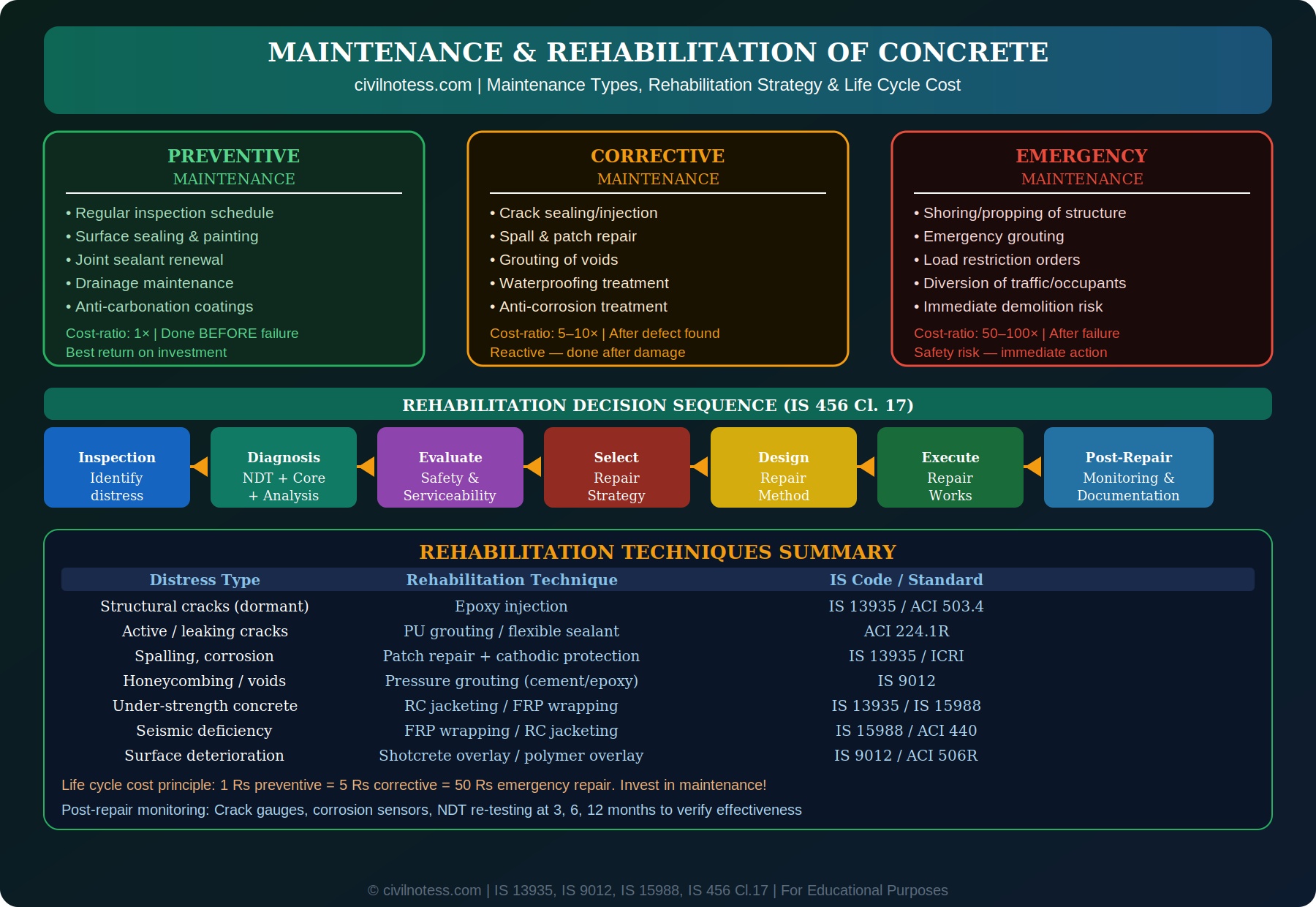
The guiding principle of modern asset management: “Maintaining concrete costs far less than replacing it.” Research and engineering practice consistently show that 1 rupee spent on preventive maintenance saves 5–10 rupees in corrective repair and 50–100 rupees in emergency or replacement intervention.
🟢 Preventive Maintenance
Performed on a scheduled basis regardless of visible deterioration. The aim is to extend service life and prevent small problems from becoming large ones.
Key Preventive Maintenance Activities:
- Regular inspection: Annual visual inspection | Comprehensive NDT inspection every 5 years | Documented condition reports
- Surface treatments: Anti-carbonation paint/coating (silane/siloxane penetrating sealers) — especially in urban environments with high CO₂. Reapply every 5–10 years.
- Joint and crack sealing: Renew expansion joint sealants (polyurethane/polysulphide) before they fail. Seal hairline cracks (<0.3mm) before they widen.
- Drainage maintenance: Clear all drainage holes, gutters, and downpipes. Ensure no water ponding on roof slabs, bridge decks, or parapets. Water is the primary agent in most deterioration.
- Cathodic protection monitoring: For structures with impressed current CP systems — check current output and anode condition annually.
- Waterproofing renewal: Roof waterproofing membranes typically last 10–15 years. Replace before failure.
Cost ratio: 1× — lowest cost intervention | Best return on infrastructure investment
🟡 Corrective Maintenance
Performed when a defect has been identified but is not yet causing immediate safety risk. Reactive — triggered by inspection findings.
- Crack repair: Epoxy injection (structural dormant cracks) | PU grouting (active/wet cracks) | Routing and sealing (surface cracks)
- Patch repair: Remove delaminated/spalled concrete → clean and treat corroded rebar (anti-corrosion primer) → apply bonding agent → cast/gun repair mortar (polymer-modified mortar, IS 2250)
- Cathodic protection installation: For chloride-contaminated concrete with active corrosion — most effective long-term repair for corrosion-affected structures
- Waterproofing application: After crack repair, apply crystalline or membrane waterproofing to water-retaining structures
- Structural strengthening: RC jacketing, FRP wrapping, steel jacketing, shotcrete overlay when structural capacity is reduced
Cost ratio: 5–10× compared to preventive maintenance
🔴 Emergency Maintenance
Required when a structure poses an immediate safety risk:
- Shoring and propping: Install temporary steel props or timber shoring to carry loads around the distressed zone
- Load restriction: Immediately reduce imposed loads (restrict traffic, evacuate occupants, remove stored goods)
- Emergency grouting: Stop active water infiltration that is eroding the structure
- Diversion of services: Reroute pipes, cables passing through the distressed zone
- Demolition decision: If structure cannot be made safe — controlled partial or full demolition
Cost ratio: 50–100× compared to preventive maintenance | Safety risk to personnel
🔄 Rehabilitation Decision Sequence (IS 456:2000 Cl. 17)
- Inspection: Identify and map all distress — cracks, spalling, corrosion, deflection, delamination
- Diagnosis: Determine the root cause — NDT (UPV, rebound, half-cell), laboratory testing (cores, chloride profiles, petrography)
- Structural evaluation: Assess whether safety (load-bearing capacity) or serviceability (cracking, deflection, water-tightness) or both are compromised
- Strategy selection: Based on cause, severity, remaining service life requirement, budget — select repair method(s)
- Design: Engineer designs the repair — material specs, structural calcs for strengthening, execution drawings
- Execution: Carry out repair works following IS 13935 and manufacturer specifications
- Post-repair monitoring: Verify effectiveness — NDT re-testing, crack monitoring, corrosion monitoring at 3, 6, 12 months
🔧 Rehabilitation Techniques Summary
| Distress Type | Rehabilitation Technique | IS / Standard |
|---|---|---|
| Structural cracks (dormant) | Epoxy injection | IS 13935 / ACI 503.4 |
| Active/leaking cracks and joints | PU grouting / flexible sealant | ACI 224.1R / IS 11433 |
| Spalling due to rebar corrosion | Concrete patch repair + anti-corrosion primer | IS 13935 / ICRI 310.2 |
| Widespread chloride contamination | Cathodic protection (impressed current) | BS EN 12696 |
| Honeycombing and internal voids | Pressure grouting (cement/epoxy) | IS 9012 |
| Under-strength concrete (cube failure) | Core test → if fails: load test / jacketing | IS 456 Cl.17.4 |
| Insufficient flexural/shear capacity | RC jacketing / FRP wrapping / steel plates | IS 13935 / IS 15988 |
| Seismic deficiency | FRP wrapping / RC jacketing / shear walls | IS 15988:2013 |
| Surface deterioration / abrasion | Shotcrete overlay / polymer overlay | IS 9012 / ACI 506R |
| Waterproofing failure | Crystalline waterproofing / membrane | IS 2645 |
💰 Life Cycle Cost Concept
Modern infrastructure management uses Life Cycle Cost Analysis (LCCA) to justify maintenance expenditure:
- A structure that receives regular maintenance and timely minor repairs can serve 60–100+ years
- A neglected structure that requires major rehabilitation typically needs intervention at 20–30 years
- Early intervention at the “corrosion initiation” stage costs far less than intervention at the “corrosion propagation + cracking + spalling” stage
📡 Post-Repair Monitoring
After repair, monitoring is essential to verify effectiveness and detect any recurrence:
- Crack monitoring: Crack tell-tales (glass microscope slides) or digital crack gauges — monitor for 6–12 months after repair
- NDT re-testing: UPV, rebound, and half-cell potential tests at 3 and 12 months — compare to pre-repair baseline
- Corrosion rate monitoring: Linear polarisation resistance (LPR) measurements — verify corrosion rate has reduced
- Deformation monitoring: Settlement gauges, inclinometers, total stations — for ongoing movement
- Documentation: All repair works and monitoring results documented in structure maintenance log — critical for future decisions
❓ Exam FAQs
Q1. What is the difference between maintenance and rehabilitation of concrete structures?
Maintenance is the routine, scheduled care of a structure to preserve its as-built condition and prevent premature deterioration (cleaning, sealing, painting, inspection). Rehabilitation is an intervention performed on a deteriorated structure to restore or improve its structural or functional performance (crack repair, jacketing, grouting, cathodic protection). Maintenance is preventive; rehabilitation is restorative.
Q2. What are the three types of maintenance in order of cost?
1. Preventive maintenance (cost ratio 1×) — scheduled care before deterioration begins. 2. Corrective maintenance (cost ratio 5–10×) — repair after a defect is identified but before safety is compromised. 3. Emergency maintenance (cost ratio 50–100×) — immediate intervention when the structure poses a safety risk. The life cycle cost principle is: 1 rupee of preventive = saves 5–10 rupees of corrective = saves 50–100 rupees of emergency.
Q3. What is the IS 456 procedure when 28-day cube test results fail?
IS 456:2000 Clause 17 specifies a clear sequence: (1) Investigate immediately — check batching records, sampling, curing; (2) Cut core samples (IS 516 Part 4) — minimum 3 cores per zone — acceptance: avg ≥ 0.85fck AND each ≥ 0.75fck; (3) If cores fail — conduct load test (IS 456 Cl.17.6) — structure passes if deflection recovery ≥ 75%; (4) If load test fails — structural intervention (jacketing, strengthening) or demolition.
📝 Quick Summary — Maintenance & Rehabilitation
- 3 maintenance types: Preventive (1×) | Corrective (5-10×) | Emergency (50-100×)
- IS 456 Cl.17 sequence: Cube fails → Core test (avg ≥0.85fck) → Load test → Strengthen/demolish
- IS 13935 — Guidelines for Repair | IS 15988 — Seismic strengthening
- Life cycle ratio: 1:5:50 — invest in prevention!
- Rehabilitation techniques: Epoxy injection | Grouting | Patch repair | Jacketing | FRP | Shotcrete
- Post-repair monitoring: 3, 6, 12 months — NDT re-testing, crack gauges, corrosion rate