
Why India Needed Systematic Road Development Planning
Post-independence India faced an enormous challenge: a vast country with poor road connectivity and an agriculture-driven economy needing efficient transport. To address this, India adopted a series of 20-year road development plans, each building on the previous one and setting progressively more ambitious targets — formulated by the Indian Roads Congress (IRC).
Background: The Jayokar Committee (1927)
The Jayokar Committee, constituted in 1927, identified critical inadequacies in India’s road network and recommended a dedicated road fund. This led to the Central Road Fund (CRF) — financed by a cess on petrol — and laid the groundwork for all future planned road development.
Plan I: Nagpur Road Development Plan (1943–1963)
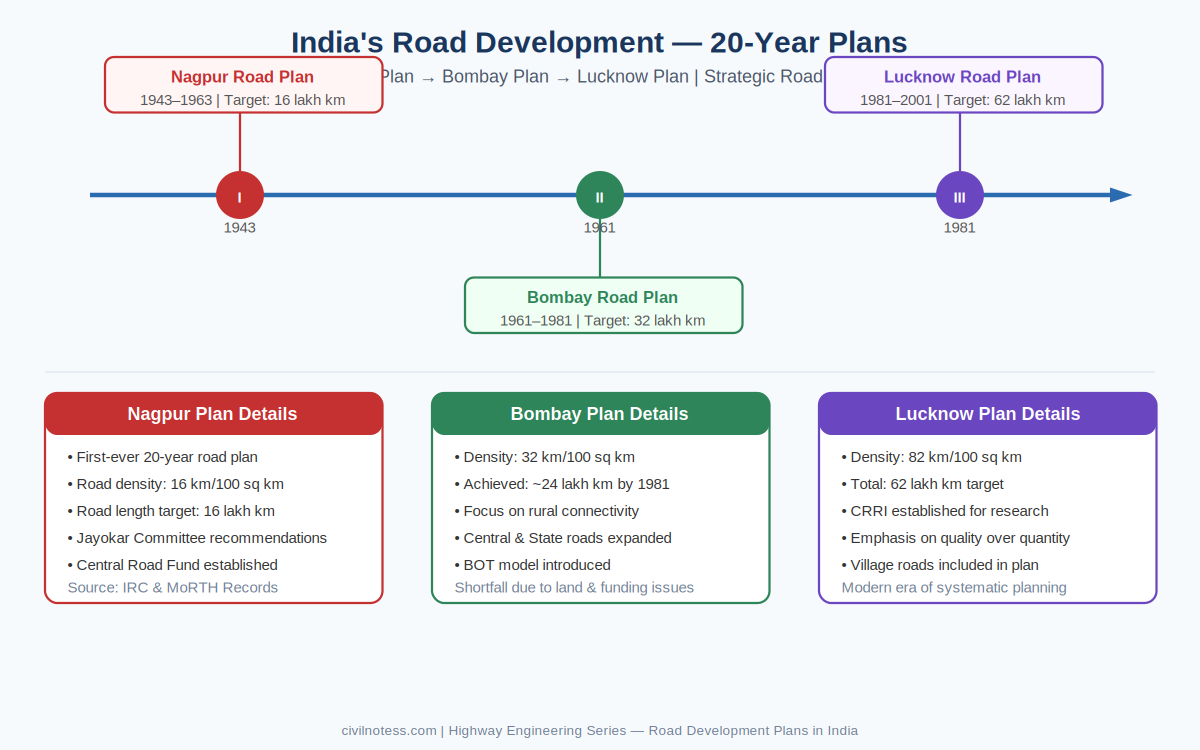
India’s first 20-year road plan, formulated at the All India Road Development Conference in Nagpur in 1943. It provided the first scientific framework for planning India’s road network.
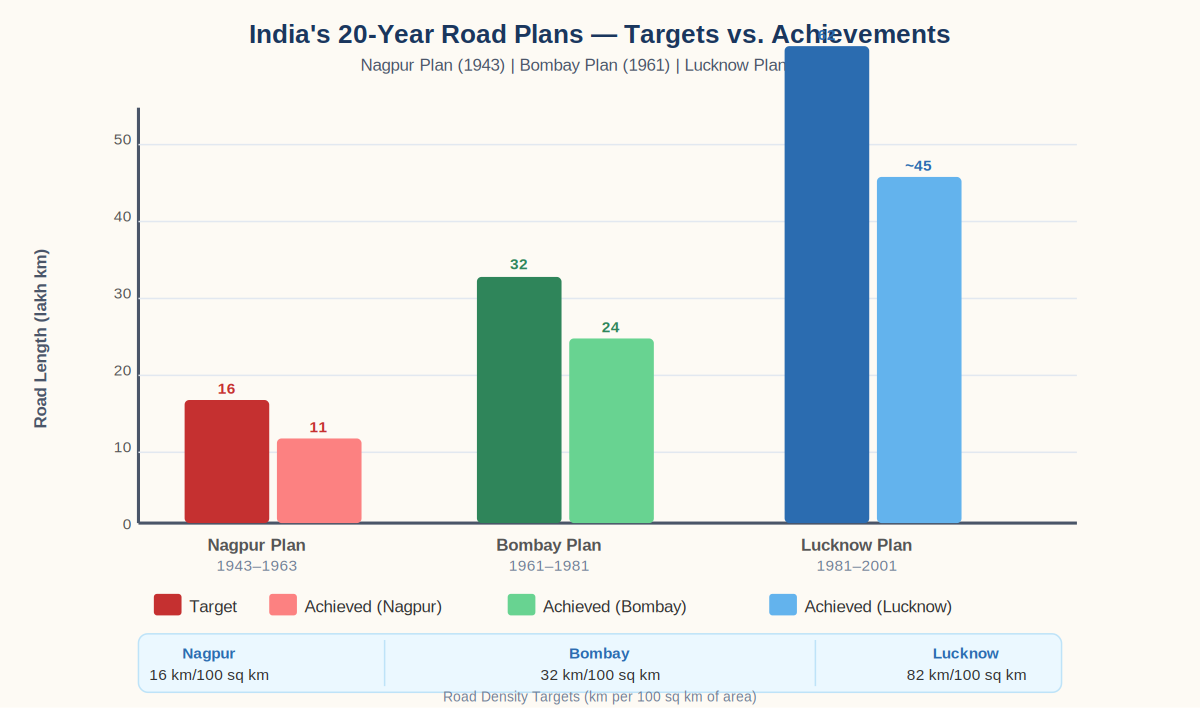
- Total road length target: 16 lakh km
- Road density target: 16 km per 100 sq km
- First classification of roads into NH, SH, District Roads, and Village Roads
- Standard formulas introduced to calculate required road lengths per region
- Achievement by 1963: approximately 11 lakh km
Plan II: Bombay Road Development Plan (1961–1981)
Formulated at the All India Road Development Conference in Bombay in 1961. Acknowledged the Nagpur Plan shortfall and set more ambitious targets with stronger rural connectivity focus.
- Total road length target: 32 lakh km
- Road density target: 32 km per 100 sq km
- Emphasized quality improvement alongside length expansion
- Achievement by 1981: approximately 24 lakh km
Plan III: Lucknow Road Development Plan (1981–2001)
Formulated at the conference in Lucknow in 1981. Marked a strategic shift toward quality standards, research, and systematic institutional development alongside road network growth.
- Total road length target: 62 lakh km
- Road density target: 82 km per 100 sq km
- Establishment of CRRI for technical research
- Emphasis on construction standards, pavement quality, and maintenance practices
- Village roads fully integrated into the national planning framework
Comparative Summary
| Plan | Conference | Period | Target Length | Density (km/100 sq km) |
|---|---|---|---|---|
| Nagpur Plan | Nagpur | 1943–1963 | 16 lakh km | 16 |
| Bombay Plan | Bombay (Mumbai) | 1961–1981 | 32 lakh km | 32 |
| Lucknow Plan | Lucknow | 1981–2001 | 62 lakh km | 82 |
Key Institutions Established During This Era
- IRC (Indian Roads Congress): Established 1934 — apex body for road standards in India
- CRRI (Central Road Research Institute): Set up 1952, New Delhi — handles road research and testing
- NHAI (National Highways Authority of India): Established 1988, operational from 1995
- Highway Research Board: Set up 1973 under IRC for research guidance
- Motor Vehicles Act: First enacted 1939, significantly revised in 1988 and 2019