
Selecting the correct water-cement (W/C) ratio is one of the most critical decisions in concrete mix design. Get it wrong and your structure may crack, fail durability tests, or collapse under load. In this guide, you will learn exactly how to select the right W/C ratio using IS 456:2000 and IS 10262:2019 — step by step, with real examples.
What is Water-Cement Ratio (W/C Ratio)?
The water-cement ratio is the ratio of the weight of water to the weight of cement used in a concrete mix. Mathematically:
W/C Ratio = Weight of Water (kg) ÷ Weight of Cement (kg)
For example, if you use 180 litres of water and 360 kg of cement, the W/C ratio = 180/360 = 0.50.
This simple number controls the strength, durability, workability, and permeability of your concrete. It is governed primarily by IS 456:2000 (Plain and Reinforced Concrete) and IS 10262:2019 (Concrete Mix Proportioning).
Why Does W/C Ratio Matter So Much?
The chemistry is straightforward: cement needs only about 0.23 to 0.25 W/C to fully hydrate. Any water beyond that amount does not chemically combine with cement — it stays in the mix, then evaporates, leaving behind voids and capillary pores. More pores = lower strength and more paths for water, chlorides, and sulfates to enter and damage your concrete.
- Low W/C ratio → Dense, strong, durable concrete with fewer pores
- High W/C ratio → Weak, porous concrete that deteriorates quickly
- Balanced W/C ratio → Best combination of workability and structural performance
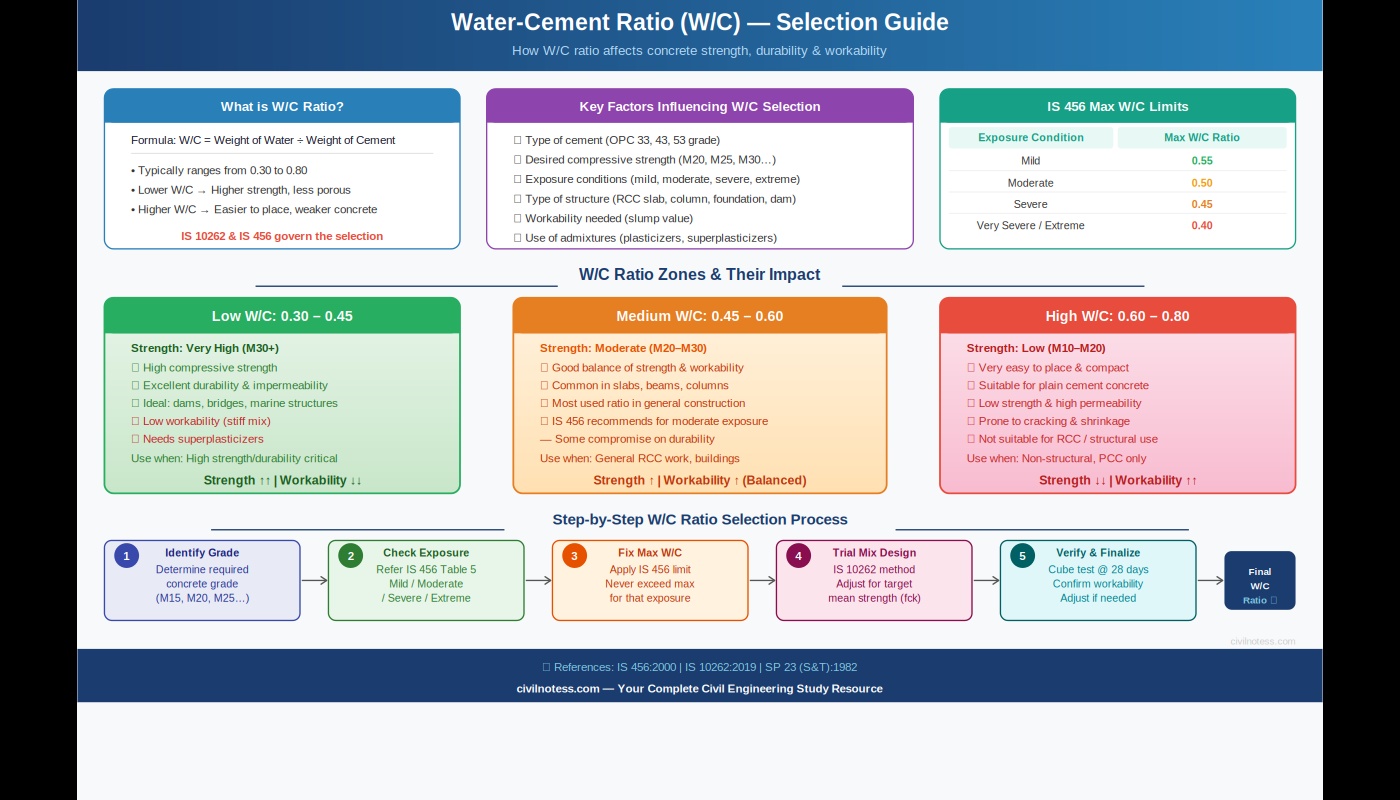
W/C Ratio Selection Guide — Diagram
The diagram below summarises the three W/C ratio zones, the IS 456 exposure-based limits, and the step-by-step selection process used in professional mix design:
Factors That Affect the Selection of W/C Ratio
No single W/C ratio works for all situations. Your choice depends on several interconnected factors:
1. Required Compressive Strength
This is the dominant factor. The Abrams’ Law (1919) established the inverse relationship: as W/C ratio increases, compressive strength decreases. Use the IS 10262:2019 strength vs W/C ratio curves to select a preliminary W/C ratio for your target mean strength (f’ck).
| Concrete Grade | Characteristic Strength (fck) | Typical W/C Range | Common Use |
|---|---|---|---|
| M10 | 10 N/mm² | 0.70 – 0.80 | PCC, lean mix |
| M15 | 15 N/mm² | 0.60 – 0.70 | PCC, levelling |
| M20 | 20 N/mm² | 0.55 – 0.60 | RCC slabs, beams |
| M25 | 25 N/mm² | 0.50 – 0.55 | Columns, footings |
| M30 | 30 N/mm² | 0.45 – 0.50 | Bridges, elevated structures |
| M40+ | 40+ N/mm² | 0.30 – 0.40 | Prestressed, marine, high-rise |
2. Exposure Conditions (IS 456 Table 5)
IS 456:2000 classifies exposure conditions into five categories and sets the maximum permissible W/C ratio for each. This is a hard upper limit — you must never exceed it regardless of workability requirements:
| Exposure Class | Environment Examples | Min. Grade | Max. W/C Ratio |
|---|---|---|---|
| Mild | Protected indoors, interior structures | M20 | 0.55 |
| Moderate | Sheltered from rain, exposed to humidity | M25 | 0.50 |
| Severe | Alternating wet/dry, coastal areas | M30 | 0.45 |
| Very Severe | Seawater spray, de-icing salts | M35 | 0.40 |
| Extreme | Aggressive chemicals, abrasion | M40 | 0.40 |
3. Type of Cement
Different cement grades and types hydrate differently, affecting the final strength for the same W/C ratio. OPC 53 Grade will give higher strength at W/C 0.45 compared to OPC 33 Grade. Blended cements (PPC, PSC) may need slightly different W/C ratios and have longer curing periods.
4. Workability Requirements
Lower W/C ratios make the mix stiffer and harder to place. When workability is critical (e.g., heavily reinforced sections, pumped concrete), use a water-reducing admixture (plasticizer or superplasticizer) to achieve the required slump without increasing the W/C ratio. This is now standard practice in modern concrete design.
5. Use of Supplementary Cementitious Materials (SCMs)
Fly ash, GGBS (Ground Granulated Blast Furnace Slag), and silica fume can replace part of the cement content. These materials affect the water demand and W/C ratio differently — silica fume, for example, significantly reduces permeability at the same W/C ratio, making it ideal for marine and chemical resistance applications.
Step-by-Step Procedure for Selecting W/C Ratio (IS 10262:2019)
Follow this systematic process used in professional concrete mix design in India:
Step 1: Determine the Target Mean Compressive Strength (f’ck)
The target mean strength is always higher than the characteristic strength to account for variability:
f’ck = fck + 1.65 × s
Where s = standard deviation from IS 10262 Table 1 (typically 4 N/mm² for good site control)
Example: For M25 concrete with good site control → f’ck = 25 + 1.65 × 4 = 31.6 N/mm²
Step 2: Select W/C Ratio from IS 10262 Chart
Using the target mean strength and the type of cement (OPC 43 or 53 Grade), read off the W/C ratio from the relationship curve in IS 10262:2019 Annex A. For OPC 43 Grade with f’ck = 31.6 N/mm², this typically gives W/C ≈ 0.50.
Step 3: Check Against IS 456 Maximum Limit
Now compare your selected W/C ratio with the maximum allowed for the exposure condition. Use the lower (more restrictive) value.
Example: If IS 10262 gives W/C = 0.52 but IS 456 limits to 0.50 for moderate exposure → adopt W/C = 0.50.
Step 4: Calculate Water and Cement Content
Select water content from IS 10262 Table 2 (based on aggregate size and slump). Then:
Cement content = Water content ÷ W/C ratio
Check that cement content is within IS 456 minimum (300 kg/m³ for moderate exposure) and maximum (450 kg/m³) limits
Step 5: Conduct Trial Mixes and Verify
Prepare at least three trial mixes with the selected W/C ratio and ±0.05 variation. Cast cube specimens (150mm × 150mm × 150mm), cure for 28 days, and test. The mix that achieves target mean strength with acceptable workability is your final design mix.
Common Mistakes Engineers Make with W/C Ratio
- Adding extra water at site to improve workability — this is the most common and most damaging practice. Even a W/C increase from 0.50 to 0.60 can reduce strength by 20-30%.
- Ignoring the exposure condition and designing only for strength — leads to premature deterioration in aggressive environments.
- Not accounting for aggregate moisture — free moisture in sand and aggregate must be subtracted from the mix water, or the actual W/C ratio will exceed the design value.
- Using too low a W/C without admixtures — the mix becomes unworkable, causing segregation and honeycombing which defeats the purpose.
Solved Example: W/C Ratio Selection for M25 Concrete (Moderate Exposure)
Given:
- Grade: M25
- Exposure: Moderate
- Cement: OPC 43 Grade
- Aggregate size: 20 mm
- Workability: 75 mm slump
Solution:
- Target mean strength: f’ck = 25 + 1.65 × 4 = 31.6 N/mm²
- From IS 10262 chart (OPC 43): W/C = 0.50
- IS 456 max for moderate exposure: 0.50
- Adopted W/C = 0.50 (both values agree)
- Water content (IS 10262 Table 2, 20mm, 75mm slump): 186 kg/m³
- Cement content: 186 ÷ 0.50 = 372 kg/m³ ✔ (Min. 300 kg/m³ for moderate — satisfied)
Quick Reference Summary
| W/C Ratio Range | Concrete Grade | Strength | Workability | Best For |
|---|---|---|---|---|
| 0.30 – 0.40 | M40 – M60 | Very High | Very Low | Prestressed, marine, high-rise |
| 0.40 – 0.50 | M30 – M40 | High | Low-Medium | Bridges, columns, foundations |
| 0.50 – 0.60 | M20 – M30 | Moderate | Medium-High | Slabs, beams, general RCC |
| 0.60 – 0.80 | M10 – M15 | Low | High | PCC, levelling, non-structural |
Conclusion
The selection of water-cement ratio is not guesswork — it is a scientific, code-governed process. Always select your W/C ratio based on both the required strength (IS 10262) and the maximum limit for exposure conditions (IS 456). Keep it as low as practicable, use admixtures for workability, and always verify with trial mixes. A well-chosen W/C ratio is the foundation of durable, economical, and structurally sound concrete.
📘 References: IS 456:2000 | IS 10262:2019 | SP 23 (S&T):1982 | Abrams’ Law (1919)