
📋 Table of Contents
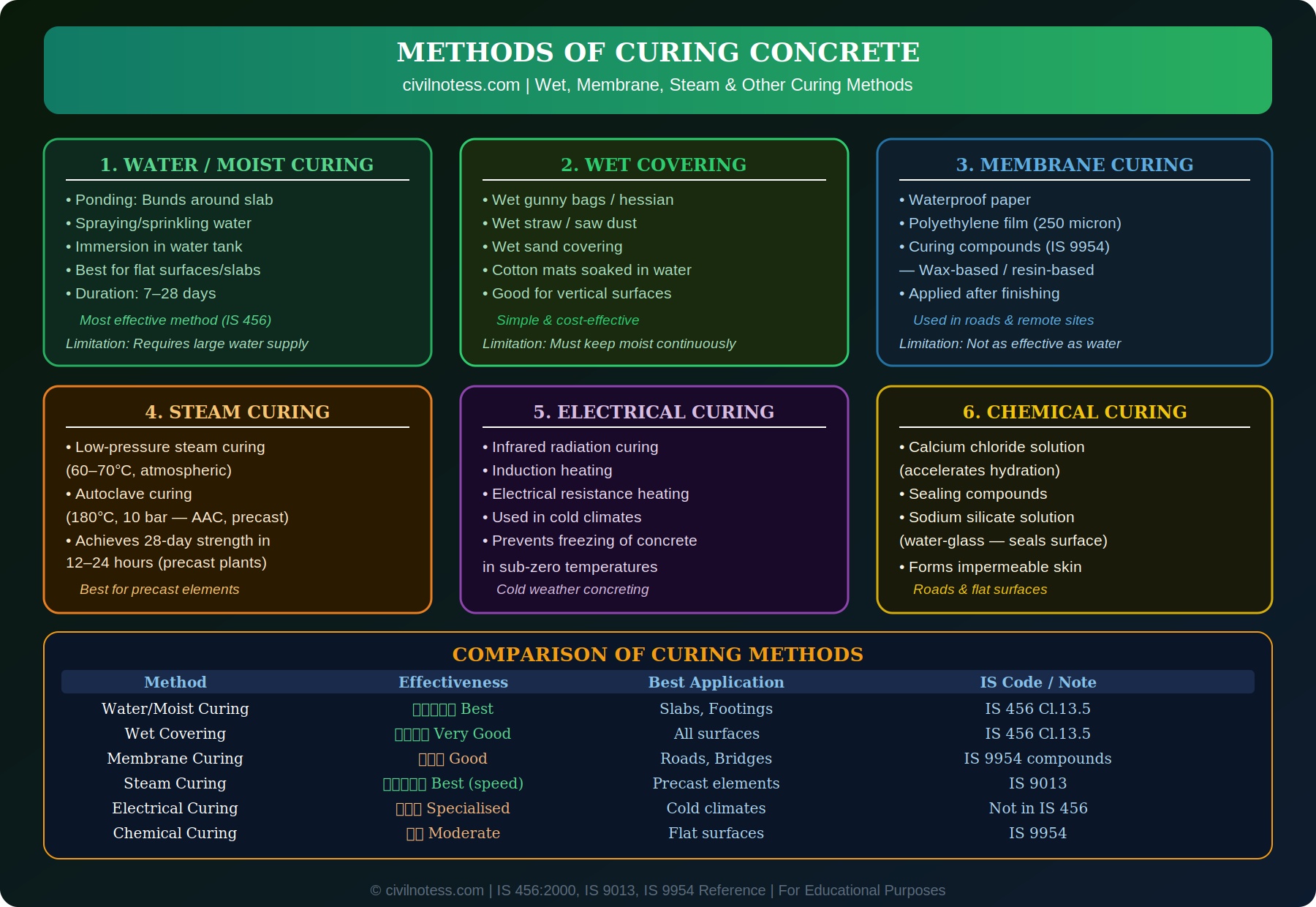
💧 Method 1: Water Curing / Moist Curing
Water curing is the most effective and preferred method of curing as per IS 456:2000. It directly supplies water for continued hydration and prevents drying of the concrete surface. Water curing methods include:
- Ponding: Building earthen or brick bunds (dams) around the slab perimeter and flooding with water (75–100mm depth). Best for horizontal surfaces (slabs, footings, road slabs). Water changed periodically. Most effective for flat, accessible surfaces.
- Spraying / Sprinkling: Water sprinkled over concrete surface using hoses or sprinklers. Must be continuous or at frequent intervals — surface must not be allowed to dry between applications. Good for large horizontal areas.
- Immersion: Concrete member submerged in a water tank. Used for precast elements, small structural members, and laboratory specimens. Provides the most uniform curing.
- Percolation: Water allowed to percolate through porous forms into contact with the concrete. Used for special situations.
🧴 Method 2: Wet Covering / Covering with Moist Materials
Concrete surface covered with moisture-retaining materials that are kept continuously wet:
- Hessian cloth / Gunny bags: Most common in India. Jute bags soaked in water are laid over concrete surface and kept wet by regular sprinkling. Very effective and inexpensive.
- Wet sand: 50–75mm layer of wet sand applied over concrete. Retains moisture well. Good for flat surfaces.
- Wet straw / hay: Used where other materials are not available. Effective but must be kept uniformly moist.
- Cotton mats: Pre-wetted cotton burlap mats laid over concrete. Good moisture retention.
- Waterproof paper or plastic sheets: Placed over moist concrete to prevent evaporation rather than supplying additional water.
Key requirement: The covering must be kept continuously moist throughout the curing period. Allowing it to dry out is worse than no covering at all, as the covering can then absorb moisture FROM the concrete.
🛡️ Method 3: Membrane Curing (Sealing Method)
Membrane curing involves applying an impermeable film or coating to the concrete surface immediately after finishing to prevent evaporation of mixing water:
- Polyethylene film: 250-micron polythene sheeting laid over freshly finished concrete. Overlaps at joints sealed with tape. Practical, widely used for roads and slabs.
- Waterproof paper (sisalkraft): Water-resistant paper sheets laid over fresh concrete. Joints lapped minimum 150mm.
- Curing compounds (IS 9954): Liquid membrane-forming compounds sprayed or brushed on concrete surface. On drying, they form a thin impermeable film. Types include:
- Resin-based compounds (most effective)
- Wax-based compounds
- Chlorinated rubber compounds
- White-pigmented compounds (reflect sunlight, reduce temperature rise)
- Application: Applied immediately after the surface water sheen disappears (immediately after final finish). Rate: 5–7 m²/litre (IS 9954).
💡 Limitation of Membrane Curing
Membrane curing relies on the water already in the concrete — it does NOT supply additional water. It is therefore only effective if the concrete has adequate water for hydration (W/C ≥ 0.38). For very low W/C concretes (HSC, HPC with W/C < 0.35), additional water supply (via water curing) is essential as the mix may not have sufficient water for complete hydration.
♨️ Method 4: Steam Curing (Accelerated Curing)
Steam curing uses elevated temperature and moisture to accelerate cement hydration, achieving in hours what normally takes days:
- Low-pressure steam curing (atmospheric): Concrete elements enclosed in chambers through which steam at 60–70°C is circulated at atmospheric pressure. Achieves 28-day cube strength in 16–24 hours. Used extensively in precast concrete factories. Standard: IS 9013.
- High-pressure steam curing (Autoclave): Concrete placed in autoclave vessels and subjected to steam at 175–185°C and 8–10 bar pressure for 8–12 hours. Achieves very high early strength. Used for AAC (Autoclaved Aerated Concrete) block manufacturing. Very high capital cost.
- Typical steam curing cycle: Preset period (2–4 hours at room temperature) → Temperature rise (2–3 hours, max rise 22°C/hour to prevent thermal cracking) → Maximum temperature holding (8–12 hours at 60–70°C) → Cooling (2–3 hours, max drop 11°C/hour).
⚡ Method 5: Electrical Curing (Cold Weather)
Electrical curing supplies heat directly to concrete to maintain hydration in cold conditions where water would freeze:
- Electrical resistance heating: Low voltage electric current passed through the concrete (water acts as electrolyte). Generates heat by resistance heating. Used in Russia and Nordic countries for winter concreting.
- Infrared radiation: Infrared lamps placed over concrete surface radiate heat. Used for thin precast elements and road repairs.
- Induction heating: Electric coils produce eddy currents in metal forms and reinforcement, generating heat. Used for column and beam casting in cold climates.
- Heated enclosures: Entire structure enclosed and space heated (indirect method). Most common cold-weather concreting practice.
🧪 Method 6: Chemical Curing Compounds
- Sodium silicate (water glass): Solution sprayed on concrete reacts with Ca(OH)₂ to form insoluble calcium silicate, sealing the surface pores. Used for industrial floors.
- Calcium chloride (CaCl₂) solution: Accelerates hydration of cement. Applied to surface or added to mix water. Not recommended for reinforced concrete (accelerates rebar corrosion).
- Aluminous compounds: Form dense impermeable layer on concrete surface.
📊 Comparison of Curing Methods
| Method | Effectiveness | Cost | Best Application | IS Code |
|---|---|---|---|---|
| Water Curing (Ponding) | ★★★★★ Best | Low | Slabs, footings, flat surfaces | IS 456 Cl.13.5 |
| Wet Covering (Hessian) | ★★★★ Very Good | Very Low | All surfaces, columns, beams | IS 456 Cl.13.5 |
| Membrane (Polythene) | ★★★ Good | Low–Moderate | Roads, bridge decks | IS 9954 |
| Curing Compounds | ★★★ Good | Moderate | Road slabs, large areas | IS 9954 |
| Steam Curing (LP) | ★★★★★ Best (speed) | High | Precast concrete factories | IS 9013 |
| Autoclave Curing | ★★★★★ Best (strength) | Very High | AAC blocks, thin precast | IS 2185 Pt.3 |
| Electrical Curing | ★★★ Specialised | High | Cold weather concreting | — |
| Chemical Curing | ★★ Moderate | Low–Moderate | Industrial floors | IS 9954 |
❓ Exam FAQs — Methods of Curing
Q1. Which is the most effective method of curing as per IS 456?
Water curing (ponding or spraying) is the most effective method as it directly supplies water for continued hydration and maintains 100% relative humidity at the concrete surface throughout the curing period.
Q2. What is membrane curing and when is it used?
Membrane curing involves applying an impermeable film (polyethylene sheet or chemical compound) over the concrete surface to prevent evaporation of mixing water. It is used when water curing is not practical — for road slabs, bridge decks, remote sites, and areas with limited water supply.
Q3. What is the IS code for curing compounds?
IS 9954:1981 — Specification for Curing Compounds for Concrete. The standard covers white-pigmented, clear, and resin-based compounds.
Q4. What is delayed ettringite formation (DEF) and how is it related to steam curing?
DEF occurs when steam curing temperature exceeds 70°C. The high temperature prevents normal ettringite formation during hydration. Later, when ettringite forms at lower temperatures (after the structure is in service), it expands within the hardened concrete, causing internal cracking and deterioration. This is why steam curing temperature is limited to 60–70°C.
📝 Quick Summary — Methods of Curing
- 6 main methods: Water curing | Wet covering | Membrane curing | Steam | Electrical | Chemical
- Best method: Water/moist curing (ponding, spraying, wet hessian)
- Membrane curing: Polythene (250 micron) or curing compounds (IS 9954)
- Steam curing: ≤ 70°C to avoid DEF | IS 9013
- Cold weather: Electrical / heated enclosure curing
- Membrane curing does NOT supply water — reliant on mix water