
📋 Table of Contents
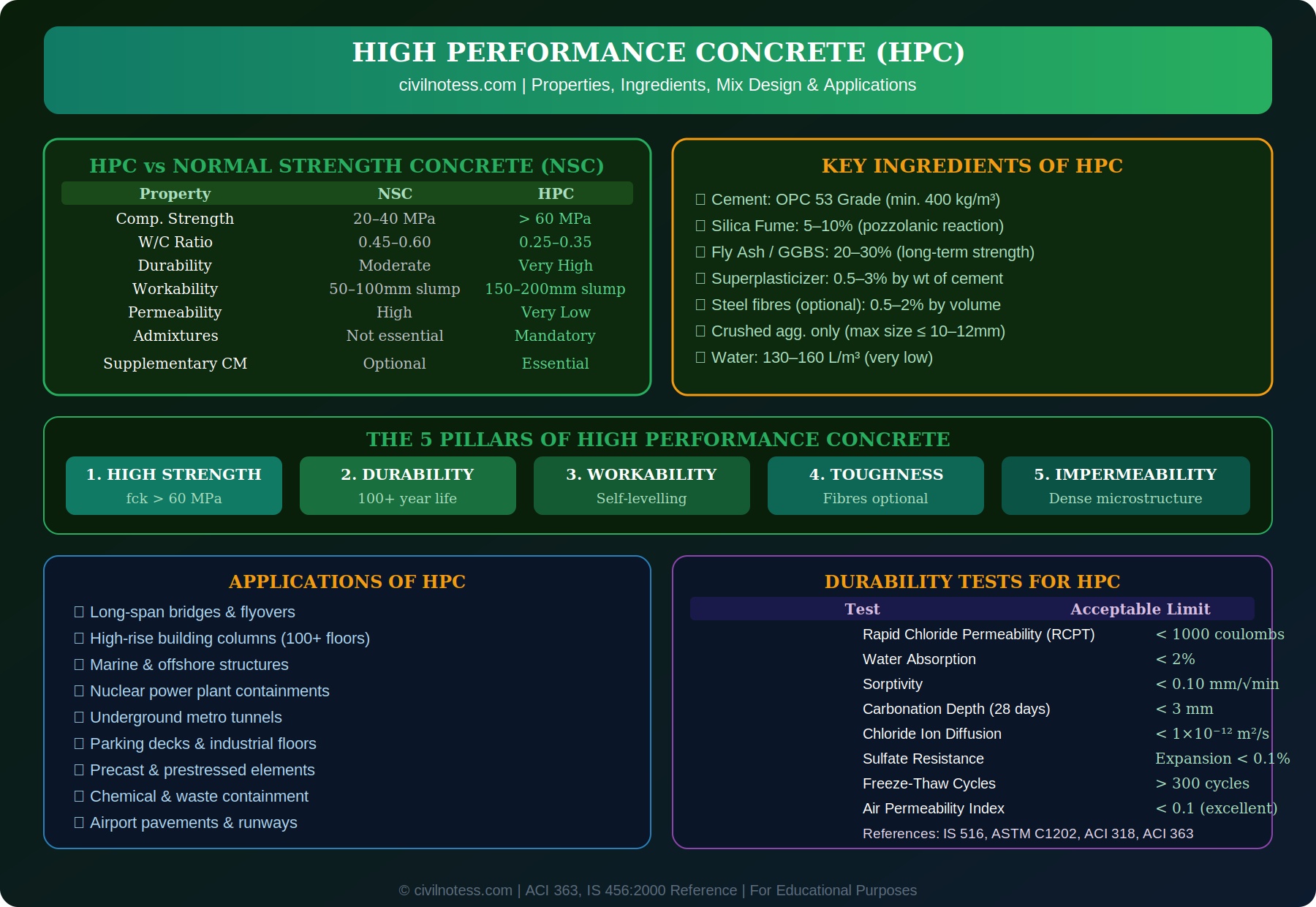
🔷 What is High Performance Concrete (HPC)?
High Performance Concrete (HPC) is concrete that meets special performance requirements beyond those achievable using conventional materials and normal mixing, placing, and curing practices. The term was introduced by the ACI (American Concrete Institute) and is defined in ACI 363R and AASHTO documents.
According to the Federal Highway Administration (FHWA), HPC is characterized by enhanced durability, workability, strength, and mechanical properties — not just strength alone. This is a crucial distinction: all HSC is HPC, but not all HPC is HSC.
⚖️ HPC vs Normal Strength Concrete (NSC)
| Parameter | Normal Strength Concrete (NSC) | High Performance Concrete (HPC) |
|---|---|---|
| Compressive Strength | 20–40 MPa | > 60 MPa (often 80–120 MPa) |
| W/C Ratio | 0.45–0.60 | 0.25–0.35 |
| Workability (Slump) | 50–100 mm | 150–200 mm (with SP) |
| Durability | Moderate (50-year design) | Very High (100+ year design) |
| Permeability | High (~1000 coulombs) | Very Low (<1000 coulombs RCPT) |
| Admixtures | Not essential | Superplasticizer mandatory |
| Supplementary CM | Optional | Silica fume + Fly ash/GGBS |
| Aggregate quality | Standard | Crushed, high-strength only |
| QC requirement | Standard | Strict, continuous monitoring |
| Cost | Lower | 20–50% higher |
🏛️ The 5 Pillars of High Performance Concrete
HPC is characterized by five essential performance attributes:
- 1. High Strength: Compressive strength typically > 60 MPa at 28 days. Achieved through low W/C ratio and use of silica fume.
- 2. High Durability: Resistance to carbonation, chloride ingress, sulphate attack, freeze-thaw cycles, and alkali-silica reaction (ASR). Service life > 100 years in aggressive environments.
- 3. High Workability: Slump 150–200mm with superplasticizer. Some HPC formulations are self-compacting. Essential for congested reinforcement and complex formwork.
- 4. High Toughness: Often achieved by adding steel or synthetic fibres. High energy absorption capacity, important for seismic and impact loading.
- 5. Low Permeability: Dense, nearly impermeable microstructure due to very low W/C and silica fume. Critical for structures exposed to chlorides (marine) or sulphates (industrial).
🧪 Key Materials & Mix Proportions for HPC
| Ingredient | Typical Quantity per m³ | Role |
|---|---|---|
| OPC 53 Grade Cement | 350–500 kg | Primary binder |
| Silica Fume | 30–50 kg (5–10% of cement) | Pozzolanic reaction + micro-filler |
| Fly Ash or GGBS | 80–150 kg | Long-term strength + durability |
| Water | 130–165 L | Hydration |
| W/CM Ratio | 0.25–0.35 | Controls strength and permeability |
| Fine Aggregate (Zone II) | 650–750 kg | Filler |
| Coarse Aggregate (10mm) | 950–1100 kg | Structural filler |
| Superplasticizer (PCE) | 5–15 L (0.5–2% bwc) | Workability with low W/C |
| Total powder content | 450–600 kg | Cement + silica fume + FA |
🔬 Durability Tests for High Performance Concrete
Durability assessment of HPC involves several specialized tests beyond routine compressive strength testing:
| Test | Standard | HPC Acceptance Limit |
|---|---|---|
| Rapid Chloride Permeability Test (RCPT) | ASTM C1202 | < 1000 Coulombs (very low) |
| Water Absorption | IS 516 / BS 1881 | < 2% by weight |
| Sorptivity (capillary suction) | ASTM C1585 | < 0.10 mm/√min |
| Carbonation Depth (28 days) | EN 13295 | < 3 mm |
| Chloride Ion Diffusion | NT Build 492 | < 1 × 10⁻¹² m²/s |
| Sulphate Resistance (expansion) | ASTM C1012 | < 0.1% at 6 months |
| Freeze-Thaw Resistance | ASTM C666 | Durability factor > 80% at 300 cycles |
| Air Permeability Index (API) | OIA Autoclam | < 0.1 × 10⁻⁷ m²/s (excellent) |
| Alkali-Silica Reaction (ASR) | ASTM C1293 | Expansion < 0.04% at 1 year |
🏗️ Applications of High Performance Concrete
- Long-span cable-stayed bridges and flyovers: High strength reduces section size; high durability extends service life in aggressive environments.
- High-rise building columns and transfer structures: 100+ storey buildings in Dubai, Hong Kong, and New York use HPC up to 120 MPa.
- Marine and offshore structures: Oil platforms, jetties, breakwaters exposed to aggressive chloride-rich seawater.
- Nuclear power plant containments: Double-wall containments with extreme impermeability requirements.
- Underground metro tunnels and stations: Precast tunnel segments require high strength, low permeability, and dimensional accuracy.
- Airport pavements and runways: High flexural strength, abrasion resistance, and impermeability.
- Prestressed & precast elements: Girders, piles, hollow core slabs benefit from high early strength.
- Chemical plant floors and containment: Resistance to aggressive chemical environments.
❓ Exam FAQs — HPC
Q1. What is the key difference between HSC and HPC?
HSC focuses primarily on high compressive strength (>60 MPa). HPC is a broader concept that also demands high durability, high workability, and low permeability. A 50 MPa concrete with extremely low permeability (RCPT < 500 C) could qualify as HPC but not HSC.
Q2. Which admixture is mandatory for HPC?
Superplasticizer (SP) — specifically Polycarboxylate Ether (PCE) type — is mandatory for HPC to achieve very low W/C ratio (0.25–0.35) while maintaining workability (slump 150–200mm).
Q3. What is RCPT and its significance in HPC?
RCPT (Rapid Chloride Permeability Test, ASTM C1202) measures the electrical charge (in Coulombs) passed through a 50mm concrete slice in 6 hours. For HPC, RCPT < 1000 Coulombs is required, indicating very low chloride ion permeability and excellent durability.
📝 Quick Summary — HPC
- HPC = High Strength + Durability + Workability + Low Permeability
- W/C ratio: 0.25–0.35 | Total powder: 450–600 kg/m³
- Essential: Silica fume + Superplasticizer (PCE type)
- Key test: RCPT < 1000 Coulombs (very low permeability)
- Service life: 100+ years in aggressive environments
- ACI 363R | IS 456:2000 | ASTM C1202 for RCPT