
📋 Table of Contents
🔷 What is Grouting?
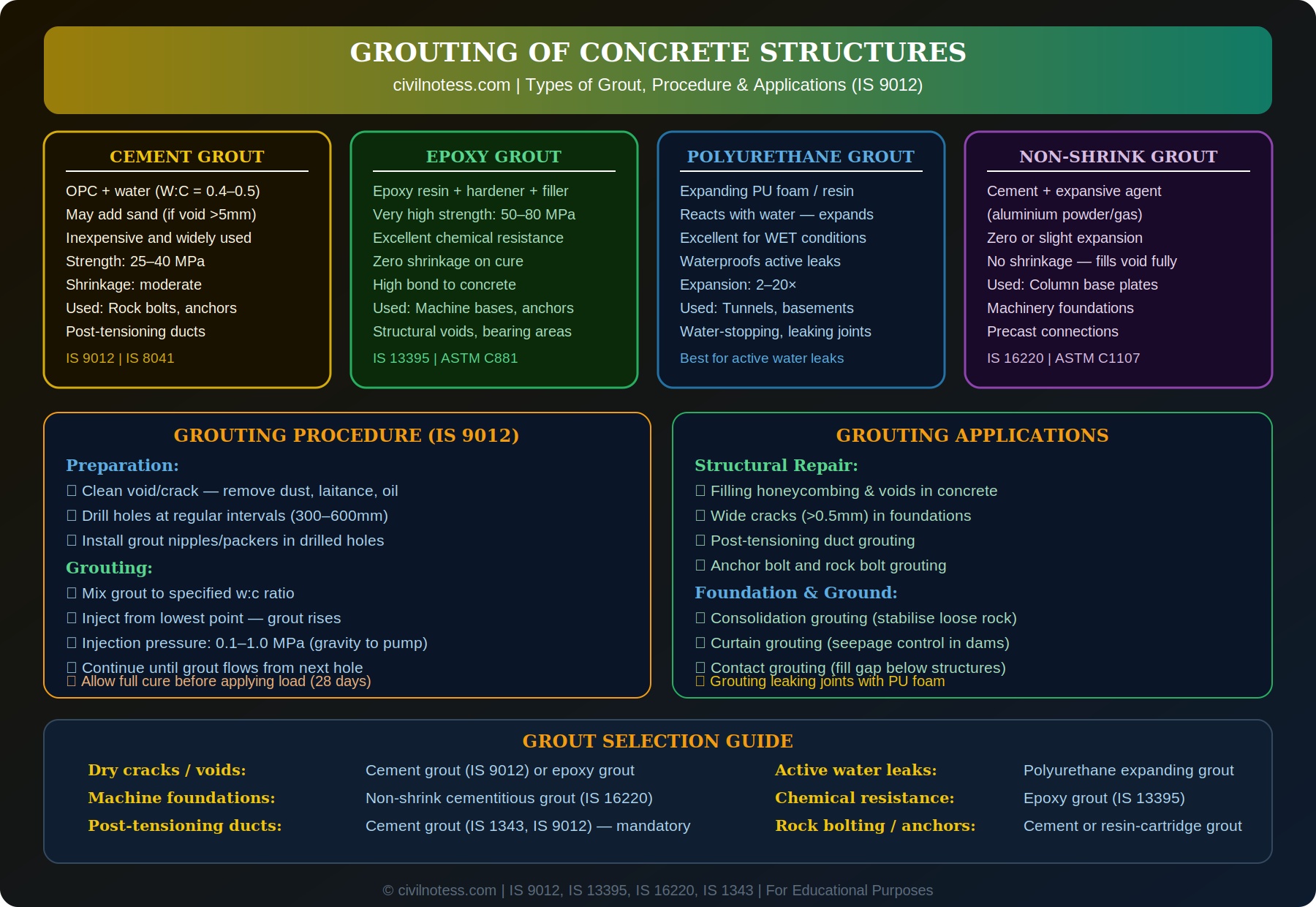
Grouting is the process of injecting or pouring a fluid cementitious, chemical, or resin material (grout) into cracks, voids, honeycombing, or soil/rock formations to fill the space, restore structural integrity, control seepage, or stabilise the surrounding material. Grouting is one of the most versatile repair and construction techniques in civil engineering.
🧪 Four Main Types of Grout
1. Cement Grout
The most widely used and economical grout. Composition: OPC + water (W:C ratio = 0.40–0.55). Sand may be added if void width exceeds 5mm (to reduce cost and shrinkage).
- Compressive strength (28d): 25–40 MPa
- Moderate shrinkage — use expansive admixture for critical applications
- Suitable for: Rock bolts, anchor bolts, post-tensioning ducts (IS 1343), contact grouting, curtain grouting in dams, filling wide cracks and honeycombing
- IS code: IS 9012 | Admixture for expansion: IS 9103
2. Epoxy Grout
Three-component system: epoxy resin (Part A) + hardener (Part B) + inert filler aggregate (Part C). Provides very high strength and chemical resistance.
- Compressive strength: 50–80 MPa | Zero shrinkage on curing
- Excellent bond to concrete and steel — high bond strength
- Chemical resistant — suitable for aggressive environments
- Suitable for: Machine bases and equipment foundations, column base plates, structural void filling requiring high strength, chemical plant flooring repairs
- IS code: IS 13395 | ASTM C881
3. Polyurethane Grout (PU Grout)
Two-component reactive system that reacts with water and expands (2–20 times original volume) to form a flexible closed-cell foam or gel. Unique ability to stop active water infiltration.
- Hydrophilic type: Reacts with water → expands → seals crack even with flowing water
- Hydrophobic type: Reacts with moisture in air → forms rigid foam
- Excellent for: Tunnel linings, basement walls, underground structures, leaking construction joints, water-stopping in dams and canals
- PU grout is injected at lower pressures than epoxy — gel time can be varied by catalyst dosage
4. Non-Shrink Grout
Cementitious grout with an expansive agent (aluminium powder or gas-generating additive) that causes slight expansion during setting, exactly compensating for drying shrinkage. Result: zero net volume change — the grout completely fills and contacts all surfaces of the void.
- Flowable consistency — self-levelling under plates
- Strength: 30–50 MPa at 28 days
- Critical for: Machine and equipment foundations (bearing area must be 100% in contact), column base plates, precast column-to-foundation connections, bridge bearing pads
- IS 16220 / ASTM C1107 | Must achieve ≥ 0.0% shrinkage (slight expansion preferred)
🔬 General Grouting Procedure (IS 9012)
- Surface preparation: Remove loose concrete, dust, oil, and laitance from all surfaces to be grouted. Provide key texture if possible. Saturate surface with water (SSD condition) — do not leave standing water in void.
- Drill holes: Drill grout holes at 300–600mm spacing along crack/void. Angle holes to intersect the void. Install grout nipples/packers.
- Mix grout: Prepare grout to specified W:C ratio. Mechanical mixing essential — hand mixing insufficient for cement grout. Maintain consistent mix throughout operation.
- Grout injection: Start from lowest point. Inject until grout flows from adjacent hole. Gravity grouting (no pressure): for large horizontal voids. Pressure grouting (0.1–1.0 MPa): for cracks, tight voids, and upward injection.
- Sequential injection: Close filled hole → move to next → continue until all holes exhausted and no further grout is accepted.
- Curing: Protect from drying. Full cure: 28 days for cement grout before applying structural load.
🏗️ Applications of Grouting
| Application | Grout Type | Code Reference |
|---|---|---|
| Post-tensioning duct grouting | Cement grout (W:C ≤ 0.44) | IS 1343, IS 9012 |
| Honeycombing and void filling | Cement grout or epoxy grout | IS 9012 |
| Rock bolt grouting | Cement or resin cartridge | IS 9012 |
| Machine foundations | Non-shrink cementitious grout | IS 16220, ASTM C1107 |
| Active water leaks in tunnels | Hydrophilic PU grout | — |
| Curtain grouting (dams) | Cement grout | IS 9012 |
| Chemical plant repairs | Epoxy grout | IS 13395 |
| Wide cracks (>0.5mm) | Cement or epoxy grout | IS 9012 |
❓ Exam FAQs
Q1. What is the IS code for grouting in India?
IS 9012:1978 — Recommended Practice for Shotcreting covers both gunite (dry-mix shotcrete) application and cement pressure grouting procedures. For post-tensioning duct grouting specifically: IS 1343 (Prestressed Concrete Code).
Q2. Why is non-shrink grout used for machine foundations?
Machine foundations require 100% bearing contact between the base plate and the concrete pedestal. Regular cement grout shrinks during setting, creating gaps under the plate that reduce bearing area and allow water ingress leading to corrosion. Non-shrink grout undergoes slight expansion during setting that exactly fills the space under the plate, ensuring complete and permanent contact — critical for vibrating machinery where a gap would cause impact loading and fatigue.
Q3. When is polyurethane grout preferred over cement grout?
Polyurethane grout is preferred when: (a) the crack or joint is actively leaking water (PU reacts with water to expand and seal); (b) the concrete is wet and cement grout would be washed away; (c) a flexible (rather than rigid) filled joint is needed; (d) very rapid set time is needed to stop active leakage. PU grout can stop active water flow within seconds to minutes, while cement grout requires dry or damp conditions and takes hours to set.
📝 Quick Summary — Grouting
- 4 types: Cement (IS 9012) | Epoxy (IS 13395) | Polyurethane | Non-shrink (IS 16220)
- Cement grout: W:C = 0.40–0.55 | 25–40 MPa | General purpose
- Epoxy grout: 50–80 MPa | Zero shrinkage | Chemical resistant | Machines
- PU grout: Reacts with water | Expanding | Best for active leaks / tunnels
- Non-shrink: Zero net shrinkage | Machine bases | Column base plates
- PT duct grouting: Mandatory by IS 1343 | W:C ≤ 0.44
- Inject from lowest point → pressure 0.1–1.0 MPa → move to next port when grout flows out