Curve ( Type of Curve, Basic Definitions of Curve, Elements of Circular Curve )

In civil engineering, curves are essential transitional elements connecting straight sections of roads, railways, and canals. They ensure smooth and safe changes in alignment or gradient, crucial for user comfort and structural integrity. This infographic provides a comprehensive overview of curve types, defines their fundamental elements, and explores the basic principles behind their design, offering…
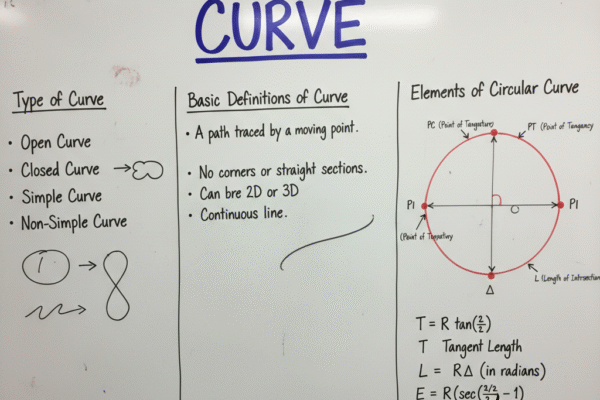
curve in highway

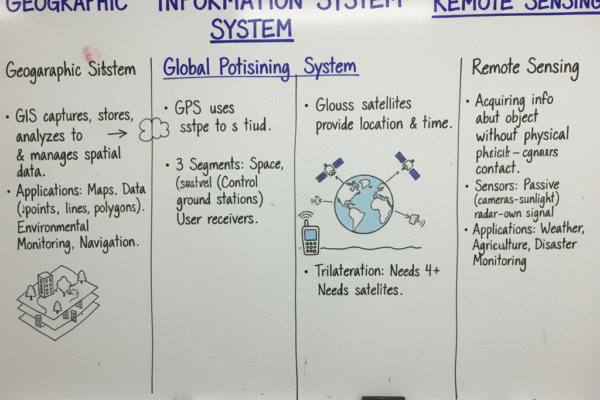
Geographic Information System, Global Positioning System, Remote Sensing

The landscape of civil engineering has been transformed by the advent of powerful geospatial technologies. Geographic Information Systems (GIS), Global Positioning Systems (GPS), and Remote Sensing (RS) are no longer niche tools but integral components for planning, design, construction, and management of infrastructure projects. These technologies enable precise data acquisition, intelligent spatial analysis, and dynamic…

Geographic Information System

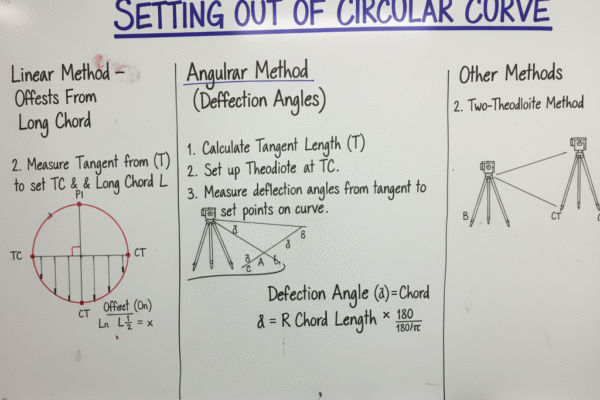
Setting Out Of Circular Curve (Linear Method -Offsets From Long Chord, Angular Method, Etc)

After the design of a circular curve is complete, the next critical step in civil engineering projects is its accurate physical realization on the ground. This process, known as “setting out,” involves transferring the designed curve from paper plans to the actual terrain. Precision in setting out curves is paramount for ensuring smooth transitions, safe…

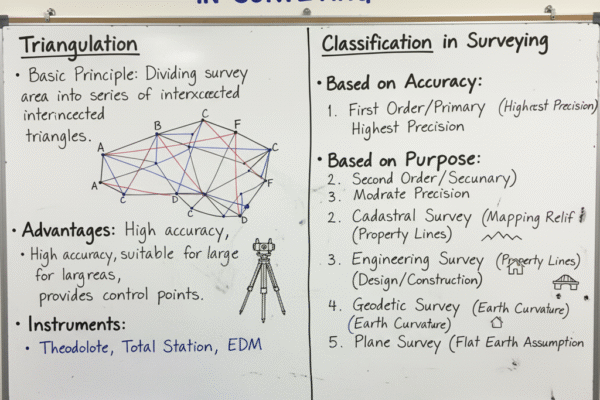
Triangulation and Classification in Surveying

Triangulation is a foundational surveying technique for establishing precise control networks over large areas. It involves creating a series of interconnected triangles, where only one side (the baseline) is measured directly, and all angles are measured accurately. This method then uses trigonometric principles to compute the lengths of all other sides and the coordinates of…

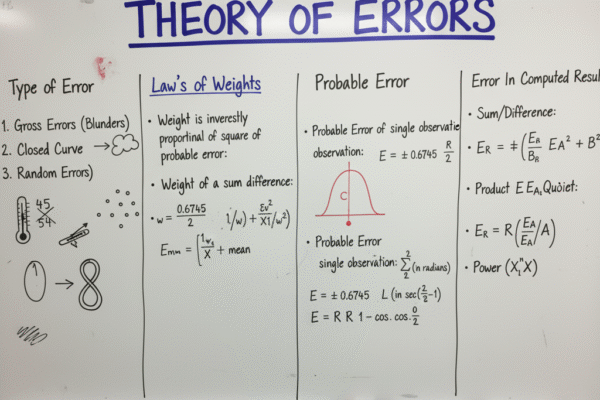
Theory of Errors (Type of Error, Law’s of Weights, Probable Error, Error In Computed Result)

In surveying, no measurement is perfectly exact; every observation is subject to a degree of uncertainty. The Theory of Errors provides a systematic framework for understanding, analyzing, and quantifying these inevitable discrepancies. For civil engineers, mastering error theory is crucial for ensuring the precision and reliability of spatial data, which forms the bedrock of design,…

Theory of Errors

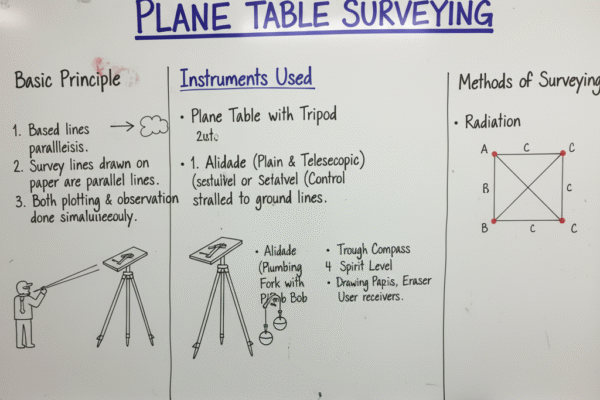
Plane Table Surveying (Setting up the Plane Table, Method Of Plane Table Survey, Accessories in PTS.)

Plane table surveying is a graphical method of surveying where fieldwork and plotting are done simultaneously. It is particularly useful for small-scale mapping, topographical surveys, and reconnaissance surveys, offering a direct and immediate visualization of the terrain. This infographic explores the core principles, essential instruments, setup procedures, various survey methods, and the inherent advantages and…

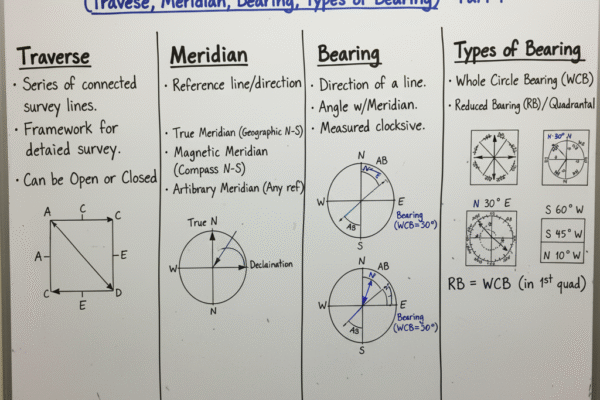
Compass Surveying (Traverse, Meridian, Bearing, Types of Bearing) – Part 1

Compass surveying is a crucial method in civil engineering for determining the relative positions of points by measuring both linear distances and angular directions. It primarily relies on a magnetic compass to establish the direction of survey lines, forming a ‘traverse’. This infographic delves into the core concepts of compass surveying, including different types of…

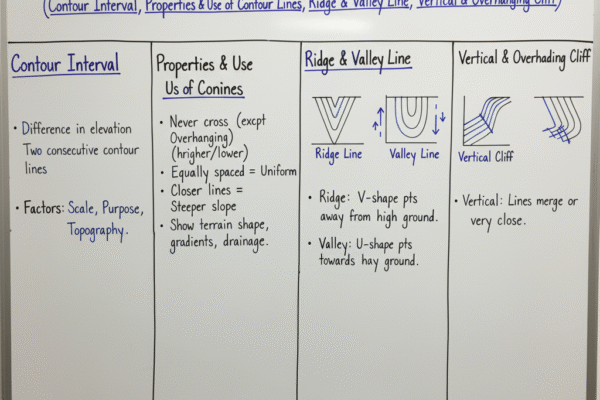
Contouring (Contour Interval, Properties & Use of Contour Lines, Ridge & Valley Line, Vertical & Overhanging Cliff).

Imagine transforming a complex, undulating landscape into a clear, actionable blueprint. Contouring is that powerful surveying technique, graphically rendering the Earth’s intricate three-dimensional relief onto a flat, two-dimensional map. By meticulously connecting points of equal elevation, contour lines unveil invaluable insights into terrain characteristics, slopes, and hidden drainage patterns. This infographic invites you to explore…

Contouring

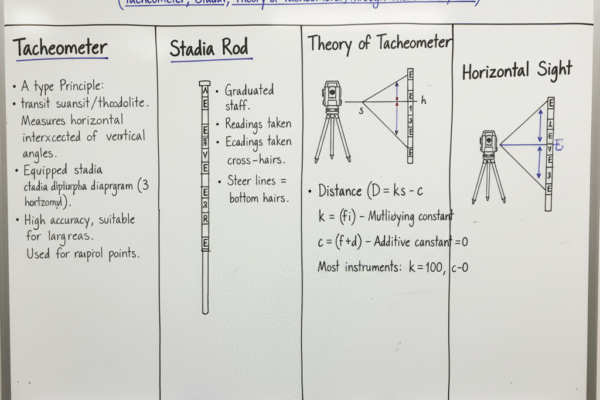
Tacheometry (Tacheometer, Stadia Rod, Theory of Tacheometer, Distance and Elevation Through Tacheometer, Etc)

Tacheometry is a branch of surveying focused on rapid optical distance and elevation measurements. It eliminates the need for chaining or taping, making it invaluable for challenging terrains like hilly or rough ground where direct measurement is impractical. Utilizing a specialized theodolite (tacheometer) and a stadia rod, this method employs optical principles to derive distances…

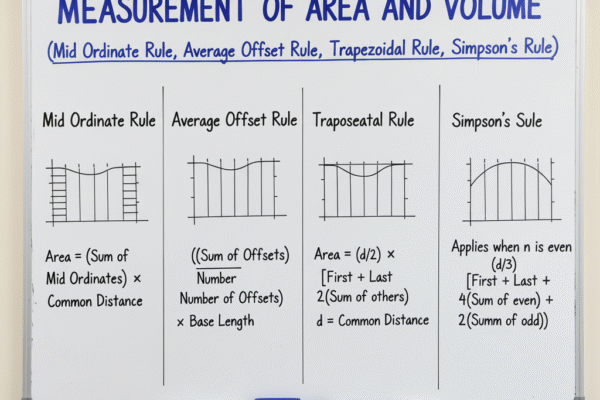
Measurement of Area and Volume (Mid Ordinate Rule, Average Offset Rule, Trapezoidal Rule, Simpson’s Rule)

Accurate quantification of areas and volumes is fundamental to all civil engineering projects, from land valuation and mapping to earthwork calculations and material estimation. While geometric shapes have straightforward formulas, determining areas and volumes for irregular boundaries or undulating terrain requires specialized rules. This infographic explores the core principles and practical formulas of Mid-ordinate, Average…

Measurement of Area and Volume