
Introduction to Highway Development
The story of highway construction is one of human ingenuity spanning thousands of years. Roads have always been the backbone of civilizations — enabling trade, migration, and military movement. Understanding how road construction evolved gives civil engineering students a critical foundation in transportation engineering.
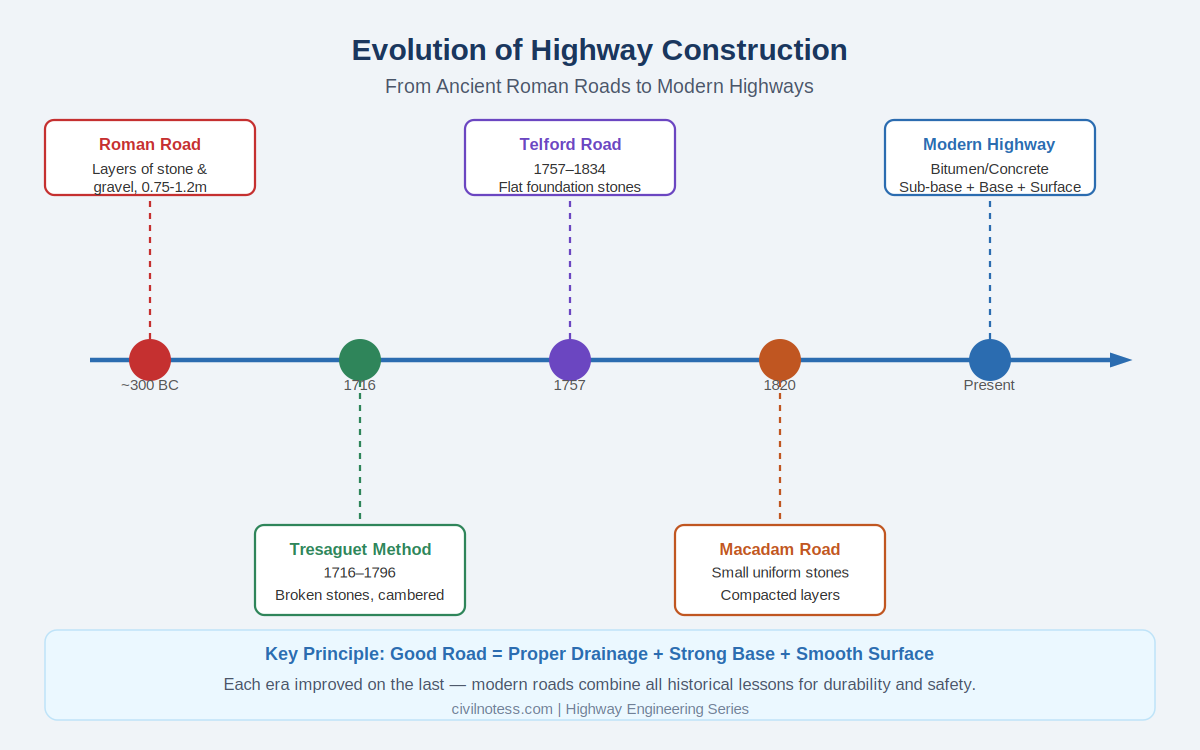
1. Ancient Roman Road Construction (~300 BC)
Roman roads are considered some of the greatest engineering achievements in ancient history. Built without modern machinery, they lasted centuries and some still exist in Europe today. The Romans understood a fundamental concept: a road is only as strong as its foundation.
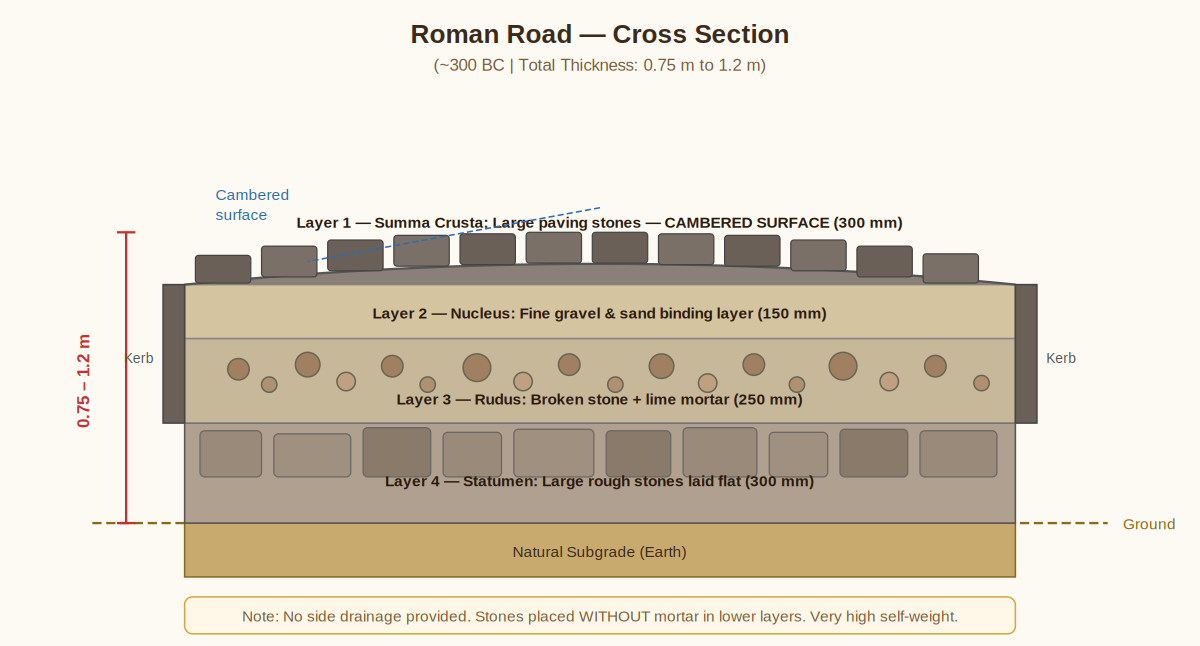
Key Features of Roman Roads
- Total pavement thickness ranged from 0.75 m to 1.2 m
- Four distinct layers: Statumen (base stones) → Rudus (broken stone+mortar) → Nucleus (fine gravel) → Summa Crusta (paved surface)
- Large paving stones on top formed a cambered riding surface
- Kerb stones were provided at edges
- No mortar used in lower layers — dry stone construction
Drawbacks of Roman Roads
- Extremely high self-weight — very expensive to build
- No side drainage channels — water accumulated at edges
- Construction was extremely labor-intensive
2. Tresaguet Road Construction Method (1716–1796)
Pierre-Marie-Jérôme Tresaguet, a French engineer, introduced a revolutionary approach that significantly reduced the weight of road construction while improving structural performance. His method became the standard in France during the 18th century.
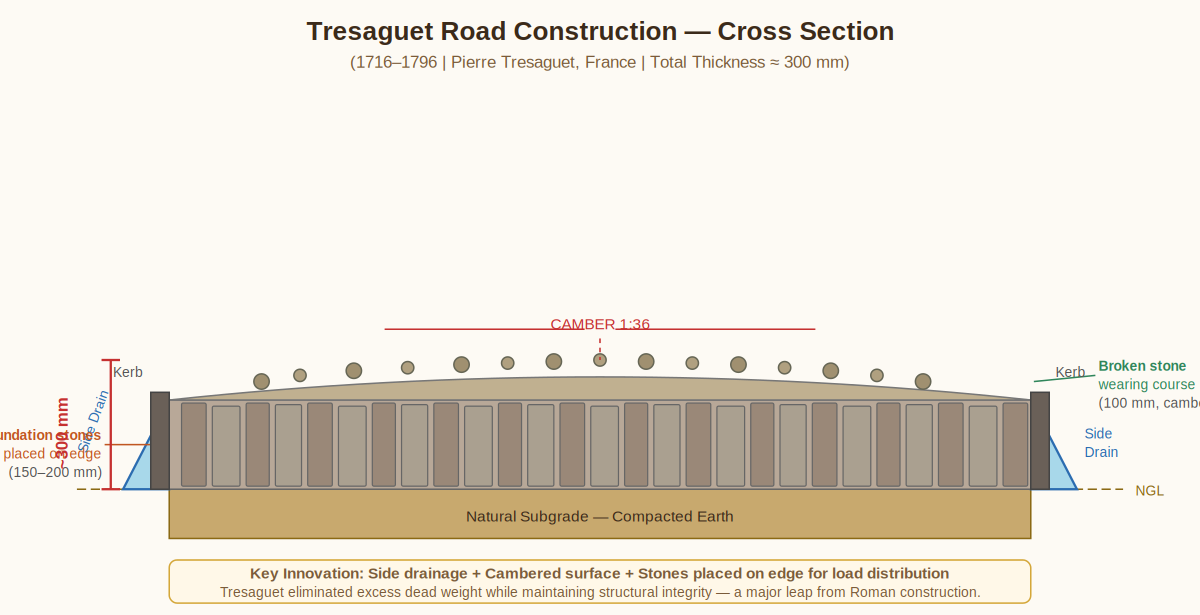
- Foundation stones were placed on edge (not flat) for better load distribution
- Side drainage channels introduced — a major innovation over Roman roads
- Road surface had a cross slope (camber) of 1 in 36
- Wearing course used small, broken stones to fill voids and smooth the surface
- Kerbs were provided to retain the road structure
3. Telford Road Construction (1757–1834)
Thomas Telford, a Scottish civil engineer, developed a system that improved load distribution by using a structured flat stone foundation. His roads were stronger and more durable than previous methods.
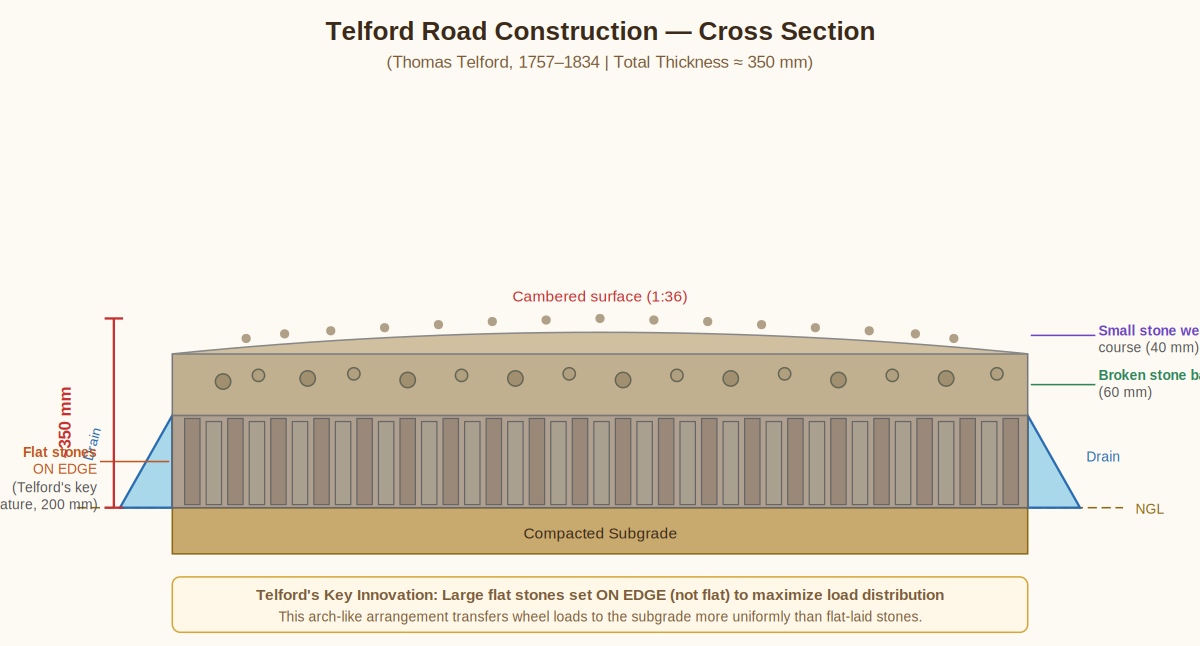
- Foundation: Large flat stones (100 mm thick) placed on edge — Telford’s defining feature
- Base Course: 60 mm broken stone layer on top of the flat stone foundation
- Surface Layer: 40 mm thick wearing course of small broken stones
- Cambered surface for effective drainage; side drains provided
- Total thickness approximately 350 mm
4. Macadam Road Construction (Early 19th Century)
John Loudon McAdam proved that a well-compacted natural subgrade could support traffic loads effectively, without the need for a heavy stone foundation. His lightweight method became widely popular and influenced road building for decades.
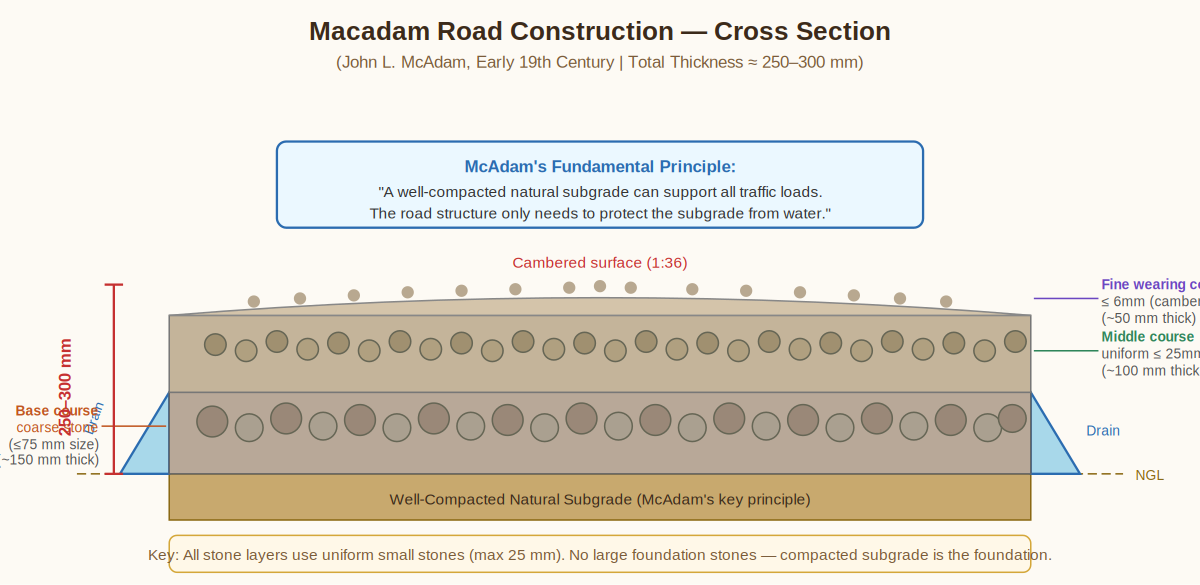
- All layers used uniformly graded small stones (maximum 25 mm size)
- No large foundation stones — compacted subgrade acts as the structural element
- Total thickness: approximately 250–300 mm
- McAdam’s rule: “Any stone larger than what fits in a person’s mouth is too large”
5. Modern Highway Construction
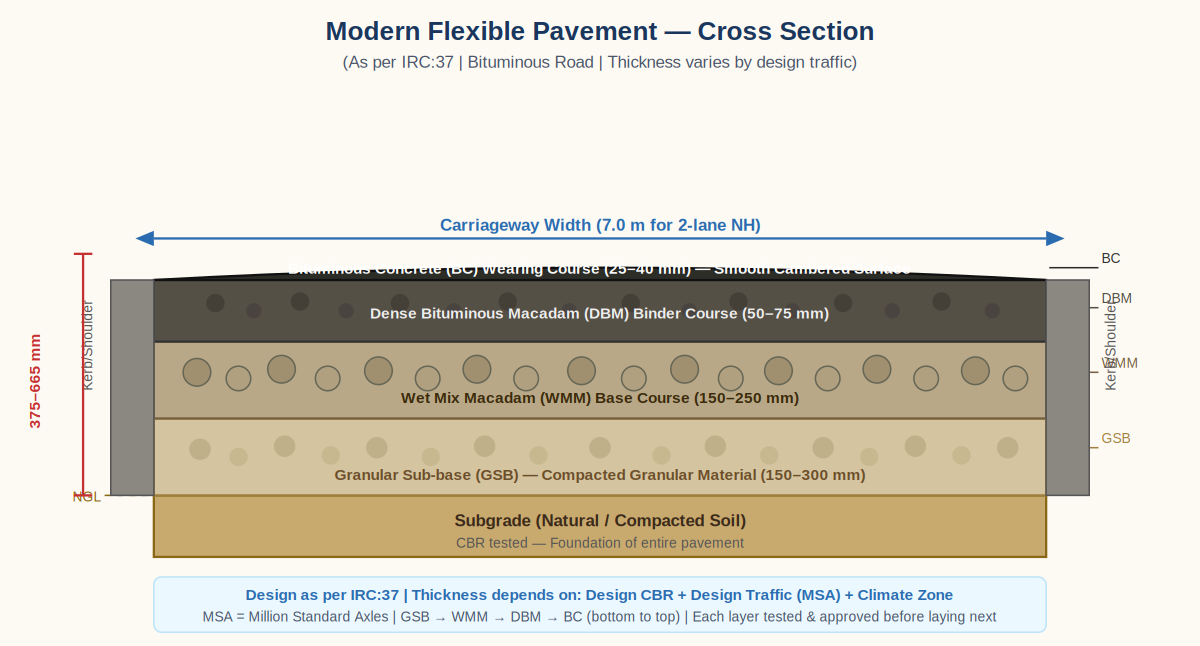
Today’s roads are built using a scientifically designed multi-layer system. Materials like GSB, WMM, DBM, and Bituminous Concrete are selected and designed based on traffic loads (MSA), soil CBR, and climatic conditions as per IRC:37.
Comparison Table: Historical Road Construction Methods
| Method | Period | Thickness | Key Feature |
|---|---|---|---|
| Roman Road | ~300 BC | 0.75–1.2 m | 4 layers; heavy stone; no side drain |
| Tresaguet | 1716–1796 | ~300 mm | Stones on edge; camber; side drains |
| Telford | 1757–1834 | ~350 mm | Flat stones ON EDGE as foundation |
| Macadam | Early 1800s | 250–300 mm | Uniform small stones; subgrade load-bearing |
| Modern | Present | Design-based | GSB+WMM+DBM+BC; IRC:37 design |
Exam Tips: Key Points to Remember
- Roman roads had the greatest thickness; Macadam roads had the least
- Tresaguet was the first to introduce side drains in road construction
- Telford’s method used flat stones placed ON EDGE — most common MCQ point
- McAdam’s key principle: subgrade compaction is the foundation, not stone thickness
- Modern roads designed per IRC:37 using CBR and MSA values